
Winemaker Notes
Professional Ratings
-
James Suckling
The aromas of flowers, blackberries, and white truffles are superb. Full to medium body and ultra-fine tannins. The finish lasts for minutes. An amazing Cicala. Don't miss this. Drink in 2022.
-
Wine Enthusiast
Aromas of dark berry, iris, menthol and a whiff of oak emerge on this vibrant wine. Firmly structured but loaded with finesse, the palate delivers ripe Marasca cherry, crushed black raspberry, vanilla, savory mineral and thyme alongside fine-grained tannins. A licorice note wraps around the tight finish. This is still primary so be sure to give it time to fully develop. Drink 2025–2045.
Cellar Selection -
Robert Parker's Wine Advocate
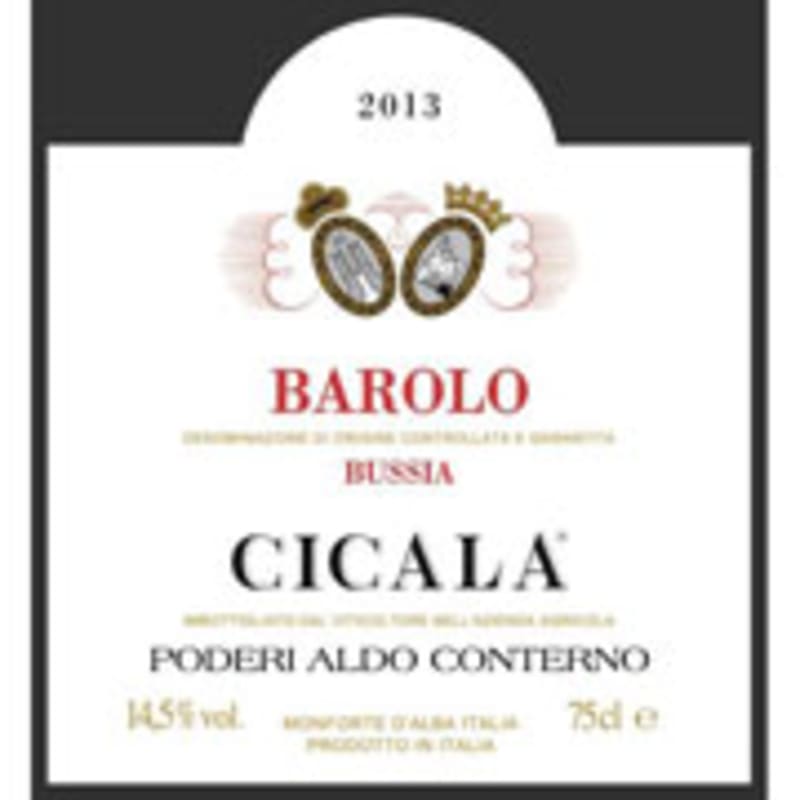
The 2013 Barolo Bussia Cicala is a beautiful wine with impressive depth and a profound sense of sharpness. This part of the Bussia cru sees a mix of clay soils (40%) with limestone (60%). In a sense, Cicala is the most indicative of the greater Bussia cru both in terms of its geological properties and its general taste profile. You get a lot of fruit in this wine followed by tannic firmness and evident power. Together, the wine presents balanced results. The alcohol here is 14.5% and I'm told that the upcoming 2016 vintage is almost a full degree stronger.



The story of Poderi Aldo Conterno, one of the elite, historic Barolo producers, is a tale of great passion for winemaking that winds back across generations and crosses international borders. While the Langhe Rosso, Chardonnay “Bussiador”, Barbera d’Alba “Conca Tre Pile” and Nebbiolo “Favot” represent a nod to modern winemaking techniques, the Barolo wines remain firmly in the traditionalist camp, aged in large Slavonian-oak botte before bottling. Only indigenous yeasts and traditional fermenting techniques are used. These are clean, polished and ethereal wines of great elegance that are guaranteed to offer years of sublime drinking while being terrific collector’s items.
Over the past decade, the estate has worked hard to ensure their place among the pantheon of hallowed Barolo producers, decreasing production by well over 50% through extreme triage in the vineyards: their harvest teams threatened mutiny at first over bunches that would normally have been harvested but that Conterno knew would be better to cut early to favor optimal development in the remaining bunches. The results of this rigorous approach have already been noticed and highly praised by the international press. The wines are remarkably approachable, characterized by particularly sweet fruit in their youth, as well as spice and vanilla notes. These are clean, polished and ethereal wines of great elegance that are guaranteed to offer years of sublime drinking while being terrific collector’s items. lity.

Responsible for some of the most elegant and age-worthy wines in the world, Nebbiolo, named for the ubiquitous autumnal fog (called nebbia in Italian), is the star variety of northern Italy’s Piedmont region. Grown throughout the area, as well as in the neighboring Valle d’Aosta and Valtellina, it reaches its highest potential in the Piedmontese villages of Barolo, Barbaresco and Roero. Outside of Italy, growers are still very much in the experimentation stage but some success has been achieved in parts of California. Somm Secret—If you’re new to Nebbiolo, start with a charming, wallet-friendly, early-drinking Langhe Nebbiolo or Nebbiolo d'Alba.

The center of the production of the world’s most exclusive and age-worthy red wines made from Nebbiolo, the Barolo wine region includes five core townships: La Morra, Monforte d’Alba, Serralunga d’Alba, Castiglione Falletto and the Barolo village itself, as well as a few outlying villages. The landscape of Barolo, characterized by prominent and castle-topped hills, is full of history and romance centered on the Nebbiolo grape. Its wines, with the signature “tar and roses” aromas, have a deceptively light garnet color but full presence on the palate and plenty of tannins and acidity. In a well-made Barolo wine, one can expect to find complexity and good evolution with notes of, for example, strawberry, cherry, plum, leather, truffle, anise, fresh and dried herbs, tobacco and violets.
There are two predominant soil types here, which distinguish Barolo from the lesser surrounding areas. Compact and fertile Tortonian sandy marls define the vineyards farthest west and at higher elevations. Typically the Barolo wines coming from this side, from La Morra and Barolo, can be approachable relatively early on in their evolution and represent the “feminine” side of Barolo, often closer in style to Barbaresco with elegant perfume and fresh fruit.
On the eastern side of the Barolo wine region, Helvetian soils of compressed sandstone and chalks are less fertile, producing wines with intense body, power and structured tannins. This more “masculine” style comes from Monforte d’Alba and Serralunga d’Alba. The township of Castiglione Falletto covers a spine with both soil types.
The best Barolo wines need 10-15 years before they are ready to drink, and can further age for several decades.