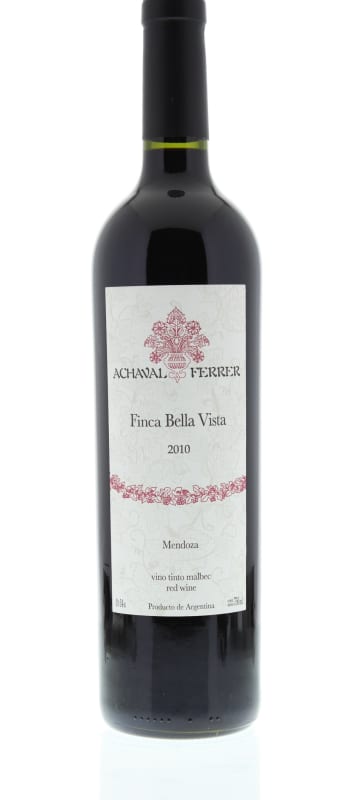


Winemaker Notes
Achaval Ferrer Finca Bella Vista Malbec has an alluring bouquet of incense, violets, black cherry and blackberry. This wine is voluptuous and lengthy.
All Achaval Ferrer wines are bottled without fining or filtering. formation of deposits in the bottle will be noticeable after some cellaring time. This is no way affects quality. We strongly recommend decanting this wine at least an hour before drinking.
Professional Ratings
-
Wine Spectator
Dark and powerful, yet elegant, with a delicious core of crushed raspberry, blackberry and damson plum notes tightly woven with silky tannins. The minerally finish lingers on with layered flavors of wildflowers, melted licorice and spice box.
-
Robert Parker's Wine Advocate
The Bella Vista is always based on four hectares planted in 1910 and is normally the second vineyard harvested each year. The 2010 Finca Bella Vista is a pure Malbec from Lujan de Cuyo located at 980 meters altitude. Fermented in cement and aged for 16 months in new French barriques from the Mercurey cooperage, it has a sublime bouquet of blackberry, briary, woodland aromas and sous-bois that is all succinctly defined. The palate is medium-bodied with ripe, fine tannins surrounding a core of pure blackberry and wild strawberry fruit, interlaced by lemon rind and dark chocolate towards the controlled, refined finish. This is class from start to finish. Drink 2013-2020+.


Celebrated for its bold flavors and supple texture, Malbec has enjoyed runaway success in Argentina since the late 20th century. The grape originated in Bordeaux, France, where it historically contributed color and tannin to blends. A French agronomist, who saw great potential for the variety in Mendoza’s hot, high-altitude landscape, brought Malbec to Argentina in 1868. Somm Secret—If you’re trying to please a crowd, Malbec is generally a safe bet with its combination of dense fruit and soft tannins.

By far the largest and best-known winemaking province in Argentina, Mendoza is responsible for over 70% of the country’s enological output. Set in the eastern foothills of the Andes Mountains, the climate is dry and continental, presenting relatively few challenges for viticulturists during the growing season. Mendoza, divided into several distinctive sub-regions, including Luján de Cuyo and the Uco Valley, is the source of some of the country’s finest wines.
For many wine lovers, Mendoza is practically synonymous with Malbec. Originally a Bordelaise variety brought to Argentina by the French in the mid-1800s, here it found success and renown that it never knew in its homeland where a finicky climate gives mixed results. Cabernet Sauvignon, Syrah, Merlot and Pinot Noir are all widely planted here as well (and sometimes even blended with each other or Malbec). Mendoza's main white varieties include Chardonnay, Torrontés, Sauvignon Blanc and Sémillon.