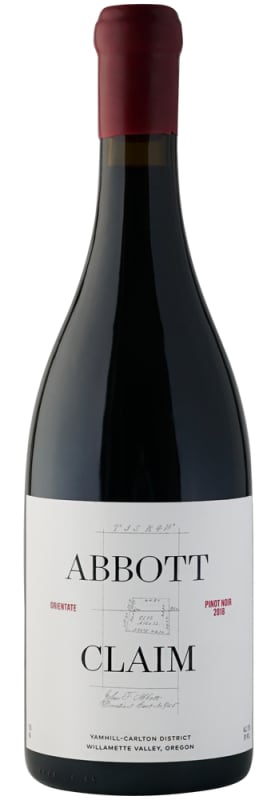


Winemaker Notes
The grapes from Abbott Claim are harvested by hand at sunrise and immediately brought to the winery, where we weigh, sort and partially destem them. Fermentation is carried by native yeasts in oak, concrete and stainless steel vessels, where Abbott Claim only encourages the most delicate, hands-off extractions. When fermentation is complete and the wine's geometry finds balance, it is drained from the vat and the fruit pressed in a basket press. Free run, press wine and lees marry together in barrel, where malolactic fermentation spontaneously starts, often the following Spring.
This bottling brings to life the story of the estate vineyard, with a density and vibrancy characteristic of the site.
Professional Ratings
-
Wine Enthusiast
This is the first estate bottling from this acclaimed (pun intended) vineyard since new owner Antony Beck and his team took over. The vineyard is being managed organically with some biodynamic practices. Wild yeasts are used for fermentation, which brings some unusual floral and textural components. The wine is lightly ripened, with cranberry, raspberry and mineral highlights. It was aged for about a year in one-third new oak


Thin-skinned, finicky and temperamental, Pinot Noir is also one of the most rewarding grapes to grow and remains a labor of love for some of the greatest vignerons in Burgundy. Fairly adaptable but highly reflective of the environment in which it is grown, Pinot Noir prefers a cool climate and requires low yields to achieve high quality. Outside of France, outstanding examples come from in Oregon, California and throughout specific locations in wine-producing world. Somm Secret—André Tchelistcheff, California’s most influential post-Prohibition winemaker decidedly stayed away from the grape, claiming “God made Cabernet. The Devil made Pinot Noir.”

Yamhill-Carlton, characterized by pastoral, rolling hills composed of shallow, quick-draining, ancient marine soil, is ideal for Pinot noir and other cool-climate-loving varieties. It is in the rain shadow of the Coast Range to its west, whose highest point climbs to an altitude of 3,500 feet. Yamhill-Carlton is actually surrounded by mountains on three sides: Chehalem Mountains to the north, the Dundee Hills to the east and the western Coast Range to its west, which, when it lets Pacific air through, serves to cool the region.
Vineyards grow on the ridges surrounding the two small communities of Yamhill and Carlton and cover about 1,200 acres of this 60,000 acre region, which roughly makes a horse-shoe shape on a map.