

Winemaker Notes
Enjoy with your favorite Spanish tapas.
Professional Ratings
-
Wine Enthusiast
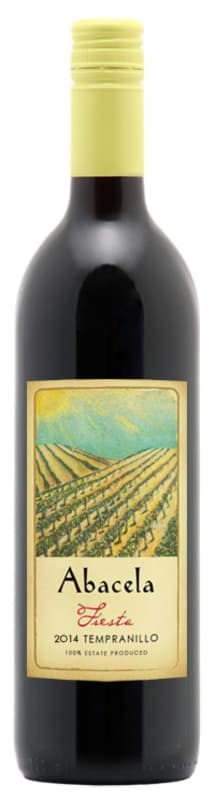
Fiesta is the lightest, most fruit forward of the four different Tempranillos from Abacela. In a great year such as this, it's also substantial and authoritative, with deeply driven flavors of red and blueberry fruit, a whiff of oak and slightly grainy tannins. This wine clearly over-delivers for the price.


Notoriously food-friendly, long-lasting and Spain’s most widely planted grape, Tempranillo is the star variety of red wines from Rioja and Ribera del Duero. The Rioja terms Joven, Crianza, Reserva and Gran Reserva indicate both barrel and bottle time before release. Traditionally blended in Rioja with Garnacha, plus a bit of Mazuelo (Carignan) and Graciano, the Tempranillo in Ribera del Duero typically stands alone. Somm Secret—Tempranillo claims many different names depending on location. In Penedès, it is called Ull de Llebre and in Valdepeñas, goes by Cencibel. Known as Tinta Roriz in Portugal, Tempranillo plays an important role in Port wine.

Three substantial mountain ranges intersect to create a region of great diversity, not only in soil and topography but also climate and as a result, grape varieties.
Where the Klamath Mountains, Coast Range and Cascades converge, is the rather small AVA, the Umpqua Valley, which boasts over 150 soils in a total growing area of merely 1,500 acres. The soils range from sedimentary, metamorphic or volcanic where valley floors are deep alluvium and heavy clay and hillsides are typically silt or clay.
In the Umpqua Valley AVA, vineyards in the north are cooler and wetter; cool climate grapes such as Pinot noir, Pinot gris and Riesling do well. In the warmer and dryer south mainly Syrah and Tempranillo thrive. But growers here are not afraid to investigate new grape varieties; the region is home to over forty types.
There are two sub-AVAs within the boundaries of the Umpqua Valley: Red Hill-Douglas Country, established in 2004 and Elkton, established in 2013.