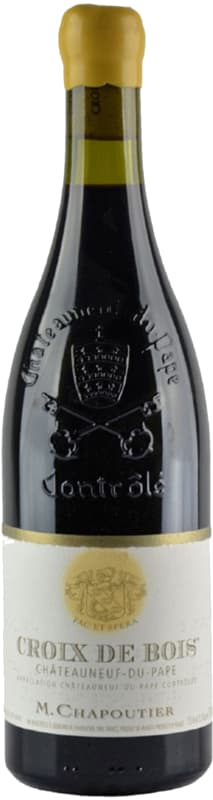


Winemaker Notes
Intense red with aromas of black fruits, blackberry jam. Smooth and full-bodied, with warm tannins.
Professional Ratings
-
James Suckling
A very structured and concentrated Chateauneuf for the 2021 vintage, with complex red-fruit aromas and a leafy freshness. In fact, it is almost minty. The fine tannins are quite serious, but the wine moves rather light-footedly over the palate in spite of this. Very long, deep finish that tends in a fascinatingly dark direction. From a slope at the extreme east of Chateauneuf with a very water-retentive soil that makes dry farming no problem. From biodynamically grown grapes. Drinkable now, but best from 2026.
-
Jeb Dunnuck
Slightly deeper hued, the 2021 Châteauneuf Du Pape Croix De Bois sees a touch more stems (25%) and is brought up in concrete as well. It has a more floral, vibrant style compared to the Barbe Rac, with Bing cherries, forest floor, violets, and peppery herbs, as well as a Grand Cru Burgundy-like sense of elegance and refinement on the palate. Medium to full-bodied and balanced, with fine tannins and a gorgeous finish, it ranks with the gems in the vintage.
-
Robert Parker's Wine Advocate
Another star of the vintage, Chapoutier's 2021 Chateauneuf du Pape Croix de Bois features attractive scents of crushed stone, dried herbs, fresh cherries and red raspberries. It's medium to full-bodied, with a silky mouthfeel and nicely concentrated fruit. It comes across as elegant and long, not overly extracted or tannic.
-
Wine Spectator
A chewy, rich, savory red, with smoked sausage, wet soil and hoisin sauce merging with red fruit on a supple, well-proportioned frame. Not about power or ripe fruit but savory complexity and nuance. Mesquite smoke plays out on the long finish. Drink now through 2038.



No name is more closely associated with the greatness of the Rhone valley than Chapoutier.
The history of the Chapoutier family stretches back to the early nineteenth century when current owner Michel Chapoutier's great-, great-, great-grandfather Marius purchased an estate and some vineyards in the now famous village of Tain l'Hermitage in the Northern Rhône Valley. Marius Chapoutier made history in the region when he became the first grape grower there to vinify his own fruit. Marius had tasted wines other winemakers produced using his fruit and he realized that something was lost in translation, so to speak. He knew that he owned some of the best growing sites in the appellation and he believed — rightly — that the grapes grown in his vineyards could produce long-lived world-class wines. In a move unusual at the time, he decided that he should make the wine himself. Not only did the quality of the wines increase greatly, but this move provided the capital to expand the Chapoutiers’ already legendary estate.
A visionary and pioneer in biodynamic winemaking, his restless energy and unconditional commitment to quality have produced tremendous success, with the most 90+ point ratings of all Rhône producers and 16 "100 point" rated wines.
Sothis Gin is distilled from grapes and plants grown near the vineyards. This family domaine is cultivated using biodynamic practices in which plants play a central role. In their wild state they offer M. Chapoutier a better understanding of the soils. When used in vine treatments they help to nourish plant life and support plant growth. They have selected a few of these plants in order to offer a new perspective of their terroirs, the story of a gin originating from the Tain l’Hermitage vineyards and their floral heritage. They have been honing this recipe for many months under the watchful eye of Sothis, the star and also the ancient Goddess who teaches us that cultivating the land is a means of moving closer to the stars.

With bold fruit flavors and accents of sweet spice, Grenache, Syrah and Mourvèdre form the base of the classic Rhône Red Blend, while Carignan, Cinsault and Counoise often come in to play. Though they originated from France’s southern Rhône Valley, with some creative interpretation, Rhône blends have also become popular in other countries. Somm Secret—Putting their own local spin on the Rhône Red Blend, those from Priorat often include Merlot and Cabernet Sauvignon. In California, it is not uncommon to see Petite Sirah make an appearance.

Famous for its full-bodied, seductive and spicy reds with flavor and aroma characteristics reminiscent of black cherry, baked raspberry, garrigue, olive tapenade, lavender and baking spice, Châteauneuf-du-Pape is the leading sub-appellation of the southern Rhône River Valley. Large pebbles resembling river rocks, called "galets" in French, dominate most of the terrain. The stones hold heat and reflect it back up to the low-lying gobelet-trained vines. Though the galets are typical, they are not prominent in every vineyard. Chateau Rayas is the most obvious deviation with very sandy soil.
According to law, eighteen grape varieties are allowed in Châteauneuf-du-Pape and most wines are blends of some mix of these. For reds, Grenache is the star player with Mourvedre and Syrah coming typically second. Others used include Cinsault, Counoise and occasionally Muscardin, Vaccarèse, Picquepoul Noir and Terret Noir.
Only about 6-7% of wine from Châteauneuf-du-Pape is white wine. Blends and single-varietal bottlings are typically based on the soft and floral Grenache Blanc but Clairette, Bourboulenc and Roussanne are grown with some significance.
The wine of Chateauneuf-du-Pape takes its name from the relocation of the papal court to Avignon. The lore says that after moving in 1309, Pope Clément V (after whom Chateau Pape-Clément in Pessac-Léognan is named) ordered that vines were planted. But it was actually his successor, John XXII, who established the vineyards. The name however, Chateauneuf-du-Pape, translated as "the pope's new castle," didn’t really stick until the 19th century.