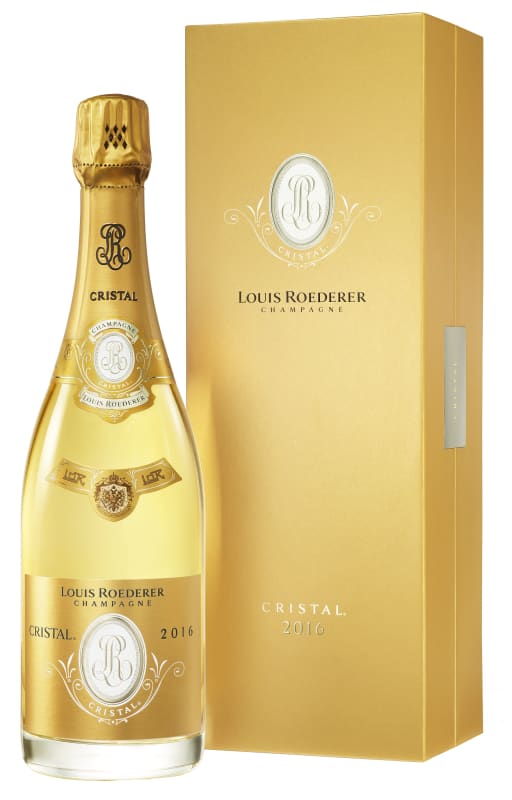


Winemaker Notes
#26 Jeb Dunnuck Top 100 of 2025
Bright, shiny yellow hue. Magnificent fine, slow-moving bubbles. The bouquet is intense, deep and precise, combining scents of white flowers (acacia), concentrated, roasted citrus (lemons) and ripe yellow fruit (peaches, mirabelle plums). After a few minutes, subtle iodised, powdery and roasted overtones emerge, the result of the autolysis of the yeasts during the "sur lattes" ageing process. On the palate, there is an immediate impression, soft and delicate, more accessible than ever! It is like a zabaglione with concentrated, juicy and ripe fruit, the hallmark of the great Pinot Noirs from the heatwave in 2016 with their soft, caressing texture derived from the chalky soil in which they grow. The bubbles are tactile, perfectly integrated and almost salty. Wheat and oyster shell notes are the signature of the slow and late ripening great Chardonnays. The substance is there, powdery, grainy and deliciously chocolatey. Louis Roederer is very close to having the "ideal" balance, the wine is crisp, saline and iodised, with a long, chalky, crystalline finish that lingers and builds to a crescendo. The overall impression is one of refinement, sapidity and purity... like the infinite grace of an opera ballerina.
Cristal 2016 is pure, delicate and concentrated. It is the perfect, eloquent "Grand Cristal": 50% sun (ripe, juicy Pinot Noirs) and 50% soil (chalky, saline Chardonnays). It is similar to the 2002, 2008 and 2012, but with an even longer, more precise and concentrated character.
Blend: 58% Pinot Noir, 42% Chardonnay
Professional Ratings
-
Jeb Dunnuck
The 2016 Champagne Cristal is transparent and complex, with lovely aromas of fresh flowers. Medium-bodied and chiseled, with great texture, well-defined saltiness, and delicate notes of shortbread, it’s a shimmering and electric wine with fantastic detail. It has a concentrated, chalky profile and is flush with crushed stones. It will demand some patience, but this is a fantastic wine in this vintage for Cristal. Bravo.
-
Wine Enthusiast
This iconic Champagne, first made in the 19th century for the Tsar of Russia, shows its typical stunning balance and poise between richness and concentration. It has a pure white fruit and honeysuckle aroma and tight, tangy fresh fruit flavors. Just ready to drink, the wine will age well, for at least 20 years.
Cellar Selection -
Decanter
Cristal 2016 represents a return to purity and classicism for this cuvée, even seen through the lens of 2016's ripe, generous opening. It is characteristically discreet in youth, cloaking its ripeness in long, chalky, stony energy. Gentle mandarin, pale apricot and raspberry fruit sit under slowly maturing notions of floral honey and tight, smoky charm. There's an airy, flowing delicacy and persistence which lifts this cuvée above some other expressions of this year. It's a hugely promising Cristal, likely to stand as tall as the sought-after 2012 and 2013 releases.
-
Robert Parker's Wine Advocate
The 2016 Cristal is a taut, incisive rendition of this benchmark bottling, unwinding in the glass with youthfully reserved aromas of citrus oil, white flowers, wet stones and subtle hints of sweet, buttery pastry. Medium to full-bodied, chiseled and racy, it's almost as electric as the brilliant 2013, with serious concentration, a pure core of fruit, chalky structuring dry extract and a long, intensely mineral finish. Given its tightly wound profile, my advice is to forget it in the cellar for a few years and work on the more open, outgoing 2014 in the meantime.
-
Vinous
The 2016 Cristal is bright, aromatic and nicely lifted. Citrus peel white flowers, mint and a touch of chamomile all grace this understated, wonderfully refined edition of Cristal. Light on its feet and super-refined, the 2016 is exquisite in its understated beauty. I can’t wait to see how the 2016 ages and won’t be surprised it gains a bit of weight in bottle, as Cristal so often does. The blend is 58% Pinot Noir and 42% Chardonnay, so a touch more Chardonnay than the norm. Of the 45 parcels that make up the Cristal domaine, just 32 were used for the blend. Verzy and Verzenay dominate the Pinots, then Aÿ. Avize takes the lead in the Chardonnays, followed by Mesnil and Cramant. Dosage is 7 grams per liter.
-
Wine Spectator
This leads with pronounced minerality on the nose, but then a bright burst of tangerine, blood orange and Meyer lemon flavors on the palate hold sway, joined by rich hints of crème de cassis, toast point, pastry cream and crystallized honey. Showing beautiful integration and a refined, lacy mousse, this is compact and statuesque, with a sense of restraint and the hint of more to come, while at the same time offering lovely expression in the glass today. Fresh and focused on the persistent finish. Pinot Noir and Chardonnay. Drink now through 2044.





Uncompromising Quality
Champagne Louis Roederer was founded in 1776 in Reims, France and is one of the rare family owned companies, which is still managed by the Roederer family. In 1833, Louis Roederer inherited the company from his uncle and renamed the company under his namesake. Under his leadership, the company rapidly grew while remaining true to their philosophy of uncompromising quality. Today, the company is under the helm of Jean-Claude Rouzaud and his son Frédéric who continue to place quality before quantity.
First-Rate Vineyards
Champagne Louis Roederer is one of the only French champagne producers to own nearly 75 percent of the grapes in the most desirable vineyards in the Champagne. The property is located on 450 acres in the finest villages of Montagne de Reims, Côtes des Blancs, and Valleé de la Marne. Each region is selected to produce Chardonnay and Pinot Noir with the elegance needed for perfectly balanced champagne. The Louis Roederer vineyards rate an average 98 percent based on France’s statutory 100-point classification scale.
The reserve wine is then tasted and graded by a team of Roederer specialists. They choose as many as 40 different wines from several lots for the blend. For the final touch, the wine is then added in order to enhance the cuvee and guarantee consistency while retaining the champagne's characteristics.

Representing the topmost expression of a Champagne house, a vintage Champagne is one made from the produce of a single, superior harvest year. Vintage Champagnes account for a mere 5% of total Champagne production and are produced about three times in a decade. Champagne is typically made as a blend of multiple years in order to preserve the house style; these will have non-vintage, or simply, NV on the label. The term, "vintage," as it applies to all wine, simply means a single harvest year.

Associated with luxury, celebration, and romance, the region, Champagne, is home to the world’s most prized sparkling wine. In order to bear the label, ‘Champagne’, a sparkling wine must originate from this northeastern region of France—called Champagne—and adhere to strict quality standards. Made up of the three towns Reims, Épernay, and Aÿ, it was here that the traditional method of sparkling wine production was both invented and perfected, birthing a winemaking technique as well as a flavor profile that is now emulated worldwide.
Well-drained, limestone and chalky soil defines much of the region, which lend a mineral component to its wines. Champagne’s cold, continental climate promotes ample acidity in its grapes but weather differences from year to year can create significant variation between vintages. While vintage Champagnes are produced in exceptional years, non-vintage cuvées are produced annually from a blend of several years in order to produce Champagnes that maintain a consistent house style.
With nearly negligible exceptions, . These can be blended together or bottled as individual varietal Champagnes, depending on the final style of wine desired. Chardonnay, the only white variety, contributes freshness, elegance, lively acidity and notes of citrus, orchard fruit and white flowers. Pinot Noir and its relative Pinot Meunier, provide the backbone to many blends, adding structure, body and supple red fruit flavors. Wines with a large proportion of Pinot Meunier will be ready to drink earlier, while Pinot Noir contributes to longevity. Whether it is white or rosé, most Champagne is made from a blend of red and white grapes—and uniquely, rosé is often produce by blending together red and white wine. A Champagne made exclusively from Chardonnay will be labeled as ‘blanc de blancs,’ while ones comprised of only red grapes are called ‘blanc de noirs.’