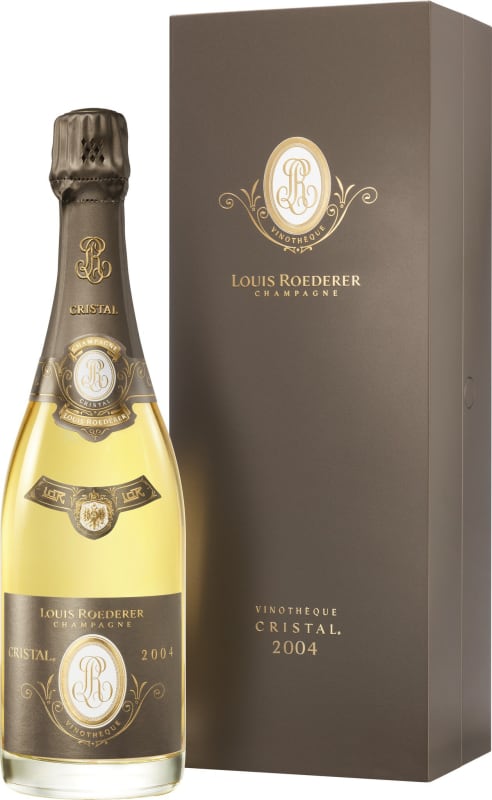


Winemaker Notes
Cristal Vinothèque 2004 celebrates the remarkable adventure of just a small number of bottles, laid down for more than 20 years in the Louis Roederer cellars, in the quest for perfect balance. This cuvée was aged for 9 years “sur lattes” followed by 5 years “sur pointes” and benefitted from a further 6 years rest after disgorgement.
Professional Ratings
-
Vinous
The 2004 Cristal Vinothèque takes things to another level. Two thousand-four has long been one of my favorite Champagne vintages for the top wines. It was a controversial year, one marked by record yields. Long aging on the lees fills out the wine while adding layers of dimension that enhance the essential qualities of the year. The 2004 Vinothèque is so timeless, so classy. [tasted in magnum]
-
Wine Spectator
There’s lots of tension and focus to this version, with the fine, pointillisme-like bead dancing a graceful foxtrot on the palate, carrying tropical hints of passion fruit coulis and blood orange granita along with an overtone of oyster shell and accents of pickled ginger and anise. This is lacy on the finish, with a salty undertow coming to the fore to create a lingering, mouthwatering impression. -- Non-blind Cristal Vinothèque retrospective (June 2025). Drink now through 2044.
-
Robert Parker's Wine Advocate
Disgorged in 2019 with a dosage of six grams per liter, the 2004 Cristal Vinothèque spent 20 years in the Louis Roederer cellars. This aging process involved the bottles being stacked horizontally on their sides, followed by a period stored neck-down to limit oxygen exposure while also reducing the surface area of lees in contact with the wine. After this, the Champagne underwent an additional six years of aging post-disgorgement. Lecaillon explains that this effort is to “push the wine with longer maturation into a more generous expression, not sacrificing salinity in the process.” Bursting from the glass with a deep bouquet of roasted nuts, candied lemon peel and brioche mingling with aromas of smoke and honeysuckle, it is richer and more dramatic aromatically, while simultaneously retaining a cool, racy profile. Medium to full-bodied, textural and multidimensional, it concludes with a long, chalky finish. With only 2,000 bottles available, it will be rather difficult to find; but those with disposable income who want to experience Cristal at its most generous expression should not hesitate to track down a bottle, as it stands as one of the most precise releases of the Vinothèque program so far and surpasses the regular 2004 Cristal in its depth and completeness.





Uncompromising Quality
Champagne Louis Roederer was founded in 1776 in Reims, France and is one of the rare family owned companies, which is still managed by the Roederer family. In 1833, Louis Roederer inherited the company from his uncle and renamed the company under his namesake. Under his leadership, the company rapidly grew while remaining true to their philosophy of uncompromising quality. Today, the company is under the helm of Jean-Claude Rouzaud and his son Frédéric who continue to place quality before quantity.
First-Rate Vineyards
Champagne Louis Roederer is one of the only French champagne producers to own nearly 75 percent of the grapes in the most desirable vineyards in the Champagne. The property is located on 450 acres in the finest villages of Montagne de Reims, Côtes des Blancs, and Valleé de la Marne. Each region is selected to produce Chardonnay and Pinot Noir with the elegance needed for perfectly balanced champagne. The Louis Roederer vineyards rate an average 98 percent based on France’s statutory 100-point classification scale.
The reserve wine is then tasted and graded by a team of Roederer specialists. They choose as many as 40 different wines from several lots for the blend. For the final touch, the wine is then added in order to enhance the cuvee and guarantee consistency while retaining the champagne's characteristics.

Representing the topmost expression of a Champagne house, a vintage Champagne is one made from the produce of a single, superior harvest year. Vintage Champagnes account for a mere 5% of total Champagne production and are produced about three times in a decade. Champagne is typically made as a blend of multiple years in order to preserve the house style; these will have non-vintage, or simply, NV on the label. The term, "vintage," as it applies to all wine, simply means a single harvest year.

Associated with luxury, celebration, and romance, the region, Champagne, is home to the world’s most prized sparkling wine. In order to bear the label, ‘Champagne’, a sparkling wine must originate from this northeastern region of France—called Champagne—and adhere to strict quality standards. Made up of the three towns Reims, Épernay, and Aÿ, it was here that the traditional method of sparkling wine production was both invented and perfected, birthing a winemaking technique as well as a flavor profile that is now emulated worldwide.
Well-drained, limestone and chalky soil defines much of the region, which lend a mineral component to its wines. Champagne’s cold, continental climate promotes ample acidity in its grapes but weather differences from year to year can create significant variation between vintages. While vintage Champagnes are produced in exceptional years, non-vintage cuvées are produced annually from a blend of several years in order to produce Champagnes that maintain a consistent house style.
With nearly negligible exceptions, . These can be blended together or bottled as individual varietal Champagnes, depending on the final style of wine desired. Chardonnay, the only white variety, contributes freshness, elegance, lively acidity and notes of citrus, orchard fruit and white flowers. Pinot Noir and its relative Pinot Meunier, provide the backbone to many blends, adding structure, body and supple red fruit flavors. Wines with a large proportion of Pinot Meunier will be ready to drink earlier, while Pinot Noir contributes to longevity. Whether it is white or rosé, most Champagne is made from a blend of red and white grapes—and uniquely, rosé is often produce by blending together red and white wine. A Champagne made exclusively from Chardonnay will be labeled as ‘blanc de blancs,’ while ones comprised of only red grapes are called ‘blanc de noirs.’