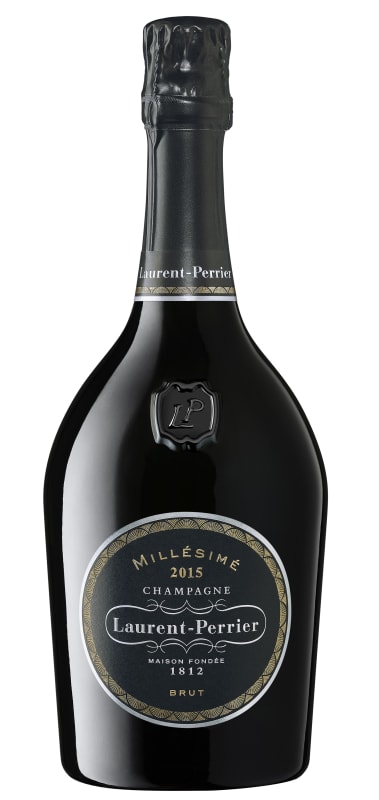


Winemaker Notes
The wine is white gold in color with a fine and persistent sparkle. A nose of great complexity offering notes of beeswax, candied lemon, honeysuckle and hawthorn followed by aromas of toast and orange. A lively attack that gives way to a creamy and elegant palate with notes of candied lemon and honeysuckle.
Professional Ratings
-
James Suckling
This is in a new bottle, like the stout ones used for the rosé and blanc de blancs. This is very structured with a density and richness with hints of strawberry to the apple character. Bubbles turn fine textured at the end. Delicious flavors of biscuits and dried apple in the finish. Special character to this because of the very ripe vintage. Disgorged in November 2021. This is half chardonnay and half pinot noir. This can age well due to the phenolics. Drink or hold.
-
Vinous
The 2015 Brut Millésimé, a blend of half Chardonnay from the Côte des Blancs and half Pinot Noir from the Montagne de Reims, spent at least seven years on lees. Supple smokiness and a sense of rye bread with distant plum create a subtle nose. The palate continues with that lovely smokiness, wrapping it around aromatic plum and taut lemon, which are delicious counter poles in this elegant wine. The bubbles are a little frothy, but it acquits itself well for a 2015 vintage with all its freshness. Dosage is 6 grams per liter.
-
Decanter
This is just the 30th vintage made at Laurent-Perrier since 1952, and it's a slightly unusual one in manifesting plenty of the heat, dryness and structure of 2015. Drinkers accustomed to Laurent-Perrier's usual delicacy and brightness will still find it in this 50:50 split of Chardonnay and Pinot Noir, but the year's up-front firmness plays clearly through bittersweet citrus, yellow apple and pithy, peppery grip, the fruit headed towards golden and tropical nuances rather than classical citrus and gentle red fruits. The body remains fairly compact rather than heavy or viscous, though, as most 2015s do. It's a punchy, food-friendly vintage for Laurent-Perrier that marks quite a contrast from both the more classical 2012 and 2008 that preceded it.
-
Robert Parker's Wine Advocate
Disgorged in September 2024 with a dosage of eight grams per liter, Laurent-Perrier’s 2015 Brut Millésimé—an equal blend of Chardonnay and Pinot Noir—unfolds with aromas of white peach, lemon zest, jasmine and pear, with a subtle hint of passion fruit. The palate is medium-bodied, taut and pillowy, though it lacks a little flesh, displaying a chalky character and vivid acidity before tapering off into a saline, mouthwatering finish.


Representing the topmost expression of a Champagne house, a vintage Champagne is one made from the produce of a single, superior harvest year. Vintage Champagnes account for a mere 5% of total Champagne production and are produced about three times in a decade. Champagne is typically made as a blend of multiple years in order to preserve the house style; these will have non-vintage, or simply, NV on the label. The term, "vintage," as it applies to all wine, simply means a single harvest year.

Associated with luxury, celebration, and romance, the region, Champagne, is home to the world’s most prized sparkling wine. In order to bear the label, ‘Champagne’, a sparkling wine must originate from this northeastern region of France—called Champagne—and adhere to strict quality standards. Made up of the three towns Reims, Épernay, and Aÿ, it was here that the traditional method of sparkling wine production was both invented and perfected, birthing a winemaking technique as well as a flavor profile that is now emulated worldwide.
Well-drained, limestone and chalky soil defines much of the region, which lend a mineral component to its wines. Champagne’s cold, continental climate promotes ample acidity in its grapes but weather differences from year to year can create significant variation between vintages. While vintage Champagnes are produced in exceptional years, non-vintage cuvées are produced annually from a blend of several years in order to produce Champagnes that maintain a consistent house style.
With nearly negligible exceptions, . These can be blended together or bottled as individual varietal Champagnes, depending on the final style of wine desired. Chardonnay, the only white variety, contributes freshness, elegance, lively acidity and notes of citrus, orchard fruit and white flowers. Pinot Noir and its relative Pinot Meunier, provide the backbone to many blends, adding structure, body and supple red fruit flavors. Wines with a large proportion of Pinot Meunier will be ready to drink earlier, while Pinot Noir contributes to longevity. Whether it is white or rosé, most Champagne is made from a blend of red and white grapes—and uniquely, rosé is often produce by blending together red and white wine. A Champagne made exclusively from Chardonnay will be labeled as ‘blanc de blancs,’ while ones comprised of only red grapes are called ‘blanc de noirs.’