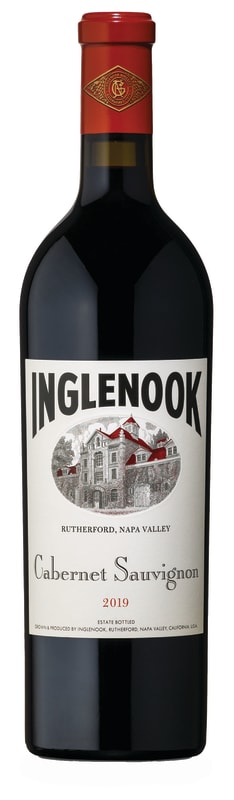


Winemaker Notes
Stunningly deep ruby in color, the 2019 Cabernet Sauvignon opens with heady aromas of brambly black cherry, vanilla, warm brioche, and crème de cassis. As the wine warms on the palate, notes of red cherry, graphite and fennel emerge, as very polished, refined tannins carry the wine into a long, fragrant finish. Layered flavors, good tension, and a perfect integration of wine and oak interact to create this classic expression of Inglenook Cabernet Sauvignon.
Blend: 96% Cabernet Sauvignon, 4% Cabernet Franc
Professional Ratings
-
James Suckling
This shows notes of ripe blackberries and blackcurrants with hints of licorice, cloves, walnuts and chocolate. It has full body and a velvety tannin structure. Juicy and vibrant fruit on the palate with a touch of earthiness. Smooth and delicious. Long, fruity finish. Very pure fruit. Try after 2024.
-
Vinous
The 2019 Cabernet Sauvignon is one of the most potent wines I have tasted from Inglenook in a long time. Readers should be patient, as the 2019 is a mere infant. A rush of black cherry, mocha, licorice, spice and leather builds as this sumptuous, towering wine gradually opens with a bit of aeration. I would give the 2019 at least a few years in bottle, as the grippy tannins need time to soften.
-
Robert Parker's Wine Advocate
The 2019 Cabernet Sauvignon is a blend of 96% Cabernet Sauvignon and 4% Cabernet Franc. Deep garnet-purple in color, it springs from the glass with vibrant notes of crushed black raspberries, black plums and blackcurrant pastilles, plus hints of underbrush and bouquet garni. Medium to full-bodied with intense, pure black fruit flavors, the fruit is well-framed by ripe, grainy tannins and fantastic freshness, finishing with a skip in its step.
-
Wine Enthusiast
Earthy and high-toned, this elegant and structured wine was blended with 4% Cabernet Franc. Supple in tannin and well integrated in oak, it finishes in a floral touch of violet.
-
Wine Spectator
Leads with a nice sweet bay leaf hint, followed quickly by singed cedar and loam before the core of reserved red and black currant fruit finally starts to unfold. Warm earth-framed finish. A touch old school, with some muscular character. This should age nicely. Best from 2024 through 2034.
-
Jeb Dunnuck
Starting with the 2019 Cabernet Sauvignon, this ruby/plum-hued effort displays attractive currants and savory black cherry fruit as well as notes of tobacco, savory herbs, leather, and earth. Medium to full-bodied on the palate, it's nicely textured, moderately concentrated, and balanced, with outstanding length.


A noble variety bestowed with both power and concentration, Cabernet Sauvignon enjoys success all over the globe, its best examples showing potential to age beautifully for decades. Cabernet Sauvignon flourishes in Bordeaux's Medoc where it is often blended with Merlot and smaller amounts of some combination of Cabernet Franc, Malbecand Petit Verdot. In the Napa Valley, ‘Cab’ is responsible for some of the world’s most prestigious, age-worthy and sought-after “cult” wines. Somm Secret—DNA profiling in 1997 revealed that Cabernet Sauvignon was born from a spontaneous crossing of Cabernet Franc and Sauvignon Blanc in 17th century southwest France.

The Rutherford sub-region of Napa Valley centers on the town of Rutherford and covers some of Napa Valley’s finest vineyard real estate, spanning from the Mayacamas in the west, to the Vaca Mountains on the other side of the valley.
Inside of the Rutherford AVA, bordering the Mayacamas, is a stretch of uplands called the Rutherford Bench. (These bench lands technically run the length of Oakville as well). Mountain runoff creates deep, well-drained, alluvial soils on the bench, giving vine roots plenty of reason to permeate deep into the ground. The result is wine with great structure and complexity.
Rutherford Cabernet Sauvingons and Bordeaux Blends garner substantial attention for their enticing fragrances of dusty earth and dried herbs, broad and juicy mid-palates and lush and fine-grained tannins. The sub-appellation claims some of the valley’s most prized vineyards today, namely Caymus, Rubicon and Beckstoffer Georges III.
It is also home to Napa’s most influential and historic personalities. Thomas Rutherford, responsible for the appellation's name, made serious investments here in grape growing and wine production between the years of 1850 to 1880. Gustave Niebaum purchased a large swath of land and completed his winery in 1887, calling it “Inglenook.” Today this remains the oldest bonded winery in California. Georges Latour founded Beaulieu Vineyard in 1900, making it the oldest continuous winery in the state. Latour also hired the famous enologist, André Tchelistcheff, a man credited for single-handedly defining the modern Napa winemaking style.