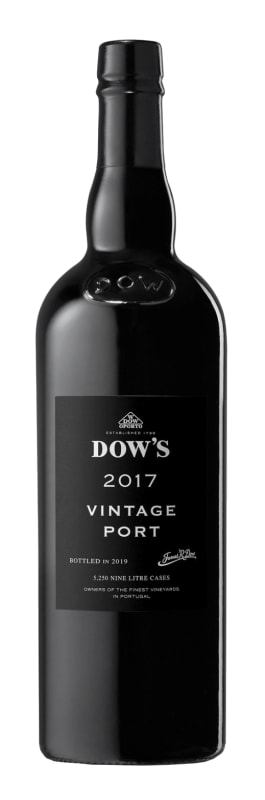


Winemaker Notes
The 2017 was a very different year to 2016 in terms of the viticultural conditions and it was interesting to watch the progression of the wine and scrutinize its quality as it developed over its first two winters. Whereas 2016 had a very mild winter and exceptionally hot summer, this was compensated by abundant winter and spring rainfall. Conversely, 2017 was warm and dry throughout, although summer temperatures were closer to average, which proved to be a very significant factor allowing for complete, balanced ripening.
It is rare to see such tremendous depth and intensity in color as this wine displays. The freshness of the floral aromas is very attractive with a dominance of rockrose, a flower that grows wild around the hills of Senhorada Ribeira. On the palate, it is exceptionally full-bodied, rich and powerful with black fruit coming to the fore. Gorgeous, ripe fruit is balanced by the fine tannin structure. On the finish, it is typically Dow, austere and somewhat drier than many other ports. The intense fruit flavors linger long on the palate.
Professional Ratings
-
James Suckling
Pure grape aromas that remind me of fermenting must but then goes to stems and dried flowers. Full-bodied, medium sweet with fine-grained tannins that coat your palate. Powerful and muscular yet remains agile and beautiful. Grows on your palate. Wonderful ripe fruit in the middle palate. Try after 2030.
-
Decanter
Based on fruit from the predominantly south-facing Quinta do Bomfim in the Cima Corgo and Quinta Senhora da Ribeira in the Douro Superior, with Touriga Nacional and Touriga Franca making up 80% of the blend. This is opaque and closed in but powerfully ripe with underlying pure berry fruit. It's seemingly quite introverted compared to some of its peers at this stage, but it's still full, rich and opulent on the palate. It also shows the latent power of the vintage, made as it is in a slightly drier style (3.4 Baumé), with lovely minty fruit and full, ripe sinewy tannins all the way through the finish. Long and lithe, and very fine.
-
Robert Parker's Wine Advocate
The 2017 Vintage Port, bottled in May for release in the third quarter of 2019, is mostly a 42/38 blend of Touriga Nacional and Touriga Franca with old vines and miscellaneous others (including about 8% Alicante Bouschet) for the rest. It was bottled about a month before this tasting after 18 months in seasoned vats, but the just-bottled sample was not actually used for fear it might be in shock. This, accordingly, was actually a pre-bottling sample. It comes in with 106 grams of residual sugar.
Barrel Sample: 94-96 -
Wine Enthusiast
This is a dry while also floral wine, perfumed and enticing with its juicy acidity. At the same time, the structure is very present, showing power and dark black fruits. The balance is coming together with the rich fruits and tannins melding into one. Drink from 2028.
-
Wine Spectator
A dense, thickly textured version, dripping with warm salted licorice, tar and açaí paste notes, while plum and blueberry pâte de fruit, chai spice and chocolate elements fill in behind. Lots of brambly grip flows underneath. Shows a very sappy feel on the finish. Best from 2035 through 2055.
-
Wine & Spirits
This 2017 has all the markers of a legendary Taylor Port—scents of green fig, the complex tannic impact of schist, the consternating sense of elegance in the face of massive structural power. David Guimaraens bases this wine on fruit from the Quinta de Vargellas, an estate on the south bank of the river in the arid Douro Superior. In our tastings, it came after several 2017s that were sourced from vineyards on the north bank, closer to Pinhão, and, while it would be simplistic to consider this a definitive difference (there are many exposures in each quinta, and other quinta parcels in the blends), there was a stark shift from the blackness of those wines to the sour-cherry impression of this wine, and its floral fraise des bois notes. Those flavors keep pushing up against the dark shadows of the wine’s schist tannins, an undulating wake of red fruit and minerals that carries the wine’s muscular power into memory.


Port is a sweet, fortified wine with numerous styles: Ruby, Tawny, Vintage, Late Bottled Vintage (LBV), White, Colheita, and a few unusual others. It is blended from from the most important red grapes of the Douro Valley, based primarily on Touriga Nacional with over 80 other varieties approved for use. Most Ports are best served slightly chilled at around 55-65°F. To learn more, see our full Port Wine Guide

The home of Port—perhaps the most internationally acclaimed beverage—the Douro region of Portugal is one of the world’s oldest delimited wine regions, established in 1756. The vineyards of the Douro, set on the slopes surrounding the Douro River (known as the Duero in Spain), are incredibly steep, necessitating the use of terracing and thus, manual vineyard management as well as harvesting. The Douro's best sites, rare outcroppings of Cambrian schist, are reserved for vineyards that yield high quality Port.
While more than 100 indigenous varieties are approved for wine production in the Douro, there are five primary grapes that make up most Port and the region's excellent, though less known, red table wines. Touriga Nacional is the finest of these, prized for its deep color, tannins and floral aromatics. Tinta Roriz (Spain's Tempranillo) adds bright acidity and red fruit flavors. Touriga Franca shows great persistence of fruit and Tinta Barroca helps round out the blend with its supple texture. Tinta Cão, a fine but low-yielding variety, is now rarely planted but still highly valued for its ability to produce excellent, complex wines.
White wines, generally crisp, mineral-driven blends of Arinto, Viosinho, Gouveio, Malvasia Fina and an assortment of other rare but local varieties, are produced in small quantities but worth noting.
With hot summers and cool, wet winters, the Duoro has a maritime climate.