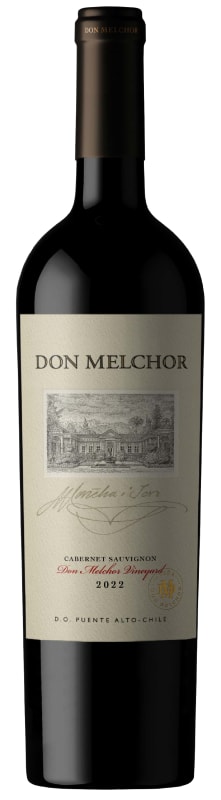


Winemaker Notes
Professional Ratings
-
James Suckling
Blackcurrants, cassis and graphite on the nose. Pure and fragrant. Full-bodied with superb density and tannins that are so polished. The texture is like touching a silk ball. Its finish is very long and compact with slightly chewy tannins, but it will come together beautifully with time in the bottle. Try after 2028.
-
Jeb Dunnuck
Richly textured and layered in tangy red fruit, the 2022 Cabernet Sauvignon is from a cooler year than the 2023, made in a similar way, blending from some 151 parcels planted at different densities and in different time periods, from 1979 through 2022. The 95% Cabernet Sauvignon is joined by 3% Cabernet Franc and 1% each of Merlot and Petit Verdot, aged 15 months in French oak barrels, 72% new. Ripening was even and relatively slow, allowing the flavors, aromas, and acidity to meld seamlessly across a full-bodied palate of lovely red and black fruit and floral tones. The tannins are melded within the breadth of the wine, textured to a delicate degree, well-balanced throughout. This is simply a gorgeous wine.
-
Vinous
The 2022 Cabernet Sauvignon Don Melchor originates from a vineyard planted in the heart of the Puente Alto region in 1979. This is renowned Cabernet Sauvignon terroir, characterized by the perfect balance of temperatures and poor gravel soils. The 2022 was aged in French oak barrels, with 78% of them being new. Garnet-hued with a purplish sheen, it offers complex aromas of currant, blackberry, ash, mint and a subtle floral tone that can be attributed to the cold vintage. Dry, rich and moderately juicy, the precisely calibrated tannins of Maipo Valley and the clear fruit impart the palate with intensity and agility. This is a more nuanced and energetic edition of Don Melchor, closing with a fairly compact finish.
-
Wine Spectator
Elegant, nuanced and concentrated, with a loamy-clay cast to the fresh thyme and subtle tuberose aromas, which give way to a rich yet balanced core of blackberry and cassis notes lifted by saline-edged acidity. Wonderfully fresh while moving toward the finish, where the flavors come together and linger harmoniously around well-formed tannins. Drink now through 2040.



Don Melchor, named after Concha Y Toro’s founder, is among Chile’s most-acclaimed wines and a Cabernet that belongs in every conversation about world-class interpretations of this singular varietal. Winemaker Enrique Tirado says of his vision for the wine, “Don Melchor’s style, complexity, and elegance are the extension of the perfect balance between the rocky soils in Puente Alto, the cold winds that slide down from the Andes Mountains, the generous climate of the Maipo Valley, the number of years the vines have taken to yield their best grapes, and the meticulous and caring work of the human hand.”
The signature wine from the exquisitely tended Puente Alto vineyard, Don Melchor celebrates its 30th vintage with the 2016 release. Set at the foot of the Andes Mountains on the northern banks of the Maipo River in the Upper Maipo Valley, 650 meters above sea level, the vineyard dates back to the mid-19th century, when the first pre-phylloxera French varieties were brought to Chile. Today, the vineyard consists of 127 hectares, divided into seven parcels, 90% of which are Cabernet Sauvignon, 7.1% are Cabernet Franc, 1.9% are Merlot, and 1% are Petit Verdot. Each parcel has been subdivided in order for very specific, detailed work that responds to the particular needs of each plant, row by row, to achieve the perfect balance with the weather characteristics of each year. Average vine age is over 30 years.
Every year, Winemaker Enrique Tirado travels to the small town of Lamarque, Bordeaux, France, to meet with renowned Bordeaux consultant Eric Boissenot, to taste approximately 150 lots from the vineyard and determine which lots, and in which proportions, will go into the new vintage of Don Melchor. Once the final blend has been defined, the new vintage of Don Melchor is transferred to French oak barrels from the Allier, Tronçois, and Nevers forests. Nearly two-thirds of the barrels are new, and the remaining third have had one prior use. After 14–15 months, the wine is bottled and aged for another year to develop the complexity and elegance that Don Melchor is known for.

A noble variety bestowed with both power and concentration, Cabernet Sauvignon enjoys success all over the globe, its best examples showing potential to age beautifully for decades. Cabernet Sauvignon flourishes in Bordeaux's Medoc where it is often blended with Merlot and smaller amounts of some combination of Cabernet Franc, Malbecand Petit Verdot. In the Napa Valley, ‘Cab’ is responsible for some of the world’s most prestigious, age-worthy and sought-after “cult” wines. Somm Secret—DNA profiling in 1997 revealed that Cabernet Sauvignon was born from a spontaneous crossing of Cabernet Franc and Sauvignon Blanc in 17th century southwest France.

The Maipo Valley is Chile’s most famous wine region. Set in the country’s Central Valley, it is warm and quite dry, often necessitating the use of irrigation. Alluvial soils predominate but are supplemented with loam and clay.
The climate in Maipo is best-suited for ripe, full-bodied reds like Cabernet Sauvignon (the region’s most widely planted grape), Merlot, Syrah and Carmenère, a Bordeaux variety that has found a successful home in Chile.
White wines are also produced with great prosperity, especially near the cooler coast, include Chardonnay and Sauvignon Blanc.