

Winemaker Notes
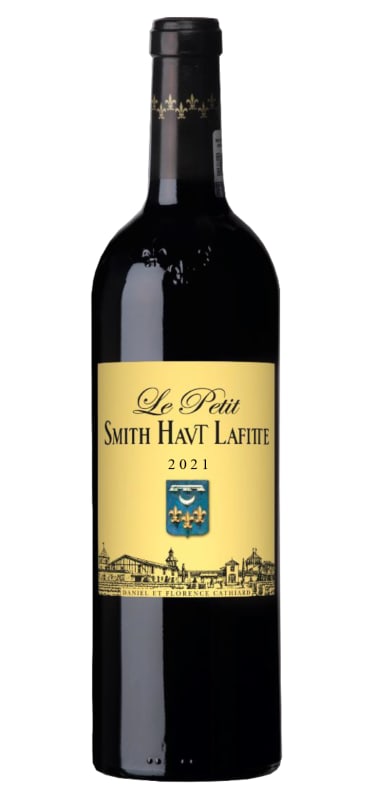
Blend: 60% Cabernet Sauvignon, 40% Merlot
Professional Ratings
-
Decanter
Dark chocolate, licorice and slate with pretty notes of rose and violet that softly edge the nose. The raspberry, strawberry and blueberry fruit has a touch of sharpness, though I love the edges of chalk and slate minerality that give it real direction and linearity with little movement up or down as the flavors travel across the palate. All the elements are well delivered, elegant and really in focus. This has excellent attention to detail and lots going on. A characterful pick in 2021.
Barrel Sample: 92 -
James Suckling
This has very pretty cabernet aromas of blackcurrants and iodine with cloves, stone and just a hint of fresh herbs. Medium-bodied with a firmness and freshness on the palate, leading to a linear and racy finish with plenty of energy. Crunchy. 60% cabernet sauvignon and 40% merlot. From organically grown grapes.
-
Jeb Dunnuck
More Cabernet Sauvignon-dominated, the 2021 Le Petit Smith Haut Lafitte is a 60/40 split of Cabernet Sauvignon and Merlot, and it's another medium-bodied, pretty, elegant, impressive wine from this team. Cassis, redcurrants, tobacco leaf, and a hint of leather all shine here, and it's focused and nicely structured on the palate, with fine tannins and a great finish. Where the Les Hauts de Smith is up-front and ready to go, this is going to benefit from at least 2-3 years in the cellar.
-
Robert Parker's Wine Advocate
The 2021 Le Petit Haut Lafitte is showing well today, evoking aromas of spices, pencil lead and dark berries. Medium-bodied, elegant and round, it’s elegantly tense with powdery tannins, concluding with a charming, fresh finish. It's a blend of 60% Cabernet Sauvignon and 40% Merlot that matured in 30% new oak barrels.
-
Wine Spectator
Gains substance from red currant and black cherry fruit notes, while savory and potpourri hints add range. This wine's acidity is less overt than most of its colleagues, resulting in some pleasant energy through the finish as well. Cabernet Sauvignon and Merlot. Drink now through 2027. Tasted twice, with consistent notes. 6,000 cases made, 1,500 cases imported.


One of the world’s most classic and popular styles of red wine, Bordeaux-inspired blends have spread from their homeland in France to nearly every corner of the New World. Typically based on either Cabernet Sauvignon or Merlot and supported by Cabernet Franc, Malbec and Petit Verdot, the best of these are densely hued, fragrant, full of fruit and boast a structure that begs for cellar time. Somm Secret—Blends from Bordeaux are generally earthier compared to those from the New World, which tend to be fruit-dominant.

Recognized for its superior reds as well as whites, Pessac-Léognan on the Left Bank claims classified growths for both—making it quite unique in comparison to its neighboring Médoc properties.
Pessac’s Chateau Haut-Brion, the only first growth located outside of the Médoc, is said to have been the first to conceptualize fine red wine in Bordeaux back in the late 1600s. The estate, along with its high-esteemed neighbors, La Mission Haut-Brion, Les Carmes Haut-Brion, Pique-Caillou and Chateau Pape-Clément are today all but enveloped by the city of Bordeaux. The rest of the vineyards of Pessac-Léognan are in clearings of heavily forested area or abutting dense suburbs.
Arid sand and gravel on top of clay and limestone make the area unique and conducive to growing Sémillon and Sauvignon blanc as well as the grapes in the usual Left Bank red recipe: Cabernet Sauvignon, Merlot, Cabernet Franc and miniscule percentages of Petit Verdot and Malbec.
The best reds will show great force and finesse with inky blue and black fruit, mushroom, forest, tobacco, iodine and a smooth and intriguing texture.
Its best whites show complexity, longevity and no lack of exotic twists on citrus, tropical and stone fruit with pronounced floral and spice characteristics.