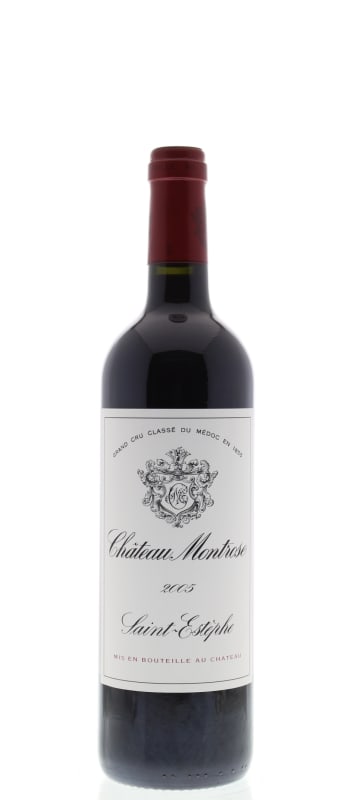


Winemaker Notes
Dense purple color, almost black.The nose is still closed: black fruits, spices, chocolate. Complex palate, long, rich, powerful, cherry, cocoa, licorice, tobacco brown, prune. This is a very big wine, full and very structured, with nice length, the tannins are very robust, with great aging potential.
Blend: 65% Cabernet Sauvignon, 31% Merlot, 3,5% Cabernet Franc, 0.5% Petit Verdot
Professional Ratings
-
Jeb Dunnuck
The 2005 Château Montrose seems to increase every time I taste it, and this was the finest showing yet. Still youthfully ruby/plum-hued, it has a gorgeously layered nose of darker currants, flowers, new saddle leather, and graphite that's to die for. This carries to a full-bodied Montrose with a dense, concentrated mid-palate, incredibly fine, polished tannins, and a great, great finish. This spicy, complex, nuanced, as well as utterly classic Montrose has another 50-75 years of overall longevity.
-
Robert Parker's Wine Advocate
The 2005 Montrose continues to show brilliantly, unwinding in the glass with notes of blackcurrant, red fruits, loamy soil, black truffles and cigar ash. Full-bodied, deep and concentrated, it's still brooding and tannic, with lively acids and an imposing chassis of structuring—and artery-cleansing—extract. Still an adolescent, it's one of the last unrepentantly old-school vintages of Montrose, and Médoc purists couldn't own enough. While this remains a very youthful wine, it is now apparent that the 2005 will, at maturity, surpass the 1989 and 1990.
-
Decanter
Deep florality and wonderful black fruit. Surprisingly smooth and silky at first then the classic firmness becomes plain towards the finish. It has more natural richness than most in 2015 – a superbly made wine from a great terroir.
-
James Suckling
This continues to be very tight yet I loved drinking it the other night at dinner. Loads of spices, berries, meat, cloves and chocolate on the nose. Full body with soft, silky tannins and lots of rich fruit. Still chewy. This is just starting to open up now. Drink or hold.
-
Wine Spectator
Black licorice and blackberry aromas, with hints of mineral, lead to a full-bodied palate. Very chewy, with loads of tannins, yet this follows through with beautifully ripe fruit, mineral and mint. Fascinating.
-
Wine & Spirits
This is so big it is blinding, a storm of mineral tannin and plum-skin extract. The volume is turned up high, and even as the tannic noise factor begins to diminish with days of air, the wine is still closed tight. The comportment of its power shows this to be a wine from a great terroir; the property, in fact, has some parallels to Latour, with its similarly shaped gravel promontory above the Gironde. Montrose consistently grows one of the staunchest, long-lived wines of the Médoc and though accommodations have been made in recent years to soften it, the tannic index in February 2006 read at 82, a force to reckon with over the decades to come.


One of the world’s most classic and popular styles of red wine, Bordeaux-inspired blends have spread from their homeland in France to nearly every corner of the New World. Typically based on either Cabernet Sauvignon or Merlot and supported by Cabernet Franc, Malbec and Petit Verdot, the best of these are densely hued, fragrant, full of fruit and boast a structure that begs for cellar time. Somm Secret—Blends from Bordeaux are generally earthier compared to those from the New World, which tend to be fruit-dominant.

Deeply colored, concentrated, and distinctive, St. Estephe is the go-to for great, age-worthy and reliable Bordeaux reds. Separated from Pauillac merely by a stream, St. Estephe is the farthest northwest of the highest classed villages of the Haut Medoc and is therefore subject to the most intense maritime influence of the Atlantic.
St. Estephe soils are rich in gravel like all of the best sites of the Haut Medoc but here the formation of gravel over clay creates a cooler atmosphere for its vines compared to those in the villages farther downstream. This results in delayed ripening and wines with higher acidity compared to the other villages.
While they can seem a bit austere when young, St. Estephe reds prove to live very long in the cellar. Traitionally dominated by Cabernet Sauvignon, many producers now add a significant proportion of Merlot to the blend, which will soften any sharp edges of the more tannic, Cabernet.
The St. Estephe village contains two second growths, Chateau Montrose and Cos d’Estournel.