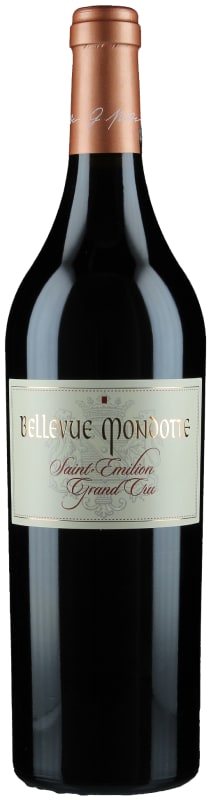


Winemaker Notes
Professional Ratings
-
Jeb Dunnuck
The 2020 Bellevue Mondotte is another powerhouse from the team at Pavie. All Merlot from the upper plateau above Chateau Pavie (the soils here contain a touch more clay), this full-bodied, deep, concentrated 2020 has a tight, unevolved bouquet of darker raspberries, cassis, truffly earth, and chocolate. Balanced, structured, and incredibly pure, it's mostly potential at this point and needs to be forgotten for 5-6 years. Best After 2028
-
James Suckling
A linear and very compacted Bellevue with blackberries, blueberries and chocolate. Full and tight with racy tannins and a long and flavorful finish. Racy and focused. 100% merlot.
-
Robert Parker's Wine Advocate
The 2020 Bellevue Mondotte is made from 100% Merlot, with an alcohol of 14.92% and a pH of 3.54. It is aging in French oak barriques, 90% new. Displaying an opaque purple-black color, it sashays out of the glass with flamboyant notes of plum preserves, blackberry compote and blueberry pie, plus hints of hoisin, Chinese five spice and camphor with a touch of dried rose petals. The concentrated, seductive, full-bodied palate delivers layer upon layer of black and blue fruit preserves, accented by exotic spices and supported with firm, ripe, rounded tannins plus fantastic freshness. The finish is epically long and achingly fragrant. Wow!
Barrel Sample: 96-98 -
Wine Enthusiast
Produced from old Merlot vines, this is a rich, juicy wine with layers of fresh acidity as well as blackberry fruits. The tannins give this superripe wine powerful density that will push it well towards aging.
Barrel Sample: 93-95 -
Wine Spectator
Loaded with loganberry, acai berry and boysenberry fruit flavors that bring underlying juicy energy, while graphite, black tea, roasted alder and violet notes fill in throughout. The long finish lets it all unfurl suavely. Merlot, Cabernet Franc and Cabernet Sauvignon. Best from 2026 through 2040.


One of the world’s most classic and popular styles of red wine, Bordeaux-inspired blends have spread from their homeland in France to nearly every corner of the New World. Typically based on either Cabernet Sauvignon or Merlot and supported by Cabernet Franc, Malbec and Petit Verdot, the best of these are densely hued, fragrant, full of fruit and boast a structure that begs for cellar time. Somm Secret—Blends from Bordeaux are generally earthier compared to those from the New World, which tend to be fruit-dominant.

Marked by its historic fortified village—perhaps the prettiest in all of Bordeaux, the St-Émilion appellation, along with its neighboring village of Pomerol, are leaders in quality on the Right Bank of Bordeaux. These Merlot-dominant red wines (complemented by various amounts of Cabernet Franc and/or Cabernet Sauvignon) remain some of the most admired and collected wines of the world.
St-Émilion has the longest history in wine production in Bordeaux—longer than the Left Bank—dating back to an 8th century monk named Saint Émilion who became a hermit in one of the many limestone caves scattered throughout the area.
Today St-Émilion is made up of hundreds of independent farmers dedicated to the same thing: growing Merlot and Cabernet Franc (and tiny amounts of Cabernet Sauvignon). While always roughly the same blend, the wines of St-Émilion vary considerably depending on the soil upon which they are grown—and the soils do vary considerably throughout the region.
The chateaux with the highest classification (Premier Grand Cru Classés) are on gravel-rich soils or steep, clay-limestone hillsides. There are only four given the highest rank, called Premier Grand Cru Classés A (Chateau Cheval Blanc, Ausone, Angélus, Pavie) and 14 are Premier Grand Cru Classés B. Much of the rest of the vineyards in the appellation are on flatter land where the soils are a mix of gravel, sand and alluvial matter.
Great wines from St-Émilion will be deep in color, and might have characteristics of blackberry liqueur, black raspberry, licorice, chocolate, grilled meat, earth or truffles. They will be bold, layered and lush.