

Winemaker Notes
Professional Ratings
-
James Suckling
This is wonderfully fragrant, with attractive notes of olive, mulberry and peppercorn. It’s juicy, medium- to full-bodied and very bright, with fine-grained tannins and a lively finish.
-
Robert Parker's Wine Advocate
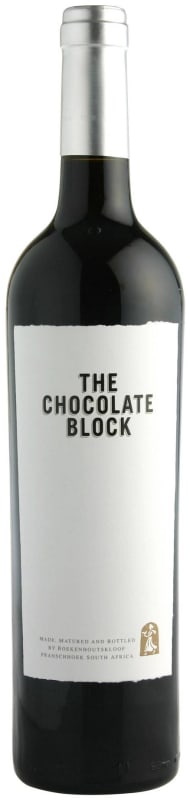
With an ample 1.2 million bottles made, the Boekenhoutskloof 2023 Swartland The Chocolate Block is one of South Africa's most popular restaurant and retail wines. The blend is 74% Syrah, 11% Grenache, 8% Cabernet Sauvignon, 6% Cinsault and 1% co-fermented Viognier. Eighty percent of the grapes are farmed by the in-house team. No new oak is used except for the Cabernet Sauvignon, and the rest sees neutral barrel. Proprietor Marc Kent says the wine is on its way to officially becoming organic. People underestimate the influence of the Cinsault, he says. It takes away from the roughness of the other grapes, and along with Grenache, creates a more perfumed style of wine. The Chocolate Block is its own brand, representing a fruit-forward, accessible and food-friendly red wine with medium-plus texture and pleasant softness.
-
Vinous
The 2023 The Chocolate Block, arguably the Cape's most successful brand in terms of both quantity and quality, is a mixture of 70% estate fruit (mainly from Porseleinberg) and 30% from partnership vineyards on reddish soils that have supplied fruit for 15 to 20 years. It matured for 12 to 14 months in 95% used barriques. Fruit picked after the rains was not included in the blend. The 2023 has a fresh nose with redcurrant and pomegranate fruit, earthy notes and a touch of tea leaf. The palate is medium-bodied with crunchy red fruit and fine acidity, fresh and vibrant with brown spices and black pepper toward the finish. According to the label, production totaled 4,043 barrels in this vintage—it is some achievement to produce a label of such scale at this level of quality. The Cape couldn't ask for a better ambassador.


With hundreds of red grape varieties to choose from, winemakers have the freedom to create a virtually endless assortment of blended red wines. In many European regions, strict laws are in place determining the set of varieties that may be used, but in the New World, experimentation is permitted and encouraged resulting in a wide variety of red wine styles. Blending can be utilized to enhance balance or create complexity, lending different layers of flavors and aromas. For example, a red wine blend variety that creates a fruity and full-bodied wine would do well combined with one that is naturally high in acidity and tannins. Sometimes small amounts of a particular variety are added to boost color or aromatics. Blending can take place before or after fermentation, with the latter, more popular option giving more control to the winemaker over the final qualities of the wine.
How to Serve Red Wine
A common piece of advice is to serve red wine at “room temperature,” but this suggestion is imprecise. After all, room temperature in January is likely to be quite different than in August, even considering the possible effect of central heating and air conditioning systems. The proper temperature to aim for is 55° F to 60° F for lighter-bodied reds and 60° F to 65° F for fuller-bodied wines.
How Long Does Red Wine Last?
Once opened and re-corked, a bottle stored in a cool, dark environment (like your fridge) will stay fresh and nicely drinkable for a day or two. There are products available that can extend that period by a couple of days. As for unopened bottles, optimal storage means keeping them on their sides in a moderately humid environment at about 57° F. Red wines stored in this manner will stay good – and possibly improve – for anywhere from one year to multiple decades. Assessing how long to hold on to a bottle is a complicated science. If you are planning long-term storage of your reds, seek the advice of a wine professional.

Originally named Franschhoek meaning the “French Corner” because it was home to the influx of French Huguenots, today the valley contains many historic cellars and is an important tourist location because of its proximity to Cape Town.
This valley falls to the southeast of Paarl and is enclosed on three sides by towering mountains. Streams from the slopes flow down to the valley floor, converging to form the Berg River. The area excels in the production of full-bodied reds.