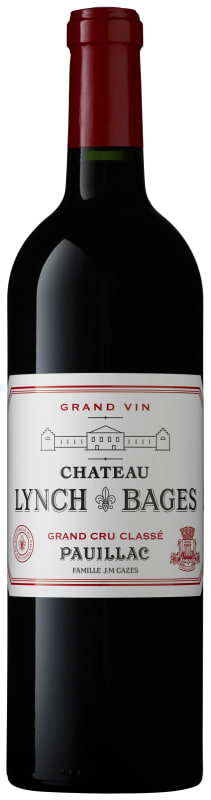


Winemaker Notes
Outstandingly consistent quality. The estate’s reputation as a top quality wine producer took off in 1945 after a series of exceptional vintages. Over the years, the wines have gained finesse and complexity. Château Lynch-Bages is defined by its outstandingly consistent quality. Vintage after vintage, the wine has acquired greater accuracy, adding distinction to the hedonistic that made its reputation.
The wine’s distinctive character has earned it a place amongst Pauillac’s greatest. Generous right from its youth, it develops structure, finesse and elegance as it matures.
Blend: 66% Cabernet Sauvignon, 28% Merlot, 3% Cabernet Franc, 3% Petit Verdot
Professional Ratings
-
Jeb Dunnuck
Currants, smoky oak, chocolate, and hints of violets all define the 2025 Château Lynch-Bages, a remarkably balanced, elegant Pauillac from this estate that has more than a passing resemblance to the 2019. Medium to full-bodied on the palate, it has ultra-fine tannins and nicely integrated acidity, and it builds beautifully with time in the glass. It should have some reasonable accessibility, but as with most vintages here, the cellar will be your friend.
Barrel Sample: 96-98 -
James Suckling
Lots of great energy, with a precision and focus that sends you down the road to gorgeous dark fruits and mineral nuances. A cool, minty note. Medium- to full-bodied. Racy and intense, with a lightness at the end. Juicy fruit, too. A blend of 66% cabernet sauvignon, 28% merlot, 3% cabernet franc and 3% petit verdot.
Barrel Sample: 97-98 -
Vinous
The 2025 Lynch-Bages was picked 9 to 21 September and matured in 75% new oak barrels. This has a stunning bouquet with exceptionally pure blackberry, cassis and subtle violet scents, the oak seamlessly integrated. The palate is medium-bodied with finely embroidered tannins, perfect acidity, a touch of cedar and black pepper that dovetails into a peacock's tail finish that “clings” to the mouth. This continues the strongest run from Lynch-Bages since the 1980s and, perhaps with the 2025, it is close to surpassing that. –Neal Martin
Barrel Sample: 96-98 -
Robert Parker's Wine Advocate
The 2025 Lynch-Bages wafts from the glass with aromas of dark wild berries, lead pencil and spices, framed by well-integrated new oak. Full-bodied, dense and concentrated, it’s deep and muscular, with a broad-shouldered profile, yet more velvety and precise than usual, showing a touch of freshness through the mid-palate, concluding with a long, cassis-inflected finish. Without departing from its customary style—combining power and generosity in youth—it is more approachable en primeur, with softer, more polished tannins than in recent vintages. This is a blend of 66% Cabernet Sauvignon, 28% Merlot, 3% Cabernet Franc and 3% Petit Verdot, matured with 75% new oak.
Barrel Sample: 94-97 -
Decanter
Dried floral scents, some cocoa powder, mint, red berries and sweet rose petals. Clean and crystalline, a lovely purity and soft chalky touch to the tannins which fill the mouth but don’t overwhelm. Feels quite a restrained style for Lynch, delicate almost, a gentle lick of liquorice, slate and wet stone with blackcurrant fruit. Quite a long style, very charming, juicy but really overall quite finessed/hands off. Ageing will add on a bit of added texture. Grippy, fleshy, chalky but cool. 3% Petit Verdot completes the blend. 3.68pH.
Barrel Sample: 96


One of the world’s most classic and popular styles of red wine, Bordeaux-inspired blends have spread from their homeland in France to nearly every corner of the New World. Typically based on either Cabernet Sauvignon or Merlot and supported by Cabernet Franc, Malbec and Petit Verdot, the best of these are densely hued, fragrant, full of fruit and boast a structure that begs for cellar time. Somm Secret—Blends from Bordeaux are generally earthier compared to those from the New World, which tend to be fruit-dominant.

The leader on the Left Bank in number of first growth classified producers within its boundaries, Pauillac has more than any of the other appellations, at three of the five. Chateau Lafite Rothschild and Mouton Rothschild border St. Estephe on its northern end and Chateau Latour is at Pauillac’s southern end, bordering St. Julien.
While the first growths are certainly some of the better producers of the Left Bank, today they often compete with some of the “lower ranked” producers (second, third, fourth, fifth growth) in quality and value. The Left Bank of Bordeaux subscribes to an arguably outdated method of classification that goes back to 1855. The finest chateaux in that year were judged on the basis of reputation and trading price; changes in rank since then have been miniscule at best. Today producers such as Chateau Pontet-Canet, Chateau Grand Puy-Lacoste, Chateau Lynch-Bages, among others (all fifth growth) offer some of the most outstanding wines in all of Bordeaux.
Defining characteristics of fine wines from Pauillac (i.e. Cabernet-based Bordeaux Blends) include inky and juicy blackcurrant, cedar or cigar box and plush or chalky tannins.
Layers of gravel in the Pauillac region are key to its wines’ character and quality. The layers offer excellent drainage in the relatively flat topography of the region allowing water to run off into “jalles” or streams, which subsequently flow off into the Gironde.