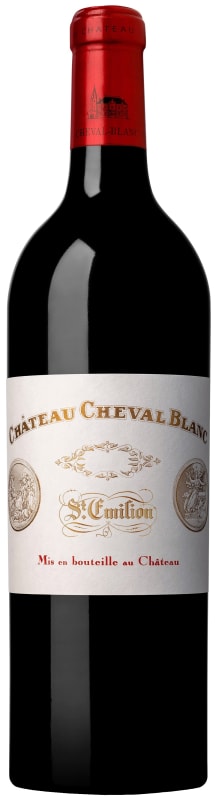


Winemaker Notes
Blend: 51% Merlot, 45% Cabernet Franc, 4% Cabernet Sauvignon
Professional Ratings
-
Robert Parker's Wine Advocate
A blend of 51% Merlot, 45% Cabernet Franc and 4% Cabernet Sauvignon, the 2025 Château Cheval Blanc stands out once again as among the finest wines of the vintage in Bordeaux. Wafting from the glass with a deep bouquet of dark berries and cherries mingled with notions of blood orange and iris, it's full-bodied, layered and concentrated, with terrific mid-palate density, sweet tannins and a long, vibrant, violet-inflected finish. With its striking aromas, intensity of flavor and resolutely classical proportions (checking in at 12.7% alcohol and pH of 3.76), the 2025 gives every indication of being one of the great Cheval Blancs of the decade.
Barrel Sample: 98-100 -
Vinous
The 2025 Cheval Blanc is seamless and textured. A wine of mystery and seduction, the 2025 dazzles. Time in the glass brings out the wine's tension and energy. Sage, mint, lavender, cloves and cool, blue-toned fruit all build in the glass. In one tasting, Cheval Blanc was massively tannic; in a second tasting, those tannins were much more seamless, highlighting how differently wines can show from day to day. In the case of Cheval Blanc, en primeur samples are mini-bottlings, and both samples I tasted came from the same batch.
Yields in 2025 were just 15 hectoliters per hectare, tiny by any measure. The winemaking team, led by Pierre-Olivier Clouet, used 46 of the 47 parcels on the estate for the Grand Vin. A small amount of wine was sold in bulk; the rest was bottled as Grand Vin. There is no Petit Cheval. Time on skins ran from 26 to 32 days, longer than the 22-28 that's more typical. For those who care about the data, alcohol is just 12.7%, which is hard to believe, with brisk acids that clock in at 3.76 pH. In many vintages Cheval Blanc can be exuberant, but the 2025 is rather closed, more of an intellectual wine that will require years in bottle to truly show everything it has to offer. –Antonio Galloni
Barrel Sample: 96-99 -
James Suckling
Perfumed, with aromas of flowers, brambleberries and wild berries. Medium-bodied with tight, fine tannins that run forever on the palate. Hints of cedar, mushrooms and bark. Crunchy at the end. Just a hint of fancy bitterness and chocolate. Transparent and complete.
Barrel Sample: 97-98 -
Jeb Dunnuck
A saturated purple hue, the 2025 Château Cheval Blanc is a unique, dense, powerful, and streamlined Cheval Blanc with remarkable purity. The nose offers lots of red, blue, and black fruits intermixed with floral, graphite, and inky nuances, and on the palate, it's powerful and medium to full-bodied, tasting like the distilled essence of this château. It has ripe, polished tannins, beautiful overall balance, and a great finish, although it certainly has very little in the way of baby fat or opulence. Based on 51% Merlot, 45% Cabernet Franc, and 4% Cabernet Sauvignon, with yields of just 15 hectoliters per hectare (no Petit Cheval was produced), it checks in at just 12.7% alcohol with a pH of 3.76. The vintage draws comparisons to 1961 and 1949, and it's going to be incredibly interesting to follow this wine's evolution over the next 40-50 years.
Barrel Sample: 95-97 -
Decanter
One of the lowest yields of Cheval Blanc ever at just 15hl/ha with no Petit Cheval made this year. Chinese five spice, cedar, cinnamon, rose buds, soy, purple flowers, blackcurrants and cherries on the nose. Supple and fleshy, round and enveloping yet softly chalky so you get weight but not massive density in the glass. Tannins are wonderful and the power comes underneath not at the fore. Suave, fresh and floats along the palate – generous yet reined in, glossy, bright with lovely acidity. Almost a bit shy and quiet but so well controlled. I love it for its delicacy and hands-off approach. Definitely not a showstopper but given the conditions it’s incredible how they ended up here. Complex, charming, soft, pretty and delicious without trying too hard at all. I'm certain this will improve over ageing and will be a fine Cheval in the decades to come. 3.76pH.
Barrel Sample: 96


One of the world’s most classic and popular styles of red wine, Bordeaux-inspired blends have spread from their homeland in France to nearly every corner of the New World. Typically based on either Cabernet Sauvignon or Merlot and supported by Cabernet Franc, Malbec and Petit Verdot, the best of these are densely hued, fragrant, full of fruit and boast a structure that begs for cellar time. Somm Secret—Blends from Bordeaux are generally earthier compared to those from the New World, which tend to be fruit-dominant.

Marked by its historic fortified village—perhaps the prettiest in all of Bordeaux, the St-Émilion appellation, along with its neighboring village of Pomerol, are leaders in quality on the Right Bank of Bordeaux. These Merlot-dominant red wines (complemented by various amounts of Cabernet Franc and/or Cabernet Sauvignon) remain some of the most admired and collected wines of the world.
St-Émilion has the longest history in wine production in Bordeaux—longer than the Left Bank—dating back to an 8th century monk named Saint Émilion who became a hermit in one of the many limestone caves scattered throughout the area.
Today St-Émilion is made up of hundreds of independent farmers dedicated to the same thing: growing Merlot and Cabernet Franc (and tiny amounts of Cabernet Sauvignon). While always roughly the same blend, the wines of St-Émilion vary considerably depending on the soil upon which they are grown—and the soils do vary considerably throughout the region.
The chateaux with the highest classification (Premier Grand Cru Classés) are on gravel-rich soils or steep, clay-limestone hillsides. There are only four given the highest rank, called Premier Grand Cru Classés A (Chateau Cheval Blanc, Ausone, Angélus, Pavie) and 14 are Premier Grand Cru Classés B. Much of the rest of the vineyards in the appellation are on flatter land where the soils are a mix of gravel, sand and alluvial matter.
Great wines from St-Émilion will be deep in color, and might have characteristics of blackberry liqueur, black raspberry, licorice, chocolate, grilled meat, earth or truffles. They will be bold, layered and lush.