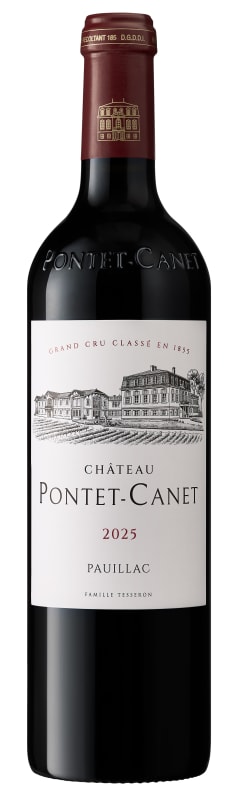


Winemaker Notes
Splendid, the 2025 vintage is concentrated, juicy, expressive, structuredand elegant, without a doubt an exceptional vintage for the estate and amost remarkable Pontet-Canet.
Blend: 56% Cabernet Sauvignon, 39% Merlot, 4% Cabernet Franc, 1% Petit Verdot
Professional Ratings
-
Robert Parker's Wine Advocate
A blend of 56% Cabernet Sauvignon, 39% Merlot, 4% Cabernet Franc and 1% Petit Verdot that weighs in at 13.3% alcohol, the 2025 Pontet-Canet is one of the finest wines this estate has produced. Wafting from the glass with aromas of sweet cassis, wild berries and plums mingled with notions of violet and burning embers, it's full-bodied, ample and velvety, with a degree of structural polish and sensuality that is rare in the Médoc, ripe acids and a long, penetrating finish. Over the last handful of years, technical director Mathieu Bessonnet and his team have revitalized Pontet-Canet's vineyards with well-timed soil work and precise phytosanitary treatments; and since 2023, the careful use of "pieds de cuve" in the winery, along with early blending, more refined barrel choices and cooler temperatures in the chai—plus more precise bottling practices—have conspired to take this estate to new heights of quality and consistency. In 2025, the team formed lower-than-usual "ponts" (whereby the canopies of adjacent vines are braided together in an arch) to retain denser foliage to protect the fruiting zone from sunshine, and they waited to pick late in pursuit of full maturity in Cabernet Sauvignon, finishing on September 23. The result is one of the wines of the vintage.
Barrel Sample: 98-100 -
Jeb Dunnuck
Deep purple-hued, the 2025 Château Pontet-Canet showed beautifully both times I tasted it, with incredibly classic Pontet-Canet notes of cassis, violets, iris, and gravelly earth and graphite. Based on 56% Cabernet Sauvignon, 39% Merlot, 4% Cabernet Franc, and 1% Petit Verdot, it's being raised in 50% new barriques, 35% concrete amphora, and 15% once-used barrels. It's rich and concentrated on the palate, with medium to full-bodied richness, ripe, building tannins, nicely integrated acidity, and a layered, elegant mouthfeel. Checking in at 13.3% alcohol with a pH of 3.7, it brings a balanced, structured, beautifully classic style with terrific elegance and a beautiful floral character.
Barrel Sample: 96-98 -
James Suckling
A precise and beautiful wine with total integration of the fruit and polished tannins that give a caressing and seductive mouthfeel. It’s medium-bodied with lovely fruit, a gentle nature and an overall softness and gorgeousness. Yet structured.
Barrel Sample: 97-98 -
Vinous
The 2025 Pontet-Canet is a wine of exquisite class. Silky, aromatic and vibrant, the 2025 is all finesse. Crushed red/purplish fruit, lavender, rose petal and a gentle hint of spice are all wonderfully knit together. Pontet-Canet is one of the more refined, sublimely beautiful wines of the year. This could turn out even better than my note suggests. Tasted two times. –Antonio Galloni
Barrel Sample: 96-98+ -
Decanter
Deep purple plum colour in the glass with earthy, blackcurrant fruit aromas. Crystalline and focussed, this is seamless and quite straight - tannins are fine but give a solid structure and edge to the wine with brilliant purity to the fruit. Excellent freshness but it’s more than just cool and pure, there’s perfect tension and weight, clarity and finesse with detail - sinewy, juicy, fresh, fragrant, cool and mouthwatering. Delicate and graceful with the power from ample tannins building afterwards full of liquorice, sticky cola, black chocolate, a dusting of espresso and tobacco. A very transparent expression of the vintage - not overly demonstrative but structured and fresh with a great promise of long ageing. 3.7pH. Harvest 2-15 September with indigenous yeasts and no sulphur usage for fermentations and a long maceration to soften the tannis. 1% of Petit Verdot completes the blend. Ageing 50% new oak, 35% amphoras and 15% one wine barrels.
Barrel Sample: 97


One of the world’s most classic and popular styles of red wine, Bordeaux-inspired blends have spread from their homeland in France to nearly every corner of the New World. Typically based on either Cabernet Sauvignon or Merlot and supported by Cabernet Franc, Malbec and Petit Verdot, the best of these are densely hued, fragrant, full of fruit and boast a structure that begs for cellar time. Somm Secret—Blends from Bordeaux are generally earthier compared to those from the New World, which tend to be fruit-dominant.

The leader on the Left Bank in number of first growth classified producers within its boundaries, Pauillac has more than any of the other appellations, at three of the five. Chateau Lafite Rothschild and Mouton Rothschild border St. Estephe on its northern end and Chateau Latour is at Pauillac’s southern end, bordering St. Julien.
While the first growths are certainly some of the better producers of the Left Bank, today they often compete with some of the “lower ranked” producers (second, third, fourth, fifth growth) in quality and value. The Left Bank of Bordeaux subscribes to an arguably outdated method of classification that goes back to 1855. The finest chateaux in that year were judged on the basis of reputation and trading price; changes in rank since then have been miniscule at best. Today producers such as Chateau Pontet-Canet, Chateau Grand Puy-Lacoste, Chateau Lynch-Bages, among others (all fifth growth) offer some of the most outstanding wines in all of Bordeaux.
Defining characteristics of fine wines from Pauillac (i.e. Cabernet-based Bordeaux Blends) include inky and juicy blackcurrant, cedar or cigar box and plush or chalky tannins.
Layers of gravel in the Pauillac region are key to its wines’ character and quality. The layers offer excellent drainage in the relatively flat topography of the region allowing water to run off into “jalles” or streams, which subsequently flow off into the Gironde.