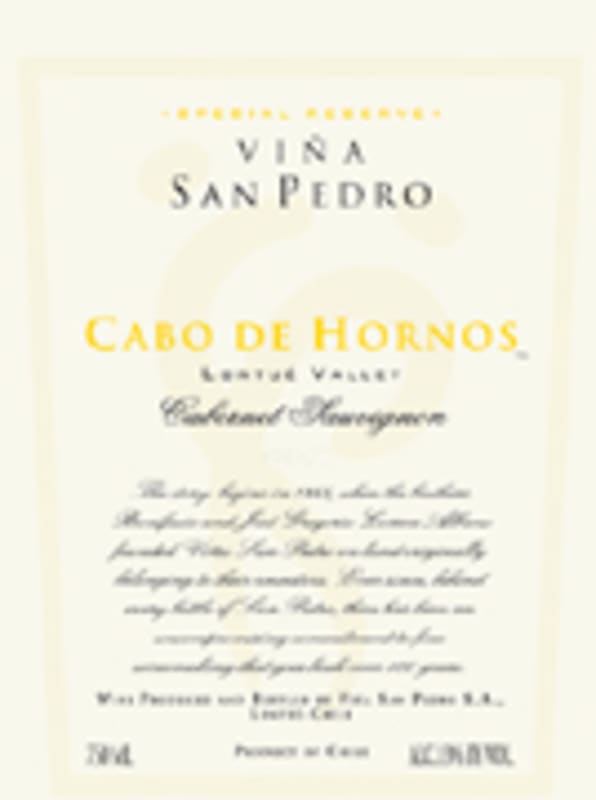

Winemaker Notes
Colour: this wine presents an intense colour that is concentrated and dark, anticipating part of the aroma and flavour to come.
Aroma: intense, ripe, spices blended with oak, coffee, and black fruit.
Palate: well-bodied, good, concentration, the tannins make their presence known but keep in harmony with the rest of the components. This is a long wine, very expressive, but serious. This is an elegant classic Cabernet. Suitable for 5 to 8 years of further aging.
"Harvested from dry farmed vines 50 years old or more, aged in French oak barrels for 18 months, then in bottle for a year before release, this wine gets coddled from start to finish. 'Smells lovely, with cedar, tea and cassis mingling effortlessly on the nose. In the mouth, it's bigger and fleshier than the '99 or '00, with a long finish filled with sweet fruit."
-Wine Enthusiast
Professional Ratings
-
Robert Parker's Wine Advocate
The 2001 Cabo de Hornos Cabernet Sauvignon was still sourced from Curicó and has a classical profile. At this time, there was an idea in Chile that all even vintages were good and that odd vintages were weak. So, 2001 was one of those forgotten vintages sandwiched between two "famous" years, 2000 and 2002. This is subtle and elegant, with that note of curry that I found in the previous years. Classical, polished and elegant, a delicious Cabernet with very good balance.


A noble variety bestowed with both power and concentration, Cabernet Sauvignon enjoys success all over the globe, its best examples showing potential to age beautifully for decades. Cabernet Sauvignon flourishes in Bordeaux's Medoc where it is often blended with Merlot and smaller amounts of some combination of Cabernet Franc, Malbecand Petit Verdot. In the Napa Valley, ‘Cab’ is responsible for some of the world’s most prestigious, age-worthy and sought-after “cult” wines. Somm Secret—DNA profiling in 1997 revealed that Cabernet Sauvignon was born from a spontaneous crossing of Cabernet Franc and Sauvignon Blanc in 17th century southwest France.

Dramatic geographic and climatic changes from west to east make Chile an exciting frontier for wines of all styles. Chile’s entire western border is Pacific coastline, its center is composed of warm valleys and on its eastern border, are the soaring Andes Mountains.
Chile’s central valleys, sheltered by the costal ranges, and in some parts climbing the eastern slopes of the Andes, remain relatively warm and dry. The conditions are ideal for producing concentrated, full-bodied, aromatic reds rich in black and red fruits. The eponymous Aconcagua Valley—hot and dry—is home to intense red wines made from Cabernet Sauvignon, Syrah and Merlot.
The Maipo, Rapel, Curicó and Maule Valleys specialize in Cabernet and Bordeaux Blends as well as Carmenère, Chile’s unofficial signature grape.
Chilly breezes from the Antarctic Humboldt Current allow the coastal regions of Casablanca Valley and San Antonio Valley to focus on the cool climate loving varieties, Pinot Noir, Chardonnay and Sauvignon Blanc.
Chile’s Coquimbo region in the far north, containing the Elqui and Limari Valleys, historically focused solely on Pisco production. But here the minimal rainfall, intense sunlight and chilly ocean breezes allow success with Chardonnay and Pinot Noir. The up-and-coming southern regions of Bio Bio and Itata in the south make excellent Riesling, Chardonnay and Pinot Noir.
Spanish settlers, Juan Jufre and Diego Garcia de Cáceres, most likely brought Vitis vinifera (Europe’s wine producing vine species) to the Central Valley of Chile sometime in the 1550s. One fun fact about Chile is that its natural geographical borders have allowed it to avoid phylloxera and as a result, vines are often planted on their own rootstock rather than grafted.