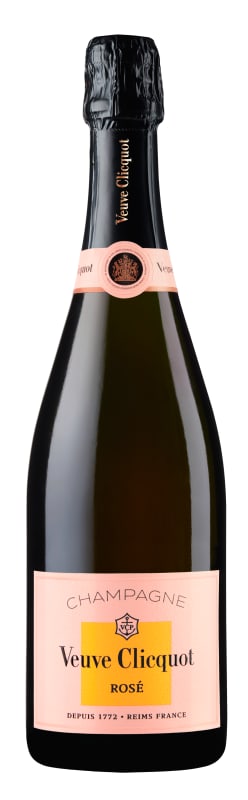


Winemaker Notes
This non-vintage Rose is the end result of a desire to create a Rose champagne with a delightfully luscious, fruit-based charm. Jacques Peters, the cellarmaster, and his team wanted a champagne that would be accessible and naturally engaging while conserving Veuve Clicquot's essential values in terms of style.
The wine has a luminous color with attractive pink glints. The nose is generous and elegant, with initial aromas of fresh red fruit (raspberry, wild strawberry, cherry, blackberry), leading to biscuity notes of dried fruits and Viennese pastries (almonds, apricots and brioche).
The fresh attack is followed by a fruity harmonious sensation on the palate. The wine is perfectly balanced in the best Veuve Clicquot style of pink champagnes, combining elegance and flair. The wine works its magic—this delectably full champagne can be enjoyed as a true delicacy. A deliciously fruity wine in earlybloom, this is a wonderful aperitif to be shared as a twosome or simply with friends.
Made using 50 to 60 different crus, the cuvee is based on Brut Yellow Label's traditional blend: 50 to 55% Pinot Noir, 15 to 20% Pinot Meunier, and 28 to 33% Chardonnay.
Professional Ratings
-
Tasting Panel
From its marked minerally streak to its soupçon of woodsy spice, this flamingo-hued beauty primarily Pinot Noir with Chardonnay and Meunier is seriously sensuous. Sanguine, saturated notes of cherry, pomegranate, and biscuit merge with savory blood orange and pink grapefruit on the palate, whose suede texture hardly negates the depth and structure derived in part from the addition of about 12% red wine.
-
Decanter
The nose features truffle, gunpowder, dried berries and grapefruit bitters, while the palate reveals redcurrants, wild berries, orange peel and red flowers. Good texture, vibrant acidity, a velvety mousse and a savoury finish.
-
James Suckling
Raspberries, nutmeg and cherry pits on the nose of this fruity rosé Champagne. It’s medium-bodied with rounded bubbles and a balanced, red-fruited finish.
-
Wine & Spirits
This pale-pink Champagne is luscious with impressive clarity to its red-fruit and orange notes, as well as a vinous character that brings to mind rosehip tea. It has the freshness of a spring rain, an austere but immediate pleasure.
-
Wine Spectator
A bright rosé Champagne that shows good cut and integration, with flavors of pink grapefruit sorbet, ripe white raspberry, toasted brioche and oyster shell riding the finely textured mousse. Minerally. Pinot Noir, Chardonnay and Pinot Meunier.
-
Jeb Dunnuck
The NV Champagne Brut Rosé is made with 50% Pinot Noir, 30% Chardonnay, and the remainder Meunier, featuring 12% red wine in the blend, which undergoes maceration. It’s made with 8 grams per liter dosage and aged on the lees for 3 years sur latte before release. A rich pink hue, it’s elegant and fruity, and I rather appreciate the restraint they have with the bottle; it’s not overly jammy, it has a refreshing, clean feel on the palate, with a creamy mousse, notes of preserved strawberries, grenadine, some zesty orange peel, and a clean, chalky texture. It’s delightful now as an aperitif. On paper, I was honestly expecting this to appear sweeter than it is, but it retains a nice level of crispiness.







Learn about Veuve Clicquot, the history of the brand, its innovative winemaking techniques, and its signature Veuve Clicquot Yellow Label Brut Champagne.
History of Veuve Clicquot
Veuve Clicquot, now one of the largest Champagne Houses, was founded in 1772 by Philippe Clicquot under the label "Clicquot". After establishing the brand throughout Europe, Russia and the United States, Philippe was joined by his son, François Clicquot, at the head of the House in 1798. Seven years later, following his untimely death, François' young widow, Barbe Ponsardin, took over the family business at just 27 years old. The House would subsequently be renamed in her honor: 'Veuve Clicquot' means 'The Widow Clicquot.'
Innovating Champagne Production
Over the course of her lifetime, Madame Clicquot (Barbe Ponsardin), developed three of the most important innovations in Champagne that are still practiced today. First, in 1810 Veuve Clicquot produced the first vintage wine in Champagne, which otherwise produced non-vintage blends. Second, in 1816 Madame Clicquot invented the riddling table to clarify Veuve Clicquot champagne, and by doing so, she improved both the quality and finesse of the wines. Riddling is now fundamental to 'La Methode Traditionelle' (the traditional Champagne production method) and is emulated around the world. Finally, in 1818 Madame Clicquot created the first rose champagne made through 'assemblage,' a method where white wines are blended with red wines.
Veuve Clicquot Yellow Label Brut
The distinctive, 90+ rated, Veuve Clicquot Yellow Label Brut has been in production since 1877. It is distinguished by the dominance of Pinot Noir in its blend, which gives strength, complexity and elegance to the champagne.
Veuve Clicquot La Grande Dame
The name La Grande Dame has been inspired by Madame Clicquot's nickname: La Grande Dame de la Champagne. 1972, the year Veuve Clicquot launched its first prestige cuvée to celebrate the bicentenary of the House. La Grande Dame respects Madame Clicquot's vision of Pinot Noir, which is about 90% since 2008, using mostly historical Grands Crus from their terroir.
Veuve Clicquot Pronunciation
vœv kliko / vuhv klee-koh
100% of Veuve Clicquot vineyards use sustainable viticulture.

What are the different types of sparkling rosé wine?
Rosé sparkling wines like Champagne, Prosecco, Cava, and others make a fun and festive alternative to regular bubbles—but don’t snub these as not as important as their clear counterparts. Rosé Champagnes (i.e., those coming from the Champagne region of France) are made in the same basic way as regular Champagne, from the same grapes and the same region. Most other regions where sparkling wine is produced, and where red grape varieties also grow, also make a rosé version.
How is sparkling rosé wine made?
There are two main methods to make rosé sparkling wine. Typically, either white wine is blended with red wine to make a rosé base wine, or only red grapes are used but spend a short period of time on their skins (maceration) to make rosé colored juice before pressing and fermentation. In either case the base wine goes through a second fermentation (the one that makes the bubbles) through any of the various sparkling wine making methods.
What gives rosé Champagne and sparkling wine their color and bubbles?
The bubbles in sparkling wine are formed when the base wine undergoes a secondary fermentation, which traps carbon dioxide inside the bottle or fermentation vessel. During this stage, the yeast cells can absorb some of the wine’s color but for the most part, the pink hue remains.
How do you serve rosé sparkling wine?
Treat rosé sparkling wine as you would treat any Champagne, Prosecco, Cava, and other sparkling wine of comparable quality. For storing in any long-term sense, these should be kept at cellar temperature, about 55F. For serving, cool to about 40F to 50F. As for drinking, the best glasses have a stem and a flute or tulip shape to allow the bead (bubbles) and beautiful rosé hue to show.
How long do rosé Champagne and sparkling wine last?
Most rosé versions of Prosecco, Champagne, Cava or others around the “$20 and under” price point are intended for early consumption. Those made using the traditional method with extended cellar time before release (e.g., Champagne or Crémant) can typically improve with age. If you are unsure, definitely consult our Customer Care team for guidance.

Associated with luxury, celebration, and romance, the region, Champagne, is home to the world’s most prized sparkling wine. In order to bear the label, ‘Champagne’, a sparkling wine must originate from this northeastern region of France—called Champagne—and adhere to strict quality standards. Made up of the three towns Reims, Épernay, and Aÿ, it was here that the traditional method of sparkling wine production was both invented and perfected, birthing a winemaking technique as well as a flavor profile that is now emulated worldwide.
Well-drained, limestone and chalky soil defines much of the region, which lend a mineral component to its wines. Champagne’s cold, continental climate promotes ample acidity in its grapes but weather differences from year to year can create significant variation between vintages. While vintage Champagnes are produced in exceptional years, non-vintage cuvées are produced annually from a blend of several years in order to produce Champagnes that maintain a consistent house style.
With nearly negligible exceptions, . These can be blended together or bottled as individual varietal Champagnes, depending on the final style of wine desired. Chardonnay, the only white variety, contributes freshness, elegance, lively acidity and notes of citrus, orchard fruit and white flowers. Pinot Noir and its relative Pinot Meunier, provide the backbone to many blends, adding structure, body and supple red fruit flavors. Wines with a large proportion of Pinot Meunier will be ready to drink earlier, while Pinot Noir contributes to longevity. Whether it is white or rosé, most Champagne is made from a blend of red and white grapes—and uniquely, rosé is often produce by blending together red and white wine. A Champagne made exclusively from Chardonnay will be labeled as ‘blanc de blancs,’ while ones comprised of only red grapes are called ‘blanc de noirs.’