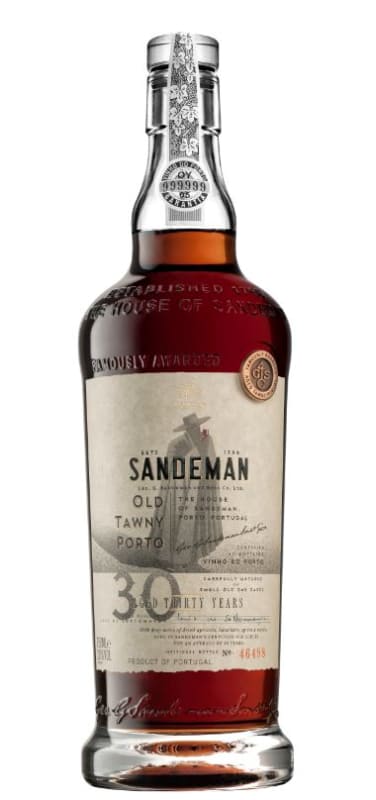


Winemaker Notes
Old gold amber colors with the intense aromas of honey and spices, underscored with deep flavors of dried apricots, hazelnuts and vanilla, creating a rich yet elegant combination.
Professional Ratings
-
Decanter
Though the final blend comprises 25- to 40-year-old wines, with its reddish-orange topaz hue, freshness and fruit intensity, this is a relatively youthful-seeming 30-year-old. Caramelized oranges, dried apricot and fig take center stage, with hints of café crème and toasted hazelnuts. Slinky, its gentle barley-sugar sweetness is cut with elegant acidity, making for a clean, controlled finish;
-
James Suckling
Candied cherries and light caramel with honey and brown sugar on the nose. Dense and rich with plenty of mahogany and nutty undertones to the very sweet palate. Shows lots of age. Sort of dusty and aged, like old furniture in England. Drink now.
-
Robert Parker's Wine Advocate
The NV 30 Years Old Tawny Porto is a typical Douro blend. It was bottled in August 2022 with a Vinolok stopper and 121 grams per liter of residual sugar. Complex and darker in flavors, yet still lively and fresh, this elegant 30 Year first shows its age when it coats the palate and proves how concentrated it is. It is remarkably delicious too, with the dark chocolate and caramel-laced fruit slammed into the palate. The melted chocolate of the 20 Year leans more to dark chocolate here, but it never goes too far in the direction of bitter. If it often seems mature, it never seems old. It's always enlivening, and the structure might be even better that the fine flavor profile. It acquires a tightly wound feel and some power on the juicy, mouthwatering finish. This is a fine success. Best after 2022.
-
Wine Enthusiast
This is a beautifully concentrated wine. Rich and dense, it offers dried fruits, spice and intensity. The wine’s spirit edge acts as a lift, bringing out acidity, honey, walnuts and a complex perfumed aftertaste. Drink now
-
Wine Spectator
Pretty, with bergamot, date, fig and caramelized peach flavors gliding through, framed by a caramel note that lingers on the polished finish. This gains intensity as it opens in the glass. Lovely. Drink now.
-
Wine & Spirits
This wine had W&S associate editor David Paradela imagining himself on a velvet couch in an old library. Maybe it has the comforting complexity of being surrounded by all the ideas in old books. At your dinner table, it may bring to mind dried cherries and apricots, along with the warmth of toasted almond in their tawny skins.


Port is a sweet, fortified wine with numerous styles: Ruby, Tawny, Vintage, Late Bottled Vintage (LBV), White, Colheita, and a few unusual others. It is blended from from the most important red grapes of the Douro Valley, based primarily on Touriga Nacional with over 80 other varieties approved for use. Most Ports are best served slightly chilled at around 55-65°F. To learn more, see our full Port Wine Guide

The home of Port—perhaps the most internationally acclaimed beverage—the Douro region of Portugal is one of the world’s oldest delimited wine regions, established in 1756. The vineyards of the Douro, set on the slopes surrounding the Douro River (known as the Duero in Spain), are incredibly steep, necessitating the use of terracing and thus, manual vineyard management as well as harvesting. The Douro's best sites, rare outcroppings of Cambrian schist, are reserved for vineyards that yield high quality Port.
While more than 100 indigenous varieties are approved for wine production in the Douro, there are five primary grapes that make up most Port and the region's excellent, though less known, red table wines. Touriga Nacional is the finest of these, prized for its deep color, tannins and floral aromatics. Tinta Roriz (Spain's Tempranillo) adds bright acidity and red fruit flavors. Touriga Franca shows great persistence of fruit and Tinta Barroca helps round out the blend with its supple texture. Tinta Cão, a fine but low-yielding variety, is now rarely planted but still highly valued for its ability to produce excellent, complex wines.
White wines, generally crisp, mineral-driven blends of Arinto, Viosinho, Gouveio, Malvasia Fina and an assortment of other rare but local varieties, are produced in small quantities but worth noting.
With hot summers and cool, wet winters, the Duoro has a maritime climate.