

Winemaker Notes
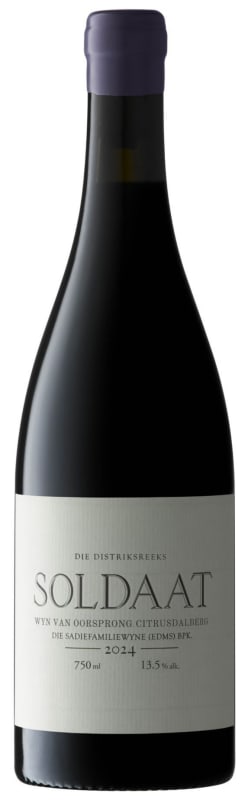
This 2024 Soldaat displays the usual red cherry, unripe strawberry, and pomegranate fruit aromas. The wine is incredibly transparent and pure in aroma. This year, there are shades of rose petals and perfumes. The palate is marked by softer tannins than usual, which meet sweet, grippy, powdery tannins with a long finish. The entire wine is an exhibition of elegance.
Professional Ratings
-
James Suckling
Sliced strawberries, pomegranates, rose hips, orange rind and wet stones on the nose of this supremely elegant, fragrant red. Sour cherries, too. It’s medium-bodied, very fresh and silky, with very fine tannins, seamless but present. Persistent and salty at the end. Great expression of grenache. Fermented and aged in concrete. Drink or hold.
-
Robert Parker's Wine Advocate
This is the first wine poured in The Sadie Family portfolio tasting. The 2024 Citrusdal Mountain Die Distriksreeks Soldaat shows an earthy yet perfumed expression of Grenache with sour cherry, pomegranate and blue floral lift carried by sweet but firm tannins. Nervy and finely structured, the wine balances high-radiation ripeness with remarkable freshness from its site at 750 meters in elevation. Planted on quartz sandstone and mudstone in the Citrusdal Mountains, Soldaat demonstrates vintner Eben Sadie’s pursuit of Grenache grown in sites that deliver light without excessive heat.


Grenache thrives in any warm, Mediterranean climate where ample sunlight allows its clusters to achieve full phenolic ripeness. While Grenache's birthplace is Spain (there called Garnacha), today it is more recognized as the key player in the red blends of the Southern Rhône, namely Châteauneuf-du-Pape, Côtes du Rhône and its villages. Somm Secret—The Italian island of Sardinia produces bold, rustic, single varietal Grenache (there called Cannonau). California, Washington and Australia have achieved found success with Grenache, both flying solo and in blends.

With an important wine renaissance in full swing, impressive red and white bargains abound in South Africa. The country has a particularly long and rich history with winemaking, especially considering its status as part of the “New World.” In the mid-17th century, the lusciously sweet dessert wines of Constantia were highly prized by the European aristocracy. Since then, the South African wine industry has experienced some setbacks due to the phylloxera infestation of the late 1800s and political difficulties throughout the following century.
Today, however, South Africa is increasingly responsible for high-demand, high-quality wines—a blessing to put the country back on the international wine map. Wine production is mainly situated around Cape Town, where the climate is generally warm to hot. But the Benguela Current from Antarctica provides brisk ocean breezes necessary for steady ripening of grapes. Similarly, cooler, high-elevation vineyard sites throughout South Africa offer similar, favorable growing conditions.
South Africa’s wine zones are divided into region, then smaller districts and finally wards, but the country’s wine styles are differentiated more by grape variety than by region. Pinotage, a cross between Pinot Noir and Cinsault, is the country’s “signature” grape, responsible for red-fruit-driven, spicy, earthy reds. When Pinotage is blended with other red varieties, like Cabernet Sauvignon, Merlot, Syrah or Pinot Noir (all commonly vinified alone as well), it is often labeled as a “Cape Blend.” Chenin Blanc (locally known as “Steen”) dominates white wine production, with Chardonnay and Sauvignon Blanc following close behind.