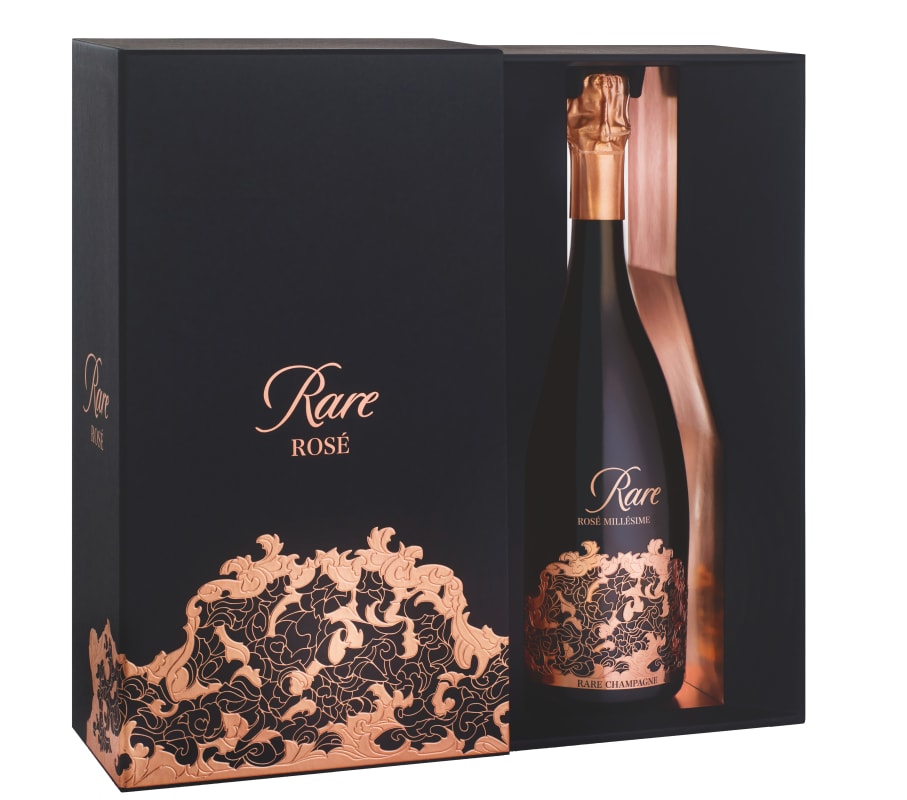


Winemaker Notes
Rare Rosé Millésime 2012 expertly balances three distinct families of sensations: floral, fruity and spiced. Combining aromas and freshness, this third vintage rosé from Rare Champagne adds a new dimension to the Maison's style.
The radiant color of Rare Rosé Millésime 2012, where rose petals meet chalcedony gemstone, is reminiscent of the rose quartz hue of the earlier Rare Rosé Millésime 2008. This harmony is part of Rare Champagne's signature style. There are also gentle hints of blue, which subtly enhance the elegant and joyful bubbles of the champagne.
The first aromas to reach the nose are a perfect balance of florals and fruit. The wine responds to the intensity of cherry blossom with the delicate, tart aromas of forest fruits and lychee. Then, notes of turmeric, ginger, white pepper and citrus begin to develop, and are enhanced by white peach and orange blossom. This is where the floral, fruity and spiced notes come together in perfect harmony.
On the palate, the first sensation is generous and expansive. Aromas of cherry, lychee and ginger intensify on the nose. Simultaneously, the structure of Rare Rosé Millésime 2012 strikes a balance between hot and cold: warm spices such as paprika, Espelette chili, turmeric and pepper give way to a cooling, mineral freshness. The finish, which combines attractive tannins and iodine notes, is the sign of a sophisticated wine with a vibrant salinity.
Blend: 60% Chardonnay, 40% Pinot Noir
Professional Ratings
-
James Suckling
Pale salmon-copper color with aromas of raspberries, fresh and dried cherries, rose-water, grapefruit, salted almonds, cloves and white pepper. Silky and vibrant, with very fine bubbles and bright acidity. Beautiful combination of fresh fruit and subtle spice. Lingering, salted yellow-plum notes on the long, elegant finish. Dry. 8% pinot noir red wine from Les Riceys, blended with 40% pinot noir and 60% chardonnay, from 12 different villages. 7g/l. Drink or hold.
-
Jeb Dunnuck
The 2012 Champagne Rare Rosé is a shimmering salmon hue and is elegant and restrained at the moment. It has a floral perfume of hibiscus, orange blossoms, white peach, and smoky incense. The palate is energetic and has more tension, with a fantastic chalky texture. It opens up with orchard fruits and honeycomb, and its floral notes linger long after the finish. Though it is a little shy now, this is an exciting release from the team at Piper-Heidsieck. Drink 2024-2044.
Rating: 96+ -
Wine Spectator
Offers aromas and flavors of ripe raspberry and nectarine, brioche and chopped almond, mandarin orange and ground coffee, graphite, star anise and verbena, which are a gorgeous panoply of expression from the fragrant nose through to the finely detailed finish. This vibrant rosé Champagne is well-honed and mouthwatering, wrapping the chiseled frame in a plushly creamy mousse. Chardonnay and Pinot Noir. Drink now through 2037.
-
Robert Parker's Wine Advocate
The 2012 Rare Rosé Millésime, disgorged in December 2021 with a dosage of seven grams per liter, has developed gracefully. It opens with aromas of candied orange, apricot, cranberry and iris, mingling with buttered toast and a hint of smoky reduction. On the palate, it is full-bodied, elegantly muscular and beautifully balanced, with a crisp fruit core, ripe yet racy acidity and a pillowy mousse, concluding with a long, sapid and delicately perfumed finish. Incorporating 8% red wine from Les Riceys, it is more complete and harmonious than the 2014 and is really just quite starting to show its cards.



What are the different types of sparkling rosé wine?
Rosé sparkling wines like Champagne, Prosecco, Cava, and others make a fun and festive alternative to regular bubbles—but don’t snub these as not as important as their clear counterparts. Rosé Champagnes (i.e., those coming from the Champagne region of France) are made in the same basic way as regular Champagne, from the same grapes and the same region. Most other regions where sparkling wine is produced, and where red grape varieties also grow, also make a rosé version.
How is sparkling rosé wine made?
There are two main methods to make rosé sparkling wine. Typically, either white wine is blended with red wine to make a rosé base wine, or only red grapes are used but spend a short period of time on their skins (maceration) to make rosé colored juice before pressing and fermentation. In either case the base wine goes through a second fermentation (the one that makes the bubbles) through any of the various sparkling wine making methods.
What gives rosé Champagne and sparkling wine their color and bubbles?
The bubbles in sparkling wine are formed when the base wine undergoes a secondary fermentation, which traps carbon dioxide inside the bottle or fermentation vessel. During this stage, the yeast cells can absorb some of the wine’s color but for the most part, the pink hue remains.
How do you serve rosé sparkling wine?
Treat rosé sparkling wine as you would treat any Champagne, Prosecco, Cava, and other sparkling wine of comparable quality. For storing in any long-term sense, these should be kept at cellar temperature, about 55F. For serving, cool to about 40F to 50F. As for drinking, the best glasses have a stem and a flute or tulip shape to allow the bead (bubbles) and beautiful rosé hue to show.
How long do rosé Champagne and sparkling wine last?
Most rosé versions of Prosecco, Champagne, Cava or others around the “$20 and under” price point are intended for early consumption. Those made using the traditional method with extended cellar time before release (e.g., Champagne or Crémant) can typically improve with age. If you are unsure, definitely consult our Customer Care team for guidance.

Associated with luxury, celebration, and romance, the region, Champagne, is home to the world’s most prized sparkling wine. In order to bear the label, ‘Champagne’, a sparkling wine must originate from this northeastern region of France—called Champagne—and adhere to strict quality standards. Made up of the three towns Reims, Épernay, and Aÿ, it was here that the traditional method of sparkling wine production was both invented and perfected, birthing a winemaking technique as well as a flavor profile that is now emulated worldwide.
Well-drained, limestone and chalky soil defines much of the region, which lend a mineral component to its wines. Champagne’s cold, continental climate promotes ample acidity in its grapes but weather differences from year to year can create significant variation between vintages. While vintage Champagnes are produced in exceptional years, non-vintage cuvées are produced annually from a blend of several years in order to produce Champagnes that maintain a consistent house style.
With nearly negligible exceptions, . These can be blended together or bottled as individual varietal Champagnes, depending on the final style of wine desired. Chardonnay, the only white variety, contributes freshness, elegance, lively acidity and notes of citrus, orchard fruit and white flowers. Pinot Noir and its relative Pinot Meunier, provide the backbone to many blends, adding structure, body and supple red fruit flavors. Wines with a large proportion of Pinot Meunier will be ready to drink earlier, while Pinot Noir contributes to longevity. Whether it is white or rosé, most Champagne is made from a blend of red and white grapes—and uniquely, rosé is often produce by blending together red and white wine. A Champagne made exclusively from Chardonnay will be labeled as ‘blanc de blancs,’ while ones comprised of only red grapes are called ‘blanc de noirs.’