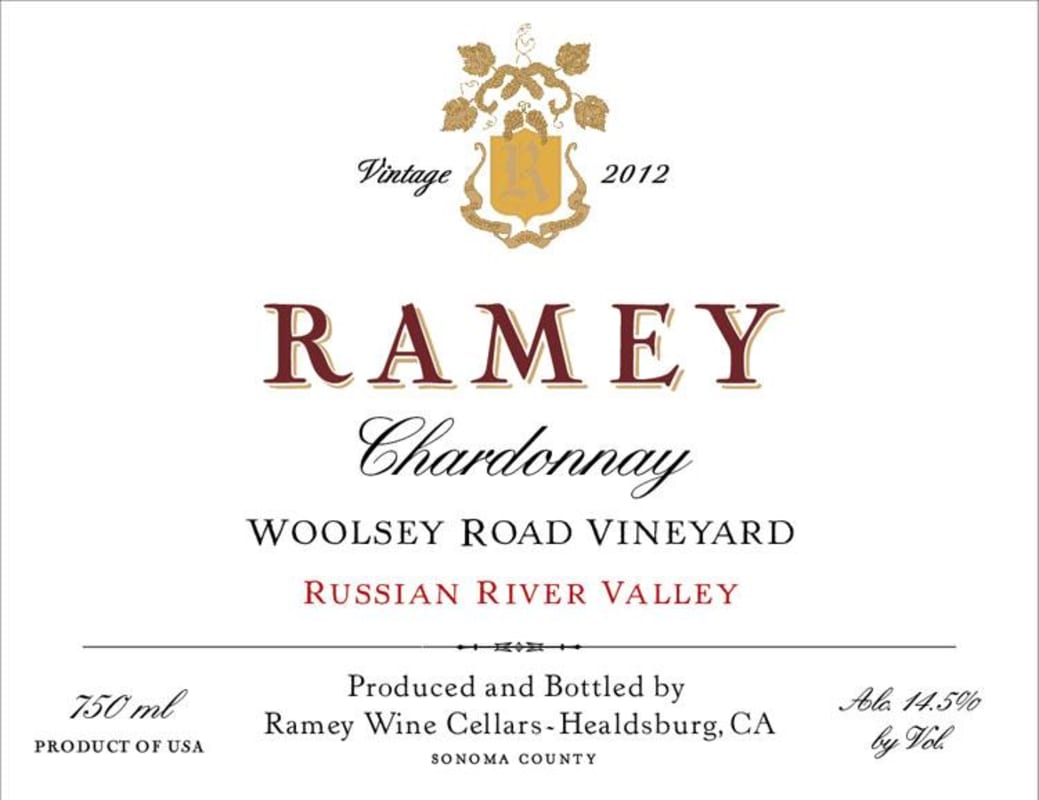

Winemaker Notes
Professional Ratings
-
Jeb Dunnuck
A library wine, the 2012 Chardonnay Woolsey Road Vineyard looks nearly identical to the current release in terms of its bright yellow color. It offers a pretty bouquet of melon, citrus blossoms, and refreshing wet stone, and it’s fantastic on the palate, with fresh acidity and a lovely floating feel on the finish. It’s just fabulous now and not showing any signs of long down. It’s gorgeous all the way through and has plenty more life ahead.




David Ramey is among a distinguished group of pioneering American vintners who revolutionized modern-day winemaking and elevated California to the forefront of the international wine community. Hailed as “Professor Chardonnay” by Wine Spectator, David's groundbreaking work with indigenous yeasts, sur lies aging and malolactic and barrel fermentation yielded a new California Chardonnay style that was richer, more lush and silky smooth. Ramey Wine Cellars crafts exceptional expressions of Chardonnay, Cabernet Sauvignon, Syrah, and Pinot Noir from top vineyards in Sonoma and Napa.
After earning a graduate degree at UC Davis, with his thesis on how aromas evolve in wine, David Ramey pursued a hands-on education in Old World winemaking traditions. He worked at Chateau Pétrus and would later apply these time-honored methods to California’s premier vineyards. In California, David led winemaking for Matanzas Creek, Chalk Hill, Dominus Estate and Rudd Estate. In 1996, David and his wife Carla founded Ramey Wine Cellars with the vision of crafting classically styled, elegant and balanced wines that age beautifully.
Still exclusively owned by the Rameys, the next generation, Claire and Alan Ramey, became co-presidents of the winery in 2021. Claire and Alan began working at the winery in 2013 and have been cross-trained in all aspects of winery operations. Decanter greeted the news of Ramey’s status as a multigenerational winery by saying: "its reputation as a touchstone for world-class Chardonnay remains firmly in place… The Ramey family is expected to go from strength to strength." The vision is unwavering: to make classic wines from Sonoma and Napa that belong amongst the world's best. Tastings are offered by appointment in Healdsburg.

One of the most popular and versatile white wine grapes, Chardonnay offers a wide range of flavors and styles depending on where it is grown and how it is made. While it tends to flourish in most environments, Chardonnay from its Burgundian homeland produces some of the most remarkable and longest lived examples. California produces both oaky, buttery styles and leaner, European-inspired wines. Somm Secret—The Burgundian subregion of Chablis, while typically using older oak barrels, produces a bright style similar to the unoaked style. Anyone who doesn't like oaky Chardonnay would likely enjoy Chablis.

A standout region for its decidedly Californian take on Burgundian varieties, the Russian River Valley is named for the eponymous river that flows through it. While there are warm pockets of the AVA, it is mostly a cool-climate growing region thanks to breezes and fog from the nearby Pacific Ocean.
Chardonnay and Pinot Noir reign supreme in Russian River, with the best examples demonstrating a unique combination of richness and restraint. The cool weather makes Russian River an ideal AVA for sparkling wine production, utilizing the aforementioned varieties. Zinfandel also performs exceptionally well here. Within the Russian River Valley lie the smaller appellations of Chalk Hill and Green Valley. The former, farther from the ocean, is relatively warm, with a focus on red and white Bordeaux varieties. The latter is the coolest, foggiest parcel of the Russian River Valley and is responsible for outstanding Pinot Noir and Chardonnay.