
Winemaker Notes
Professional Ratings
-
Wine Spectator
This sports serious heft, with a core of brooding fig jam, ganache, Christmas pudding and pastis-soaked black currant notes, followed by a powerhouse finish of smoldering charcoal and tar. The feel is remarkably velvety and rounded overall, with a mouthwatering licorice root element adding to the already considerable length. Best from 2026 through 2056.
-
Wine Enthusiast
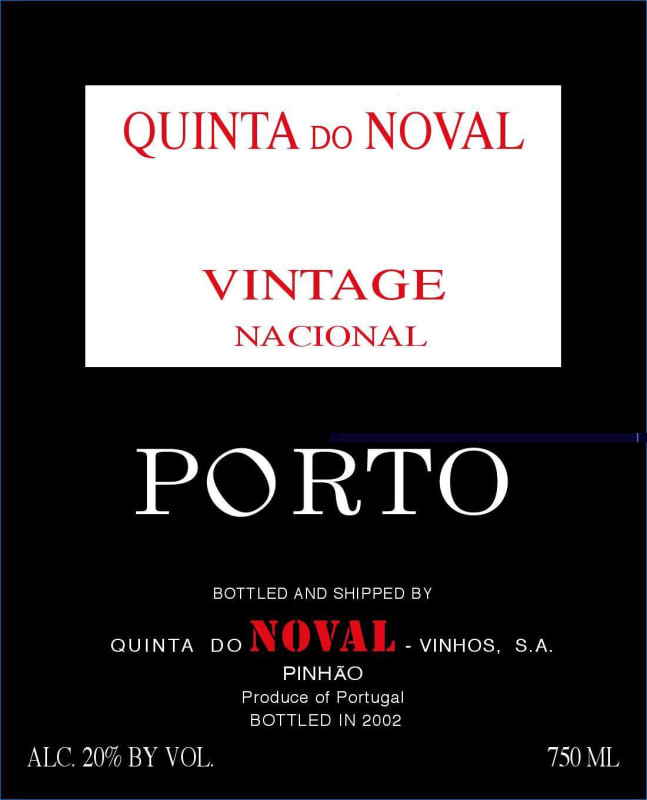
Nacional Vintage Port comes from a small parcel of ungrafted vines on a series of terraces at the Noval estate. It is a legendary wine, produced only occasionally. This wine is still impressively young and shows that it will age for decades. With its dark black fruits and succulent tannins, it is powerful and concentrated. Drink this wine from 2021 and for many years.
Cellar Selection -
Jeb Dunnuck
I loved the 2001 Nacional, which is just singing right now. Possessing a huge nose of roasted herbs, black olives, licorice, coffee grinds, and sandalwood, it hits the palate with a full-bodied, concentrated, incredibly layered texture that stays lively, balanced and clean. This heady, ripe, sensationally complex Port should continue to stay on this plateau of maturity for another 2-3 decades.
-
Robert Parker's Wine Advocate
The 2001 Vintage Port Nacional is a typical blend, mostly Touriga Franca, Touriga Nacional, Tinta Cão, Sousão and Tinta Roriz. Aged for 20 months in old barrels in Douro, it comes in with 19.3% alcohol and 76.8 grams per liter of residual sugar. This is a late release, declared in 2003 but just now about to hit the market. Christian Seely said: "[T]he 2001 was extremely backward and quite closed up, dense and very tannic. Since we had just declared and released the 2000 Nacional, we decided to lay down the 250 cases of Nacional 2001 ..." The late release has certainly tamed this. It still feels very firm and has a real backbone, but it is not overly drying and it is a lot more approachable than newly-released Nacionals can be. By day three, though, it was showing a bit more pure power and complexity--and it seemed far better.
-
James Suckling
Tight and linear vintage Port with ripe berries, almonds, chocolate and hints of spices. Medium to full body, racy tannins and a long, flavorful finish. Very beautiful now.


Port is a sweet, fortified wine with numerous styles: Ruby, Tawny, Vintage, Late Bottled Vintage (LBV), White, Colheita, and a few unusual others. It is blended from from the most important red grapes of the Douro Valley, based primarily on Touriga Nacional with over 80 other varieties approved for use. Most Ports are best served slightly chilled at around 55-65°F. To learn more, see our full Port Wine Guide

The home of Port—perhaps the most internationally acclaimed beverage—the Douro region of Portugal is one of the world’s oldest delimited wine regions, established in 1756. The vineyards of the Douro, set on the slopes surrounding the Douro River (known as the Duero in Spain), are incredibly steep, necessitating the use of terracing and thus, manual vineyard management as well as harvesting. The Douro's best sites, rare outcroppings of Cambrian schist, are reserved for vineyards that yield high quality Port.
While more than 100 indigenous varieties are approved for wine production in the Douro, there are five primary grapes that make up most Port and the region's excellent, though less known, red table wines. Touriga Nacional is the finest of these, prized for its deep color, tannins and floral aromatics. Tinta Roriz (Spain's Tempranillo) adds bright acidity and red fruit flavors. Touriga Franca shows great persistence of fruit and Tinta Barroca helps round out the blend with its supple texture. Tinta Cão, a fine but low-yielding variety, is now rarely planted but still highly valued for its ability to produce excellent, complex wines.
White wines, generally crisp, mineral-driven blends of Arinto, Viosinho, Gouveio, Malvasia Fina and an assortment of other rare but local varieties, are produced in small quantities but worth noting.
With hot summers and cool, wet winters, the Duoro has a maritime climate.