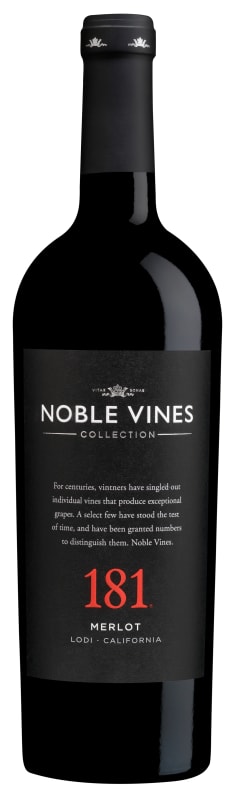


Winemaker Notes
Behind these red numbers is a noble legacy. Prized by Kings and Queens for centuries, certain noble vine stocks have proven their excellence over time. Noble Vines takes the best of these vine stocks-identified today by number-and cultivates them in California. Merlot 181 vine stock originated at the great chateaus of Bordeaux, France. With its luxurious black cherry and vanilla flavors and smooth tannins, Noble Vines Merlot 181 displays the traits that earned the 181 stock its noble reputation.
This complex red stands up ably to rich roasts, and is just as delicious with cheesy pastas, barbecued ribs and moo shu pork.


With generous fruit and supple tannins, Merlot is made in a range of styles from everyday-drinking to world-renowned and age-worthy. Merlot is the dominant variety in the wines from Bordeaux’s Right Bank regions of St. Emilion and Pomerol, where it is often blended with Cabernet Franc to spectacular result. Merlot also frequently shines on its own, particularly in California’s Napa Valley. Somm Secret—As much as Miles derided the variety in the 2004 film, Sideways, his prized 1961 Château Cheval Blanc is actually a blend of Merlot and Cabernet Franc.

Positioned between the San Francisco Bay and the Sierra Nevada mountain range, the Lodi appellation, while relatively far inland, is able to maintain a classic Mediterranean climate featuring warm, sunny days and cool evenings. This is because the appellation is uniquely situated at the end of the Sacramento River Delta, which brings chilly, afternoon “delta breezes” to the area during the growing season.
Lodi is a premier source of 100+ year old ancient Zinfandel vineyards—some dating back as far as 1888! With low yields of small berries, these heritage vines produce complex and bold wines, concentrated in rich and voluptuous, dark fruit.
But Lodi doesn’t just produce Zinfandel; in fact, the appellation produces high quality wines from over 100 different grape varieties. Among them are Cabernet Sauvignon, Merlot, Chardonnay and Sauvignon blanc as well as some of California's more rare and unique grapes. Lodi is recognized as an ideal spot for growing Spanish varieties like Albarino and Tempranillo, Portugese varieties—namely Touriga Nacional—as well as many German, Italian and French varieties.
Soil types vary widely among Lodi’s seven sub-appellations (Cosumnes River, Alta Mesa, Deer Creek Hills, Borden Ranch, Jahant, Clements Hills and Mokelumne River). The eastern hills are clay-based and rocky and in the west, along the Mokelumne and Cosumnes Rivers, sandy and mineral-heavy soils support the majority of Lodi’s century-old own-rooted Zinfandel vineyards. Unique to Lodi are pink Rocklin-Jahant loam soils, mainly found in the Jahant sub-appellation.