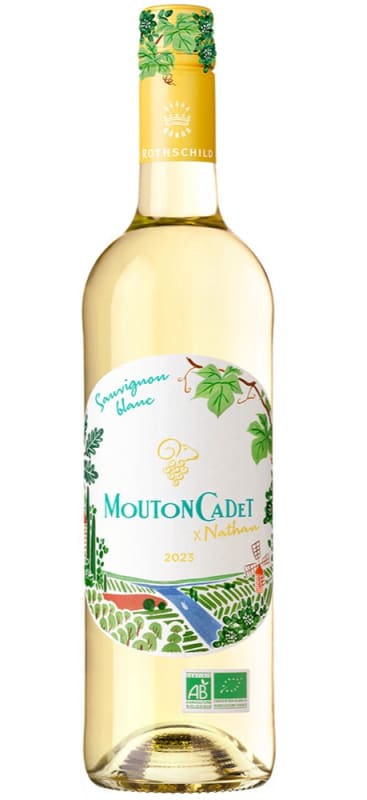


Winemaker Notes
Golden in color, with a slight ivory hue. The nose opens on citrus aromas, especially lemon and grapefruit, then with airing develops hawthorn and jasmine notes as well as a touch of fresh apricot. From a fresh attack on Kaffir lime flavors with a hint of aniseed, the mid-palate expresses the elegance of the floral notes found on the nose, leading into a finish that lingers on hints of licorice.
A wine to be drunk chilled, it is ideal for aperitifs with friends and family and will go very well with Galician-style octopus, artichoke hearts with fleur de sel sea salt or vegetable tartare.
Vegan-Friendly
Professional Ratings
-
Decanter
Lovely nose with aromas of almond blossom, linden tree, fresh cut red apple and pure lemon. Attractive richness, well-defined finish.
-
Wine Enthusiast
Named after one of the current younger generation of Rothschilds, this crisply bright wine is finely textured. An aroma of green citrus highlights the wine's fruity pink-grapefruit acidity and fresh aftertaste.Best Buy



In 1930, Baron Philippe de Rothschild created Mouton Cadet with the aim of bringing Bordeaux wine to a wide audience. His two ambitions were to ensure constant quality and to promote the Bordeaux vineyard. Now Philippe Sereys de Rothschild, with his sister Camille Sereys de Rothschild and his brother Julien de Beaumarchais de Rothschild, are guiding Mouton Cadet into a new era. Since 2014, they have placed people and the earth at the center of the process of making Mouton Cadet.
Breaking new ground ever since its creation in 1930, Mouton Cadet aims to offer everyone good and beautiful things while respecting the future. Mouton Cadet embodies the perfect combination of tradition and innovation, with an unfailing commitment to quality, authenticity and terroir: strong values shared with a community of 150 winegrowers committed to the same pursuit of continuous improvement for increasingly sustainable winegrowing.
Mouton Cadet is first and foremost about people, a community that works hand in hand so that each wine is a reflection of the quest for excellence and sustainability. For this collection, Mouton Cadet highlights the wines of the grandchildren of Baron Philippe de Rothschild with their own unique wines - by Mathilde Rose by Nathan Sauvignon Blanc, and by Pierre rouge. Bordeaux wines easy to drink, lively and ecological, inspired by southwest lifestyle, they symbolize both transmission and ecological transition.

Capable of a vast array of styles, Sauvignon Blanc is a crisp, refreshing variety that equally reflects both terroir and varietal character. Though it can vary depending on where it is grown, a couple of commonalities always exist—namely, zesty acidity and intense aromatics. This variety is of French provenance. Somm Secret—Along with Cabernet Franc, Sauvignon Blanc is a proud parent of Cabernet Sauvignon. That green bell pepper aroma that all three varieties share is no coincidence—it comes from a high concentration of pyrazines (herbaceous aromatic compounds) inherent to each member of the family.

One of the most important wine regions of the world, Bordeaux is a powerhouse producer of wines of all colors, sweetness levels, and price points. Separated from the Atlantic Ocean by a coastal pine forest, this relatively flat region has a mild maritime climate, marked by cool wet winters and warm summers. Annual weather differences create significant vintage variations, making Bordeaux an exciting French wine region to follow.
The Gironde estuary, a defining feature of Bordeaux, separates most of the region into the Left Bank and the Right Bank. Farther inland, where the Gironde splits into the Garonne and Dordogne Rivers, the bucolic, rolling hills of the area in between, called Entre-Deux-Mers, is a source of great quality, approachable reds and whites.
The Left Bank, dominated by Cabernet Sauvignon, contains the Médoc, Graves, and Sauternes, as well as the region’s most famous chateaux. Merlot is important here as the perfect blending grape for Cabernet Sauvignon adding plush fruit and softening Cabernet's sometimes hefty tannins. Cabernet Franc, Petit Verdot and Malbec may also be used in the Left Bank Bordeaux wine blends.
Merlot is the principal Bordeaux wine variety of the Right Bank; Cabernet Franc adds structure and complexity to Merlot, creating wines that are concentrated, supple, and more imminently ready for drinking, compared with their Left Bank counterparts. Key appellations of the Right Bank include St. Emilion and Pomerol.
Dry and sweet Bordeaux white wines are produced throughout the region from Sauvignon Blanc, Sémillon, and sometimes Muscadelle or Sauvignon Gris. Some of the finest dry whites can be found in the Graves sub-appellation of Pessac-Léognan, while Sauternes is undisputedly the gold standard for sweet wines. Small amounts of rosé and sparkling Bordeaux wines are made in the region as well.