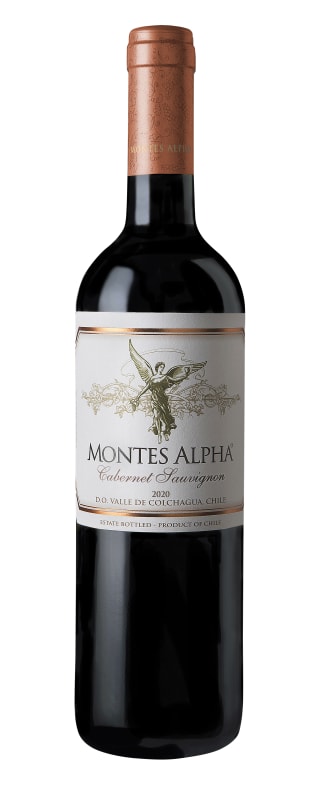


Winemaker Notes
Deep, ruby-red in color. The nose is complex, with ripe red and black fruit, including strawberry, prune, and blueberry. There are also well-balanced notes of tobacco, leather, and toast, thanks to the 12 months of barrel ageing. These are followed by dairy notes of dulce de leche and toffee. The tannins are silky on the palate, with great body and elegance. With medium balance and a long finish, the wine’s palate repeats the aromas perceived on the nose.
Blend: 90% Cabernet Sauvignon, 10% Merlot
Professional Ratings
-
Vinous
The 2020 Cabernet Sauvignon Alpha is also 10% Syrah and 5% Carménère from Marchigüe, Colchagua, and was aged for 14 months in one-third new barrels. Dark garnet red in hue. The ripe nose ranges from blackberry to cassis with hints of spice and faint balsamic notes. In the mouth, this has a full body, reactive, grippy tannins, and good juice and structure. Very much reflecting the character of the variety right now; it might be best to put it aside for a while.
-
James Suckling
Olives and fresh blackcurrants with nice twists of bay leaf and dark chocolate. This is a medium-bodied cabernet sauvignon with crunchy red and black cherries and tight but silky tannins. More red fruit here. 10% merlot in the blend.
-
Wine Enthusiast
After 12 months in oak barrels, wood notes are well integrated in this red. It has a fruit-forward nose of berries blended with licorice, eucalyptus and peppercorn. The palate delivers smoke and juicy black fruits over a chalky texture and bright acidity. A dash of bay leaf complements the flavors. This wine is medium bodied and has slightly drying tannins, but it’s very approachable.


A noble variety bestowed with both power and concentration, Cabernet Sauvignon enjoys success all over the globe, its best examples showing potential to age beautifully for decades. Cabernet Sauvignon flourishes in Bordeaux's Medoc where it is often blended with Merlot and smaller amounts of some combination of Cabernet Franc, Malbecand Petit Verdot. In the Napa Valley, ‘Cab’ is responsible for some of the world’s most prestigious, age-worthy and sought-after “cult” wines. Somm Secret—DNA profiling in 1997 revealed that Cabernet Sauvignon was born from a spontaneous crossing of Cabernet Franc and Sauvignon Blanc in 17th century southwest France.

Well-regarded for intense and exceptionally high quality red wines, the Colchagua Valley is situated in the southern part of Chile’s Rapel Valley, with many of the best vineyards lying in the foothills of the Coastal Range.
Heavy French investment and cutting-edge technology in both the vineyard and the winery has been a boon to the local viticultural industry, which already laid claim to ancient vines and a textbook Mediterranean climate.
The warm, dry growing season in the Colchagua Valley favors robust reds made from Cabernet Sauvignon, Carmenère, Malbec and Syrah—in fact, some of Chile’s very best are made here. A small amount of good white wine is produced from Chardonnay and Sauvignon Blanc.