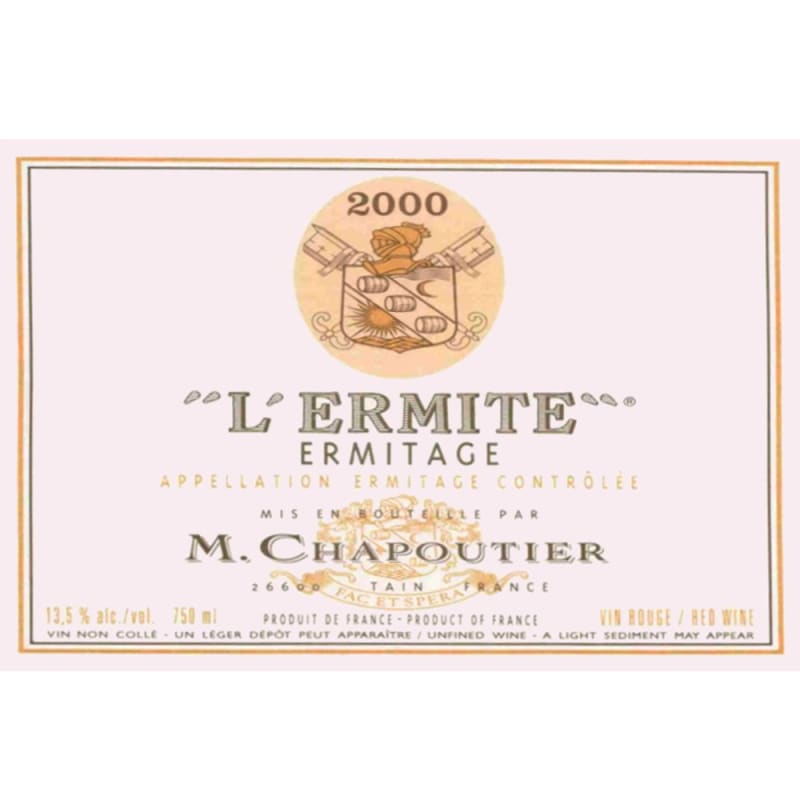

Winemaker Notes
Professional Ratings
-
Robert Parker's Wine Advocate
I grossly underestimated the 2000 Ermitage l’Ermite from barrel. This wine, which emerges from largely pre-phylloxera vines planted on the dome of Hermitage, adjacent to the chapel that is perched there so photogenically, possesses extraordinary finesse and elegance. It reveals notes of liquid minerals intermixed with kirsch liqueur and blackberries. While it never possesses the power and breadth of flavor of Le Meal or Le Pavillon, l’Ermite appears to be a hypothetical blend of Bordeaux’s Lafleur and Ausone as it always displays a certain austerity early in life. The extraordinary 2000 flirts with perfection. A provocative wine with great minerality, finesse, and delineation, it blew me away when I tasted it from bottle. Anticipated maturity: 2009-2035.



No name is more closely associated with the greatness of the Rhone valley than Chapoutier.
The history of the Chapoutier family stretches back to the early nineteenth century when current owner Michel Chapoutier's great-, great-, great-grandfather Marius purchased an estate and some vineyards in the now famous village of Tain l'Hermitage in the Northern Rhône Valley. Marius Chapoutier made history in the region when he became the first grape grower there to vinify his own fruit. Marius had tasted wines other winemakers produced using his fruit and he realized that something was lost in translation, so to speak. He knew that he owned some of the best growing sites in the appellation and he believed — rightly — that the grapes grown in his vineyards could produce long-lived world-class wines. In a move unusual at the time, he decided that he should make the wine himself. Not only did the quality of the wines increase greatly, but this move provided the capital to expand the Chapoutiers’ already legendary estate.
A visionary and pioneer in biodynamic winemaking, his restless energy and unconditional commitment to quality have produced tremendous success, with the most 90+ point ratings of all Rhône producers and 16 "100 point" rated wines.
Sothis Gin is distilled from grapes and plants grown near the vineyards. This family domaine is cultivated using biodynamic practices in which plants play a central role. In their wild state they offer M. Chapoutier a better understanding of the soils. When used in vine treatments they help to nourish plant life and support plant growth. They have selected a few of these plants in order to offer a new perspective of their terroirs, the story of a gin originating from the Tain l’Hermitage vineyards and their floral heritage. They have been honing this recipe for many months under the watchful eye of Sothis, the star and also the ancient Goddess who teaches us that cultivating the land is a means of moving closer to the stars.

Marked by an unmistakable deep purple hue and savory aromatics, Syrah makes an intense, powerful and often age-worthy red. Native to the Northern Rhône, Syrah achieves its maximum potential in the steep village of Hermitage and plays an important component in the Red Rhône Blends of the south, adding color and structure to Grenache and Mourvèdre. Syrah is the most widely planted grape of Australia and is important in California and Washington. Sommelier Secret—Such a synergy these three create together, the Grenache, Syrah, Mourvedre trio often takes on the shorthand term, “GSM.”

One of the smallest and most important Syrah regions of northern Rhone, Hermitage is practically one single south-facing slope of crushed granite, thinly covered with varied, yet well-charted soil types. Many climats (well identified parcels) exist within Hermitage and while some smaller producers make single climat Syrahs, some larger ones blend to make one balanced expression of the appellation.
Though the AC regulations allow the addition of up to 15% white grapes to a red Hermitage, in practice it is usually made from Syrah alone. Winemaking is pretty traditional—or you might say historic—with hot fermentations and aging in older barrels of various sizes. The best wines, characterized by deep, dense and sexy flavors of black fruit, cocoa, licorice and tobacco, have massive textures and a solid 10-20 years aging potential.
The region of Hermitage is totally enclosed; the only place it could go really is to literally fall down its own hill into the city of Tain or the Rhone River. Soil erosion is a problem and terraces exist alongside the hill in order to keep the earth in place. Crozes-Hermitage encloses the region entirely to its north and south.
While Hermitage seems synonymous with some of the best Syrah on the planet, actually about one third of the wine produced here comes from white grapes. The full, lush and robust Marsanne or the less common, but almost more charming, Roussanne create wonderful whites in which the best have great potential for aging, like the reds.