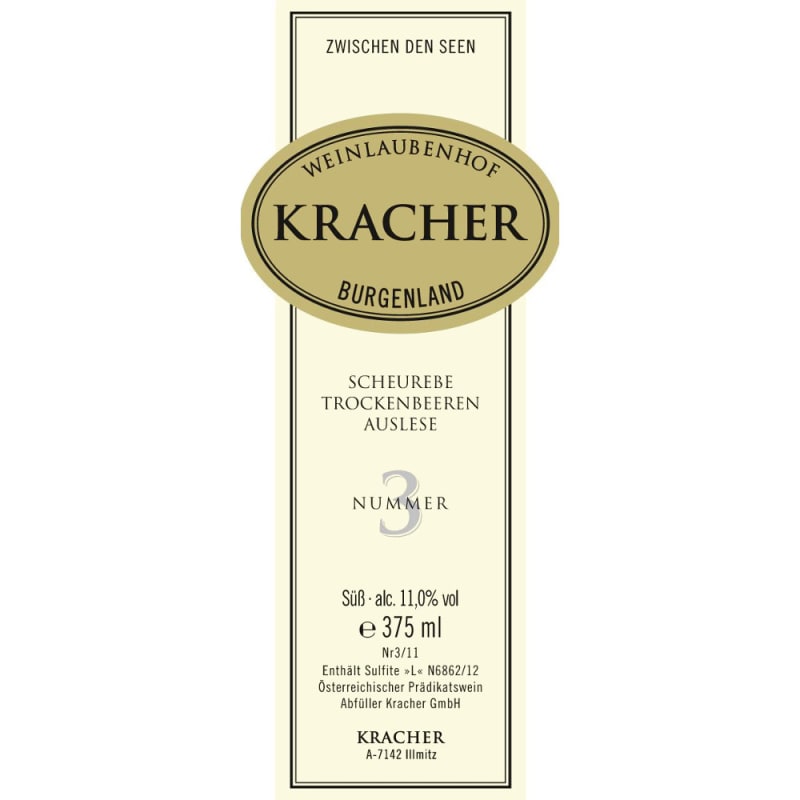

Winemaker Notes
Extravagant bouquet of grapefruit zest, white blossom, tropical fruit aromas and herbal spice. Very elegant and compact style with fine acidity, leading to hints of salty characters and a lingering aftertaste of sweet ginger.
Recommended to be served with curded cheese cake, steeped-kumquats with white chocolate ice cream, or citrus fruit desserts.
Professional Ratings
-
Wine & Spirits
Stunning from the first whiff, this is scheurebe in all its glory. It’s spicy more than green; it’s creamy more than banana-rich; it’s cool orange more than Carmen Miranda–fruity, never tilting over the edge into caricature. It’s also as smooth as satin, lithe and airy, propelled by something that feels more like energy than anything as tangible as acidity. With nearly 200 grams of sugar per liter, it’s certainly sweet, but it doesn’t feel ponderously so. Pour it with a soft, ripe washed-rind cheese.
-
Wine Spectator
Very lush and rich-tasting, this features concentrated flavors of pear tart, ripe apple and buttercream that take on loads of spicy notes. Buttery midpalate, with notes of ripe melon that flow into the rich, plush finish. A mouthwatering sweetie. Drink now through 2045.
-
Robert Parker's Wine Advocate
The 2012 Scheurebe Trockenbeerenauslese No 3 Zwischen den Seen displays a concentrated grapefruit bouquet followed by a firm, piquant and grippy palate. This is well structured Scheurebe with a long and persistent finish. Impressive.


Apart from the classics, we find many regional gems of different styles.
Late harvest wines are probably the easiest to understand. Grapes are picked so late that the sugars build up and residual sugar remains after the fermentation process. Ice wine, a style founded in Germany and there referred to as eiswein, is an extreme late harvest wine, produced from grapes frozen on the vine, and pressed while still frozen, resulting in a higher concentration of sugar. It is becoming a specialty of Canada as well, where it takes on the English name of ice wine.
Vin Santo, literally “holy wine,” is a Tuscan sweet wine made from drying the local white grapes Trebbiano Toscano and Malvasia in the winery and not pressing until somewhere between November and March.
Rutherglen is an historic wine region in northeast Victoria, Australia, famous for its fortified Topaque and Muscat with complex tawny characteristics.

The source of Austria’s finest botrytized sweet wines, Burgenland covers a lofty portion of Austria's wine producing real estate. It encompasses the smaller regions of Neusiedlersee, Neusiedlersee-Hügelland, Mittelburgenland and Südburgenland. The latter two are most associated with their exceptional red wines. The region as a whole produces no shortage of important whites.
Neusiedlersee, named for the lake that it surrounds to the east, is home to a great diversity of grape varieties. The region’s most notable wines, however, are the botrytis-infected, sweet versions.
Neusiedlersee-Hügelland, which wraps the lake on its western side, includes the town of Rust, a historically esteemed wine community. Its close proximity to the lake’s fog and mist make it another source of some of the more prestigious botrytized wines. Neusiedlersee-Hügelland also produces fine Blaufränkisch, Pinot Blanc, Neuburger and Grüner Veltliner, though a label will usually name the more general, Burgenland, so as not to confuse it with its eastern cousin, Neusiedlersee, across the lake.
Blaufränkisch is well suited to and makes up over half of the vineyard area in Mittelburgenland. The region’s hills and plateaus, which are composed of variations in schist, loess and clay-limestone, produce high quality reds with interesting diversity.
Südburgenland, also known for its deep, complex and age-worthy Blaufränkisch, is beginning to turn out some alluring whites from Grüner Veltliner, Welschriesling and Weissburgunder (Pinot Blanc).