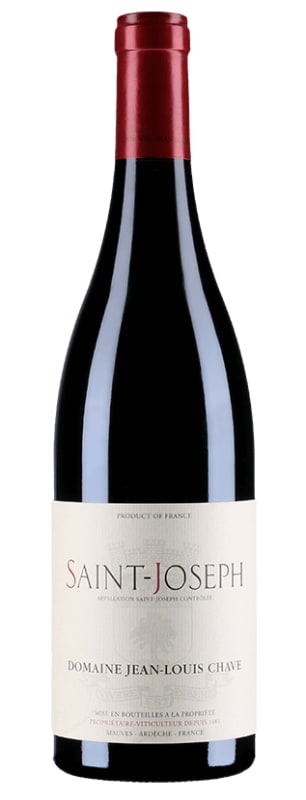


Winemaker Notes
The Chave's methods for all their winemaking are traditional farming, super low yields, full ripeness, and minimal manipulation. Their unmatched meticulousness continues through five centuries to render venerable expressions of the purest of Rhône terroir.
Professional Ratings
-
Robert Parker's Wine Advocate
The rating and review of the 2020 Saint Joseph is a composite based on tasting several lots—Chalaix, Dardouilles and Bechasson—from barrel. With aromas that range from violets to rose petals, garrigue and licorice, plus fruit notes from raspberries to blueberries and cassis, it should prove remarkably complex, backed by ample concentration and ripe, silky tannins.
Barrel Sample: 94-96 -
Wine Spectator
Dark and brooding, with richness to the black plum and cherry flavors edged with bacon. Creamy and svelte on the palate, this shows polish, with cardamon, allspice and aniseed adding detail, backed by a thread of singed mesquite. Concentration builds toward the very long, serious finish, which is firmly grounded by iron.
-
Decanter
All the lieux-dits I tasted that make up this domaine's Saint-Joseph were showing well and expressed their typical characters, this promising to be a precise style with clear, complex aromatics. It's possible that the rose-scented lieu-dit Bachesson component might be bottled separately this year - in which case you should buy it without hesitation.


Marked by an unmistakable deep purple hue and savory aromatics, Syrah makes an intense, powerful and often age-worthy red. Native to the Northern Rhône, Syrah achieves its maximum potential in the steep village of Hermitage and plays an important component in the Red Rhône Blends of the south, adding color and structure to Grenache and Mourvèdre. Syrah is the most widely planted grape of Australia and is important in California and Washington. Sommelier Secret—Such a synergy these three create together, the Grenache, Syrah, Mourvedre trio often takes on the shorthand term, “GSM.”

Spanning the longest stretch of river in the northern Rhône—from Condrieu in the north, to Cornas in the south—the heart of St.-Joseph lies directly across the Rhône River from Hermitage. While its soils are basically the same as Hermitage: granite, supplemented by sand and gravel, its east facing slope receives less sunlight than Hermitage, which causes less overall berry ripening on its Syrah vines. However, some of the best of them can rival any fine expression of Hermitage, Cote-Rotie or Cornas with concentrated black fruits, dark spices, crushed rock and violets. A general advantage of the region is that its Syrahs typically don’t need as much time in the bottle compared to a Cote-Rotie or Hermitage and are much easier on the bank account!
A textbook St.-Joseph red is firm with a core of minerality that is enhanced by savory and peppery qualities. Aromas and flavors of smoke, olives, herbs, and violets are common; its wines are dense in red and black fruit.
St.-Joseph is also a source of fine northern Rhône white wine. Viognier, Marsanne and Roussanne grow well here and can be blended or made into single varietal wines. St.-Joseph whites are full and silky with citrus, pear and pineapple flavors and a rich bouquet reminiscent of honeysuckle, toasted nuts, spice and caramel.