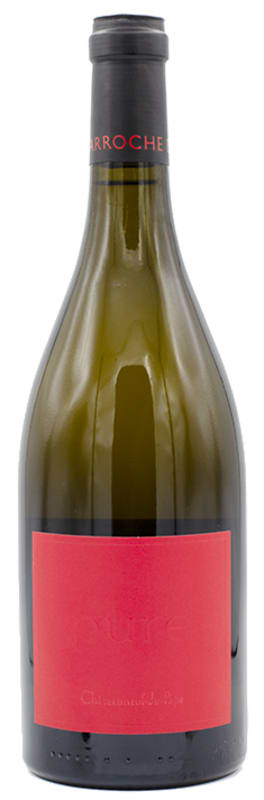


Winemaker Notes
Pure Blanc is extremely elegant and delicate. This cuvée has fresh, floral, and spicy overtones as well as subtle nuances of fennel and star anise. It features a pure, mineral flavor with excellent crispness and a great energy. Round, but not rich, this graceful wine reveals all its fullness and personality if decanted beforehand.
Professional Ratings
-
Jeb Dunnuck
The 2022 Châteauneuf Du Pape Pure Blanc from this terrific estate is based on pure Clairette from the sandier soils of Le Pied Long lieu-dit and was aged 14 months in demi-muids. Its light gold hue is followed by a gorgeous bouquet of stone fruits, honeyed white flowers, spice, and a kiss of crushed stone-like minerality. I’ve found this cuvée to be a touch lean and dilute in the past, yet this brings beautiful depth and richness in its medium-bodied, textured, layered profile, and I love its overall balance and purity. It's going to evolve gracefully for at least 5-7 years and is well worth seeking out.
-
Decanter
Interesting nose: cashew, pink grapefruit and mandarin skin. Full-bodied, very generous, with a little hint of struck-match reduction which adds spice and complexity. The acidity is surprisingly high for the style, and it adds some balance and zest. Long finish, with some nutty oak spice. Has good energy and tension on the palate. This has serious intensity; it demands rich food and will age well for a 2022. Saline finish. Pure Clairette, fermented and aged in demi-muids for 14 months.
-
Vinous
Showing a little less in the way of oak-derived aromas and flavors than its predecessor, the 2022 Châteauneuf-du-Pape Blanc Pure hits the palate with intense lemon flesh, yellow apple, ripe pear, quince, discrete cedar and crushed flowers. Bursting with inner energy, the 2022 is at eye level with the stellar 2019 and 2020 versions.


There are hundreds of white grape varieties grown throughout the world. Some are indigenous specialties capable of producing excellent single varietal wines. Each has its own distinct viticultural characteristics, as well as aroma and flavor profiles.

Famous for its full-bodied, seductive and spicy reds with flavor and aroma characteristics reminiscent of black cherry, baked raspberry, garrigue, olive tapenade, lavender and baking spice, Châteauneuf-du-Pape is the leading sub-appellation of the southern Rhône River Valley. Large pebbles resembling river rocks, called "galets" in French, dominate most of the terrain. The stones hold heat and reflect it back up to the low-lying gobelet-trained vines. Though the galets are typical, they are not prominent in every vineyard. Chateau Rayas is the most obvious deviation with very sandy soil.
According to law, eighteen grape varieties are allowed in Châteauneuf-du-Pape and most wines are blends of some mix of these. For reds, Grenache is the star player with Mourvedre and Syrah coming typically second. Others used include Cinsault, Counoise and occasionally Muscardin, Vaccarèse, Picquepoul Noir and Terret Noir.
Only about 6-7% of wine from Châteauneuf-du-Pape is white wine. Blends and single-varietal bottlings are typically based on the soft and floral Grenache Blanc but Clairette, Bourboulenc and Roussanne are grown with some significance.
The wine of Chateauneuf-du-Pape takes its name from the relocation of the papal court to Avignon. The lore says that after moving in 1309, Pope Clément V (after whom Chateau Pape-Clément in Pessac-Léognan is named) ordered that vines were planted. But it was actually his successor, John XXII, who established the vineyards. The name however, Chateauneuf-du-Pape, translated as "the pope's new castle," didn’t really stick until the 19th century.