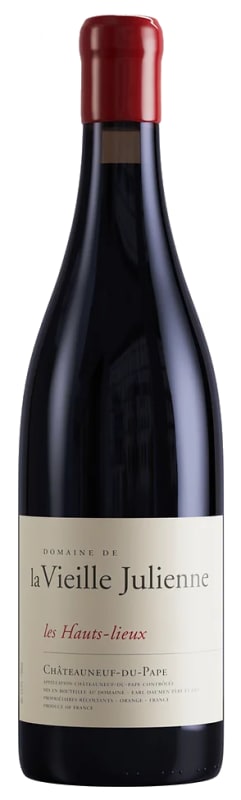


Winemaker Notes
This is the highest elevation and the most sheltered part of the terroir of slopes. Marlstone soils and shallow safres covered with quartzite pebbles are entirely suitable for mourvedre. Under the tense tannins, wines are vigorous with huge elegance.
Professional Ratings
-
Jeb Dunnuck
The 2022 Châteauneuf Du Pape Les Hauts-Lieux is based on 65% Grenache, 20% Mourvèdre, 10% Cinsault, and the rest Counoise and comes from vines just in front of the estate as well as the slightly higher elevation Brusquière plateau, which is a later, cooler terroir. Its deep ruby hue is followed by a killer nose of ripe red and black fruits, peppery herbs, leather, and graphite. With medium to full-bodied richness, it's concentrated, has a deep, layered mouthfeel, beautiful mid-palate density, and one hell of a great finish. It's one of the wines of the vintage.
-
Decanter
Very ripe, and if anything even fresher than Les Trois Sources this year. Great finesse of tannin, and a really solid base for long ageing. This will take a long time to come round, and will be good for decades. Moderate alcohol, and a freshening, succulent, saline edge. No Syrah in the blend here, plentiful Mourvèdre however, which performed well in 2022. From three parcels close to the limestone plateau, some clay, relatively high altitude and late ripening, with less exposure to the sun.
-
Robert Parker's Wine Advocate
One of my favorite wines at this address, the 2022 Les Hauts-Lieux, derives from vines planted on a cooler, higher elevation on calcareous soils. These grapes, including more Mourvèdre (20%), are picked 15 days later than the other grapes. Evoking aromas of dark cherries, ground pepper, iris, tapenade and dark olive, it’s full-bodied, powerful and structured with velvety tannins and a dense, concentrated core of fruit enhanced by notes of chocolate and spices that segues into a long, mineral and superb finish. It’s poised to reach its 20th anniversary in outstanding condition.
-
Wine Spectator
This is texturally stunning, offering intricately woven layers of steeped cherry, plum and smoldering cast iron all smudged in salt and smoke. Heady and not shy on fruit, this shows expert balance and drive, with salty mineral underpinnings and a pretty floral edge. The refined tannins hold on effortlessly. Delicious now but will benefit from a few years in the cellar. Grenache, Mourvèdre, Counoise and Cinsault. Best from 2027 through 2040.
-
James Suckling
A textural, succulent and spicy Chateauneuf-du-Pape with sweet cherries, grilled meat, grilled thyme and some stones. It's full-bodied with fine tannins. Juicy center-palate with crushed-berry and dried-rose character and some candied orange in the energetic finish. From biodynamically grown grapes with Demeter certification. Drink from 2027.
-
Vinous
Mixing 70% Grenache with 20% Mourvèdre, 7% Cinsault, 7% Counoise and other permitted varieties, the 2022 Châteauneuf-du-Pape Les Hauts-Lieux is dashing. Sun-drenched raspberry, strawberry, red plum and licorice are front and center. Leafy shadings add gentle freshness. Full-bodied and concentrated, the 2022 is firmly framed by ripe tannins that provide solid structure. It will take at least four more years before to unleash its full potential.


With bold fruit flavors and accents of sweet spice, Grenache, Syrah and Mourvèdre form the base of the classic Rhône Red Blend, while Carignan, Cinsault and Counoise often come in to play. Though they originated from France’s southern Rhône Valley, with some creative interpretation, Rhône blends have also become popular in other countries. Somm Secret—Putting their own local spin on the Rhône Red Blend, those from Priorat often include Merlot and Cabernet Sauvignon. In California, it is not uncommon to see Petite Sirah make an appearance.

Famous for its full-bodied, seductive and spicy reds with flavor and aroma characteristics reminiscent of black cherry, baked raspberry, garrigue, olive tapenade, lavender and baking spice, Châteauneuf-du-Pape is the leading sub-appellation of the southern Rhône River Valley. Large pebbles resembling river rocks, called "galets" in French, dominate most of the terrain. The stones hold heat and reflect it back up to the low-lying gobelet-trained vines. Though the galets are typical, they are not prominent in every vineyard. Chateau Rayas is the most obvious deviation with very sandy soil.
According to law, eighteen grape varieties are allowed in Châteauneuf-du-Pape and most wines are blends of some mix of these. For reds, Grenache is the star player with Mourvedre and Syrah coming typically second. Others used include Cinsault, Counoise and occasionally Muscardin, Vaccarèse, Picquepoul Noir and Terret Noir.
Only about 6-7% of wine from Châteauneuf-du-Pape is white wine. Blends and single-varietal bottlings are typically based on the soft and floral Grenache Blanc but Clairette, Bourboulenc and Roussanne are grown with some significance.
The wine of Chateauneuf-du-Pape takes its name from the relocation of the papal court to Avignon. The lore says that after moving in 1309, Pope Clément V (after whom Chateau Pape-Clément in Pessac-Léognan is named) ordered that vines were planted. But it was actually his successor, John XXII, who established the vineyards. The name however, Chateauneuf-du-Pape, translated as "the pope's new castle," didn’t really stick until the 19th century.