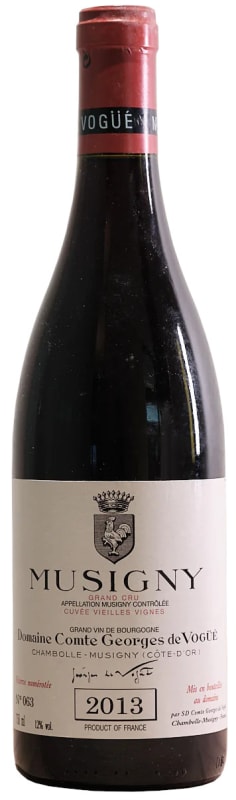


Winemaker Notes
Professional Ratings
-
Vinous
"
Very dark bright red. Great purity and lift to the aromas of black cherry, violet, graphite, bitter chocolate and minerals. Showing less obvious density today than the Bonnes-Mares but this is extremely tight and unevolved, with its saline crushed stone and mineral elements currently dominating its underlying fruit. The yield was just 20 hectoliters per hectare, due in large part to millerandage, but this extremely imploded Musigny is showing little of the early sweetness one might expect from tiny berries. Finishes with outstanding flavor authority, length and grip. This wine should go on for decades.
" -
Robert Parker's Wine Advocate
Served blind, the 2013 Musigny Vieilles Vignes Grand Cru from Comte de Vogüé wore its pedigree on its sleeve, opening in the glass with a superb bouquet of wild strawberries, rose, cherry, blood orange and plum—much like it did in barrel. On the palate, the wine is full-bodied, ample and layered, with succulent acids, a deep mid-palate and a sapid, mineral-laden finish. Pure and transparent, this is a beautifully elegant Musigny that should be comparatively approachable in another 5 or 6 years.


Thin-skinned, finicky and temperamental, Pinot Noir is also one of the most rewarding grapes to grow and remains a labor of love for some of the greatest vignerons in Burgundy. Fairly adaptable but highly reflective of the environment in which it is grown, Pinot Noir prefers a cool climate and requires low yields to achieve high quality. Outside of France, outstanding examples come from in Oregon, California and throughout specific locations in wine-producing world. Somm Secret—André Tchelistcheff, California’s most influential post-Prohibition winemaker decidedly stayed away from the grape, claiming “God made Cabernet. The Devil made Pinot Noir.”

Chambolle-Musigny represents the charm of the Côte de Nuits district of Burgundy. But you’ll find that term mainly in reference to the vineyards in its southern stretches, which border Clos Vougeot: the Grand Cru of Le Musingy and in part, its neighboring and most exceptional Premier Cru, Les Amoureuses. Some producers argue for the primacy of Les Amoureuses and its eligibility for Grand Cru status given its wines can sometimes surpass other Grands Crus.
Le Musigny ranks on par with the most acclaimed Grands Crus for Pinot Noir: Romanée-Conti, La Tâche, Richebourg, Chambertin, and Chambertin-Clos de Bèze. It is also the only Grand Cru in Côte de Nuits for Chardonnay. All of the others are in Côte de Beaune.
This village can in fact claim only two Grands Crus vineyards and—in the context of breaking down the minutiae—they are markedly different. Bonnes-Mares, the other one at the far northern end above the village, bordering Morey-St-Denis, offers power, strength and great aging potential. But Chambolle-Musigny includes a nice handful of exceptional Premiers Crus, as noted above with Les Amoureuses as the finest. Le Fuees and Les Cras are other noteworthy Premiers Crus.
Overall, a top Chambolle-Musigny offers pure aromas of violets, dark cherry and damp earth, coupled with a velvety elegance, supple mid-palate, an abundance of black and red berry, and finesse and power through a long and fine-grained finish.