
Winemaker Notes
Pair with steak, smoked beef and dishes highlighting spinach and tomatoes.
Professional Ratings
-
Robert Parker's Wine Advocate
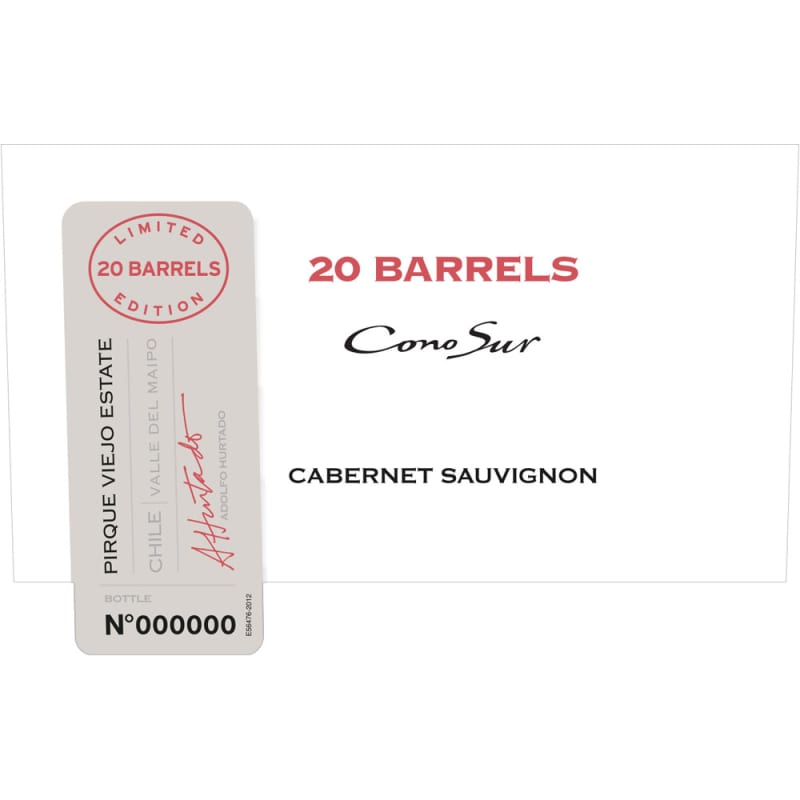
The 2012 Cabernet Sauvignon 20 Barrels Limited Edition is the selection of the best Cabernet barrels of the vintage blended with some 4% Syrah and 3% Carménère. It fermented in open stainless steel vats and matured in new French oak barrels for 17 months after malolactic in barrique. It is from Pirque Viejo in Alto Maipo, old vines planted in the 1960s; it was a ripe vintage that produced a powerful Cabernet, very balanced with aromas of paprika and smoke over the core of ripe blackberries. The palate reveals the telltale tannins from the variety with very tasty flavors that I associate with the granite soils. A textbook Cabernet from Maipo. 60,000 bottles were produced so not quite 20 barrels anymore...
-
Wine Enthusiast
Dry, briary aromas of field brush, black olive, herbs, berry fruits and saucy tomato are textbook Maipo. This is fresh, a touch choppy, and not overly heavy. Flavors of cassis, plum and vanilla carry over to the finish, which is fresh and bolstered by fine natural acidity. Drink through 2022.


A noble variety bestowed with both power and concentration, Cabernet Sauvignon enjoys success all over the globe, its best examples showing potential to age beautifully for decades. Cabernet Sauvignon flourishes in Bordeaux's Medoc where it is often blended with Merlot and smaller amounts of some combination of Cabernet Franc, Malbecand Petit Verdot. In the Napa Valley, ‘Cab’ is responsible for some of the world’s most prestigious, age-worthy and sought-after “cult” wines. Somm Secret—DNA profiling in 1997 revealed that Cabernet Sauvignon was born from a spontaneous crossing of Cabernet Franc and Sauvignon Blanc in 17th century southwest France.

Dramatic geographic and climatic changes from west to east make Chile an exciting frontier for wines of all styles. Chile’s entire western border is Pacific coastline, its center is composed of warm valleys and on its eastern border, are the soaring Andes Mountains.
Chile’s central valleys, sheltered by the costal ranges, and in some parts climbing the eastern slopes of the Andes, remain relatively warm and dry. The conditions are ideal for producing concentrated, full-bodied, aromatic reds rich in black and red fruits. The eponymous Aconcagua Valley—hot and dry—is home to intense red wines made from Cabernet Sauvignon, Syrah and Merlot.
The Maipo, Rapel, Curicó and Maule Valleys specialize in Cabernet and Bordeaux Blends as well as Carmenère, Chile’s unofficial signature grape.
Chilly breezes from the Antarctic Humboldt Current allow the coastal regions of Casablanca Valley and San Antonio Valley to focus on the cool climate loving varieties, Pinot Noir, Chardonnay and Sauvignon Blanc.
Chile’s Coquimbo region in the far north, containing the Elqui and Limari Valleys, historically focused solely on Pisco production. But here the minimal rainfall, intense sunlight and chilly ocean breezes allow success with Chardonnay and Pinot Noir. The up-and-coming southern regions of Bio Bio and Itata in the south make excellent Riesling, Chardonnay and Pinot Noir.
Spanish settlers, Juan Jufre and Diego Garcia de Cáceres, most likely brought Vitis vinifera (Europe’s wine producing vine species) to the Central Valley of Chile sometime in the 1550s. One fun fact about Chile is that its natural geographical borders have allowed it to avoid phylloxera and as a result, vines are often planted on their own rootstock rather than grafted.