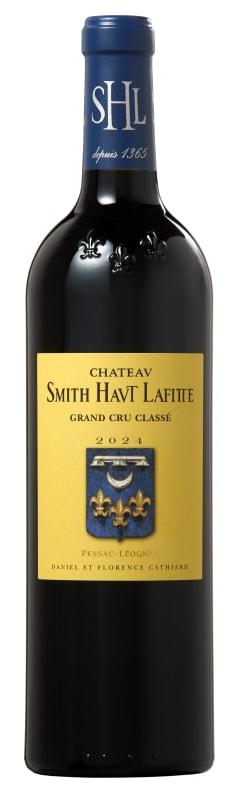


Winemaker Notes
The nose is highly expressive, with notes of fresh red fruits such as raspberry, cherry, and black cherry, interwoven with vibrant hints of mint, blond tobacco leaf, and sweet spices. These highly aromatic grapes echo the flavors they tasted in their vineyards back in September. The attack on the palate is well-balanced, offering a beautiful sensation of freshness, but also a refined texture and a soft, delicate mouthfeel. The palate reveals a remarkable harmony of texture and flavor, with good substance, superb volume, and great length, all supported by a bright freshness. You'll love this soft and delicate texture combined with freshness, which gives it an impressive energy, perfectly counterbalanced by its smoothness. The aromatic profile, both on the palate and in the finish, highlights fresh red fruits along with notes of blackcurrant, complemented by a broad spectrum of spices and fresh herbs such as blond tobacco, clove, and sage. This Smith Haut Lafitte Rouge 2024 displays outstanding overall harmony, with great energy and an exquisite texture, while expressing a beautifully fresh and complex aromatic profile, characteristic of their gravel soils.
Blend: 67% Cabernet Sauvignon, 27% Merlot, 5% Cabernet Franc, 1% Petit Verdot
This wine does not include the blanket 10% tariff imposed in April 2025. When the wines are shippable in fall of 2027, customers will have the option to pay any tariff in place at the time or to keep their wines stored in a temperature-controlled facility free of charge in France.
Professional Ratings
-
James Suckling
A fresh, complex and deep nose of spiced blue fruit, waxberries, blue flowers, minerals, licorice and graphite. Full-bodied and really fine-grained, with tight, chalky tannins and a long, structured finish. Very juicy and complete, with excellent fruit definition and an al dente texture. More reactive tannins this year. 67% cabernet sauvignon, 27% merlot, 5% cabernet franc and 1% petit verdot.
Barrel Sample: 96-97 -
Jeb Dunnuck
The Grand Vin 2024 Château Smith Haut Lafitte is based on 67% Cabernet Sauvignon, 27% Merlot, 5% Cabernet Franc, and 1% Petit Verdot, harvested between September 18 and October 9. Resting in 60% new barrels, it's a deep purple-hued wine with classic aromas of dark currants, smoky tobacco, graphite, and spicy, wood-driven nuances. These carry to a medium to full-bodied Pessac-Léognan with ripe, velvety tannins, a dense mid-palate, and outstanding length. It's one of the few 2024s that will benefit from bottle age.
Barrel Sample: 93-95 -
Decanter
Dark fruit and soft rose aromatics, neat and tidy scents. A lovely juicy, fun expression from Smith this year with a dollop of sweet ripe fruit with cooling acidity and fine tannins. Definitely not demonstrative, this is about the precision rather than power or density but it’s graceful and long with focus and charm. Not trying too hard, this is sinewy with a soft fleshiness and really mineral-edged finish that adds tension - liquorice, slate, graphite and pencil lead. Harmonious and balanced. This leans into the vintage. Good construction and energy. 1% Petit Verdot completes the blend. Ageing 60% new oak barrels. 3.6pH.
Barrel Sample: 94 -
Robert Parker's Wine Advocate
Notes of spices, oak, dark berries and gentian preface the 2024 Smith Haut Lafitte, a medium-bodied, firm and structured wine with an assertive tannic frame that leads to a compact, gentian-inflected finish. This blend of 67% Cabernet Sauvignon, 27% Merlot, 5% Cabernet Franc and 1% Petit Verdot, matured in 60% new oak, is somewhat introverted and linear, making it a chewy Smith Haut Lafitte that will need time to unwind.
Barrel Sample: 90-92


One of the world’s most classic and popular styles of red wine, Bordeaux-inspired blends have spread from their homeland in France to nearly every corner of the New World. Typically based on either Cabernet Sauvignon or Merlot and supported by Cabernet Franc, Malbec and Petit Verdot, the best of these are densely hued, fragrant, full of fruit and boast a structure that begs for cellar time. Somm Secret—Blends from Bordeaux are generally earthier compared to those from the New World, which tend to be fruit-dominant.

Recognized for its superior reds as well as whites, Pessac-Léognan on the Left Bank claims classified growths for both—making it quite unique in comparison to its neighboring Médoc properties.
Pessac’s Chateau Haut-Brion, the only first growth located outside of the Médoc, is said to have been the first to conceptualize fine red wine in Bordeaux back in the late 1600s. The estate, along with its high-esteemed neighbors, La Mission Haut-Brion, Les Carmes Haut-Brion, Pique-Caillou and Chateau Pape-Clément are today all but enveloped by the city of Bordeaux. The rest of the vineyards of Pessac-Léognan are in clearings of heavily forested area or abutting dense suburbs.
Arid sand and gravel on top of clay and limestone make the area unique and conducive to growing Sémillon and Sauvignon blanc as well as the grapes in the usual Left Bank red recipe: Cabernet Sauvignon, Merlot, Cabernet Franc and miniscule percentages of Petit Verdot and Malbec.
The best reds will show great force and finesse with inky blue and black fruit, mushroom, forest, tobacco, iodine and a smooth and intriguing texture.
Its best whites show complexity, longevity and no lack of exotic twists on citrus, tropical and stone fruit with pronounced floral and spice characteristics.