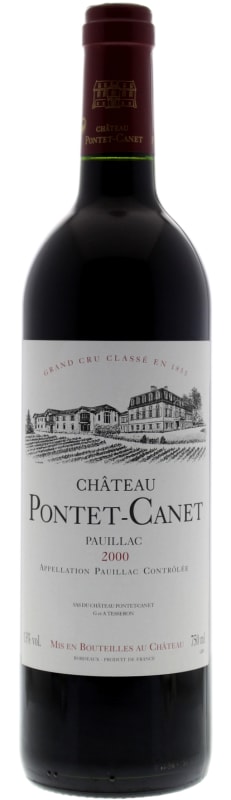


Winemaker Notes
Very intense color. The very powerful nose features an excellent balance between fruit (blackberry, raspberry) and wood (licorice, toasty notes). On the palate, the attack is full but very mild. This wine stands out with its fine length and imposing structure a characteristic of great Pauillacs - made up of extremely smooth tannins. The finish shows no trace of aggressiveness and is very long.
Professional Ratings
-
Jeb Dunnuck
A serious, nuanced, classic Pauillac, the 2000 Château Pontet-Canet is based on 66% Cabernet Sauvignon, 30% Merlot, and 4% Cabernet Franc that was brought up in 50% new oak barrels, 35% in concrete amphorae, and 15% in one-wine oak barrels. Showing a touch of maturity with its ripe blackcurrant, leather, truffly earth, graphite, and smoky nuances on the nose, it's medium to full-bodied on the palate, with a pure, graceful, balanced mouthfeel, nicely resolved yet still present tannins, and outstanding length. It's complex, nuanced, and ready to go, yet will clearly hold here nicely for another two decades or so given its tannins and acidity.
-
James Suckling
A lovely lead-in of singed cedar and vanilla notes gives way to slightly taut, racy red and black currant fruit flavors that drive nicely through an iron-edged finish. Rather sleek and tightly focused, relying more on minerality than power.—2000 Bordeaux blind retrospective (December 2015). Drink now through 2023.
-
Robert Parker's Wine Advocate
Tasted at the Pontet-Canet vertical, the 2000 Château Pontet-Canet is perhaps where things start getting interesting, as Alfred Tesseron's top-to-toe reconfiguration of the vineyard and vinification began to impact and ameliorate the wine. It has a lovely bouquet of blackberry and briary fruit, hints of black truffle developing, later damp earth. There is an intensity here, if not the complexity of the best millennial Pauillacs. The palate is medium-bodied with a mixture of red and black fruit, cedar and sous-bois percolating up through and rendering it a "serious" Pontet-Canet in keeping with the vintage. There is a subtle and yet insistent grip on the finish. It has always been a tannic wine, but these are now softening, albeit at a slower pace than some might like. Therefore, I might be inclined to hold on to bottles for another 3-4 years. Tasted February 2016.
-
Wine Spectator
A lovely lead-in of singed cedar and vanilla notes gives way to slightly taut, racy red and black currant fruit flavors that drive nicely through an iron-edged finish. Rather sleek and tightly focused, relying more on minerality than power.—2000 Bordeaux blind retrospective (December 2015). Drink now through 2023.
-
Wine Enthusiast
This is a very modern style of wine, with generous new wood and super-ripe fruit flavors, balancing with polished solid tannins. Very international in style, it is good, but could come from anywhere.


One of the world’s most classic and popular styles of red wine, Bordeaux-inspired blends have spread from their homeland in France to nearly every corner of the New World. Typically based on either Cabernet Sauvignon or Merlot and supported by Cabernet Franc, Malbec and Petit Verdot, the best of these are densely hued, fragrant, full of fruit and boast a structure that begs for cellar time. Somm Secret—Blends from Bordeaux are generally earthier compared to those from the New World, which tend to be fruit-dominant.

The leader on the Left Bank in number of first growth classified producers within its boundaries, Pauillac has more than any of the other appellations, at three of the five. Chateau Lafite Rothschild and Mouton Rothschild border St. Estephe on its northern end and Chateau Latour is at Pauillac’s southern end, bordering St. Julien.
While the first growths are certainly some of the better producers of the Left Bank, today they often compete with some of the “lower ranked” producers (second, third, fourth, fifth growth) in quality and value. The Left Bank of Bordeaux subscribes to an arguably outdated method of classification that goes back to 1855. The finest chateaux in that year were judged on the basis of reputation and trading price; changes in rank since then have been miniscule at best. Today producers such as Chateau Pontet-Canet, Chateau Grand Puy-Lacoste, Chateau Lynch-Bages, among others (all fifth growth) offer some of the most outstanding wines in all of Bordeaux.
Defining characteristics of fine wines from Pauillac (i.e. Cabernet-based Bordeaux Blends) include inky and juicy blackcurrant, cedar or cigar box and plush or chalky tannins.
Layers of gravel in the Pauillac region are key to its wines’ character and quality. The layers offer excellent drainage in the relatively flat topography of the region allowing water to run off into “jalles” or streams, which subsequently flow off into the Gironde.