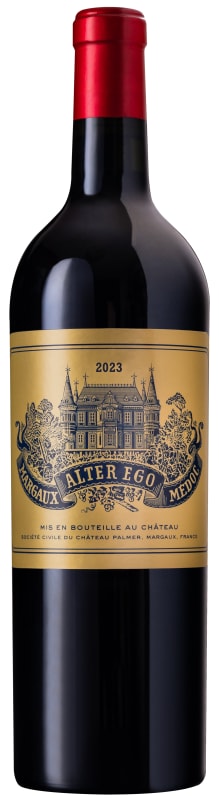


Winemaker Notes
Alter Ego was launched with the 1998 vintage, driven by the idea of producing another facet to the estate. Spontaneous, round, generous, and silky, this 'other wine' is both intense and light, rich and delicate. It has the elegance and grain de tanin of its predecessor. Throughout its creation, Alter Ego is led by the same high standards that govern the composition of Château Palmer's great wine.
Blend: 53% Cabernet Sauvignon, 43% Merlot, 4% Petit Verdot
Professional Ratings
-
Jeb Dunnuck
The second wine of Château Palmer, the 2023 Alter Ego De Palmer is a blend of 53% Cabernet Sauvignon, 43% Merlot, and 4% Petit Verdot that was aged 12 months in 30% new French oak barrels followed by 12 months in foudre. This deep purple-hued beauty boasts gorgeous aromatics of black cherry and blueberry fruit intermixed with graphite, crushed stone, and licorice. It's rich, full-bodied, and powerful, yet has great acidity, ripe tannins, and outstanding length. It's too good for a second wine and will cruise over the coming three decades. There are roughly 5,300 cases produced. Drink 2026-2056.
-
Vinous
The 2023 Alter Ego is plump, juicy and super-expressive. Soft, silky tannins enshroud a core of plum, red cherry, spice, menthol and mocha. All the elements are so nicely balanced. A burst of red-toned fruit and spice lingers on a finish lifted by bright acids. This is such a sensual Alter Ego. –Antonio Galloni
Barrel Sample: 93-95 -
James Suckling
A nice creamy twist of cocoa and a touch of hazelnuts to the ripe, rich dark cherries and sweet black plums. Some anise and cumin too. Juicy and structured, with medium to full body and a flavorful, succulent finish. Tight-grained. A blend of 53% cabernet sauvignon, 43% merlot and 4% petit verdot.
-
Robert Parker's Wine Advocate
Wafting from the glass with pure aromas of cherries, berries, plums and potpourri, the 2023 Alter Ego de Palmer is medium to full-bodied, bright and vibrant, with a vigorous core of fruit framed by supple tannins. It's a blend of 53% Cabernet Sauvignon, 43% Merlot and 4% Petit Verdot.
Barrel Sample: 92-94 -
Decanter
Gorgeous nose, so full, voluptuous, intensely aromatic, violets, blackcurrants, damsons, cherries, plums, tobacco and liquorice and cedar spice. Deep pink purple rim too. Nice weight straight away but with tension - you get clearly ripe fruit with such high acidity. Balanced, relatively lean but still juicy, certainly full and intense but streamlined ending on a real graphite and wet stone note. Slightly more lean and austere than some but not harsh, just not as fleshy as normal. It’s got body and style, nice movement and energy, a hint of fleshiness and subtle chew to the tannins. I like this, feels a real mix of ripe and cool with freshness on the finish. 3.75pH. 14% press.
Barrel Sample: 93 -
Wine Enthusiast
his is a ripe, smooth wine, impressively open and generous. Its black fruits and soft tannins allied to the smoky aroma are full of promise and richness.
-
Wine Spectator
This is juicy and fresh in feel, with nice energy tucked inside a core of dark cherry, pomegran- ate and blackberry fruit. Keeps its juicy feel through the alder- and violet-accented finish, which is nicely defined, with lingering iron and ink hints. Both acces- sible and cellar-worthy. Nicely done. Cabernet Sauvi- gnon, Merlot and Petit Verdot.


One of the world’s most classic and popular styles of red wine, Bordeaux-inspired blends have spread from their homeland in France to nearly every corner of the New World. Typically based on either Cabernet Sauvignon or Merlot and supported by Cabernet Franc, Malbec and Petit Verdot, the best of these are densely hued, fragrant, full of fruit and boast a structure that begs for cellar time. Somm Secret—Blends from Bordeaux are generally earthier compared to those from the New World, which tend to be fruit-dominant.

Silky, seductive and polished are the words that characterize the best wines from Margaux, the most inland appellation of the Médoc on the Left Bank of Bordeaux.
Margaux’s gravel soils are the thinnest of the Médoc, making them most penetrable by vine roots—some reaching down over 23 feet for water. The best sites are said to be on gentle outcrops, or croupes, where more gravel facilitates good drainage.
The Left Bank of Bordeaux subscribes to an arguably outdated method of classification but it is nonetheless important in regards to history of the area. In 1855 the finest chateaux were deemed on the basis of reputation and trading price—at that time. In 1855, Chateau Margaux achieved first growth status, yet it has been Chateau Palmer (officially third growth from the 1855 classification) that has consistently outperformed others throughout the 20th century.
Chateau Margaux in top vintages is capable of producing red Cabernet Sauvignon based wines described as pure, intense, spell-binding, refined and profound with flavors and aromas of black currant, violets, roses, orange peel, black tea and incense.
Other top producers worthy of noting include Chateau Rauzan-Ségla, Lascombes, Brane-Cantenac, and d’Issan, among others.
The best wines of Margaux combine a deep ruby color with a polished structure, concentration and an unrivaled elegance.