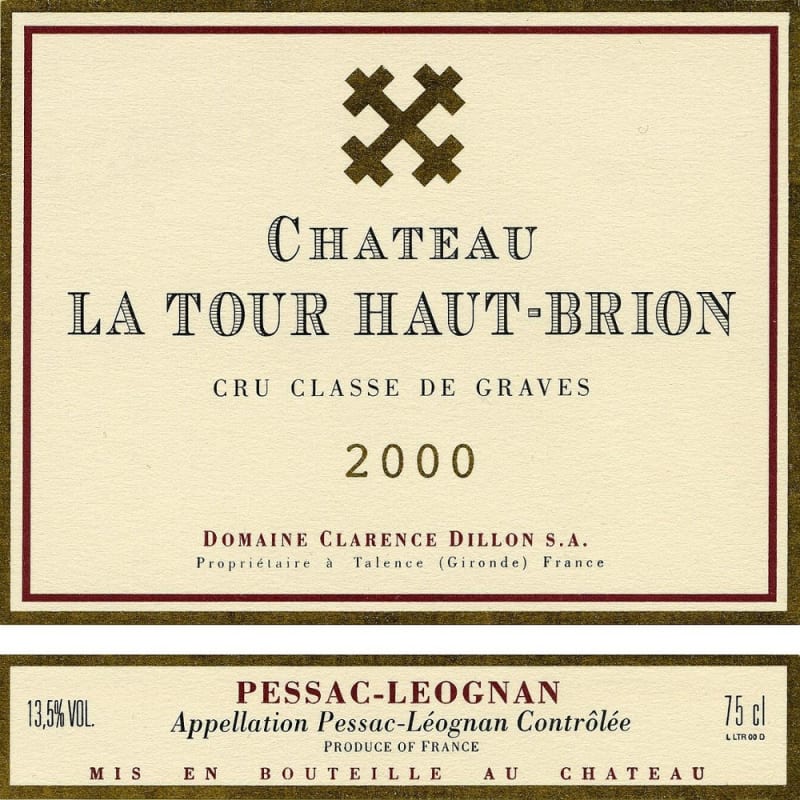

Winemaker Notes
Professional Ratings
-
Robert Parker's Wine Advocate
A blend of 52% Merlot, 43% Cabernet Sauvignon, and 5% Cabernet Franc, the sexy, complex, fragrant 2000 La Tour Haut-Brion is the finest wine made under the ownership of the Dillon family and their brilliant administrator, Jean-Bernard Delmas. The vintage yielded fabulous raw materials, the vineyard is older, and more young vine Merlot is making it into the blend, thus fattening up what was once a herbaceous, more Cabernet Sauvignon-dominated wine. The dense purple-colored 2000 boasts a gorgeously sweet perfume of plums, black currants, tobacco, and a hint of olives. Sweet, ripe, and medium to full-bodied, with terrific richness, purity, and copious tannin, this is the finest La Tour Haut-Brion since the 1982. Anticipated maturity: 2007-2020.
-
Wine Spectator
Wonderful aromas of tobacco, berry and currants. Full-bodied, with a solid core of fruit and vanilla character. Long and silky on the finish, with ripe tannins. The little brother of La Mission.


One of the world’s most classic and popular styles of red wine, Bordeaux-inspired blends have spread from their homeland in France to nearly every corner of the New World. Typically based on either Cabernet Sauvignon or Merlot and supported by Cabernet Franc, Malbec and Petit Verdot, the best of these are densely hued, fragrant, full of fruit and boast a structure that begs for cellar time. Somm Secret—Blends from Bordeaux are generally earthier compared to those from the New World, which tend to be fruit-dominant.

Recognized for its superior reds as well as whites, Pessac-Léognan on the Left Bank claims classified growths for both—making it quite unique in comparison to its neighboring Médoc properties.
Pessac’s Chateau Haut-Brion, the only first growth located outside of the Médoc, is said to have been the first to conceptualize fine red wine in Bordeaux back in the late 1600s. The estate, along with its high-esteemed neighbors, La Mission Haut-Brion, Les Carmes Haut-Brion, Pique-Caillou and Chateau Pape-Clément are today all but enveloped by the city of Bordeaux. The rest of the vineyards of Pessac-Léognan are in clearings of heavily forested area or abutting dense suburbs.
Arid sand and gravel on top of clay and limestone make the area unique and conducive to growing Sémillon and Sauvignon blanc as well as the grapes in the usual Left Bank red recipe: Cabernet Sauvignon, Merlot, Cabernet Franc and miniscule percentages of Petit Verdot and Malbec.
The best reds will show great force and finesse with inky blue and black fruit, mushroom, forest, tobacco, iodine and a smooth and intriguing texture.
Its best whites show complexity, longevity and no lack of exotic twists on citrus, tropical and stone fruit with pronounced floral and spice characteristics.