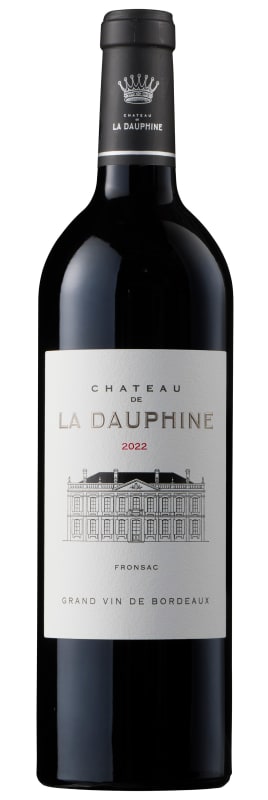


Winemaker Notes
Blend: 80% Merlot, 20% Cabernet Franc
Professional Ratings
-
Decanter
Richly concentrated dark berry fruits with crushed stones and slate minerality on the nose. Supple, generous and bright, this is so smooth and sleek, excellently weighted in the mouth with quite a sharp, almost sour tang to the fruit that gives a buzz to the palate while the crushed stone, slate, graphite and pencil lead give the salty undercurrent. Liquorice and clove join towards the finish giving a spiced angle all adding to quite a complex whole. Lovely purity of fruit, still tense and focussed but sculpted and well worked retaining a sense of finesse and restraint as well as the terroir markers. 3.5pH. HVE3 certified. Ageing in separate lots for 12 months with 30% new wood, amphora and foudres. Julien Viaud consultant.
-
Jeb Dunnuck
Gorgeous stuff, the 2022 Château La Dauphine is richly textured and layered, with notes of black cherries, red plums, spicy wood, dried flowers, and chocolate. Round, concentrated, and medium to full-bodied, it has polished tannins and a great finish. It has a solid 10-12 years of prime drinking ahead of it.
-
James Suckling
This youthful and fruit-forward red has notes of fresh plums, mulberries and violets. It’s medium-bodied, creamy and broad, with chalky and still chewy tannins. 85% merlot and 15% cabernet franc. From organically grown grapes. Best from 2027.
-
Wine Spectator
Violet and iris notes dart out from a core of black currant and bitter cherry fruit flavors, while a swath of warm earth and tobacco moves in on the finish. A solid, terroir-driven style. Merlot and Cabernet Franc. Best from 2026 through 2036.


One of the world’s most classic and popular styles of red wine, Bordeaux-inspired blends have spread from their homeland in France to nearly every corner of the New World. Typically based on either Cabernet Sauvignon or Merlot and supported by Cabernet Franc, Malbec and Petit Verdot, the best of these are densely hued, fragrant, full of fruit and boast a structure that begs for cellar time. Somm Secret—Blends from Bordeaux are generally earthier compared to those from the New World, which tend to be fruit-dominant.

Home of the very first remarkable Right Bank wines, dating back to the 1730s, Fronsac and Canon-Fronsac actually retained more fame than Pomerol well into the 19th century. Today these wines represent some of Bordeaux’s best hidden gems.
Fronsac is a very small region at an unusually high elevation compared to other Bordeaux appellations. Its vineyards unroll along the oak-dotted hills bordering the river’s edge, making it perhaps Bordeaux’s prettiest and most majestic countryside.
Merlot covers 60% of the vineyard acreage; the rest of the vines are Cabernet Franc and Cabernet Sauvignon. The Fronsac and Canon-Fronsac appellations are limited to the higher land where soils are predominantly limestone and sandstone. Lower vineyards along the Dordogne River mainly qualify for Bordeaux AOC status
The best Fronsac are deeply concentrated in ripe red and black berry; they have a solid mineral backbone and are rich and plush on the finish.