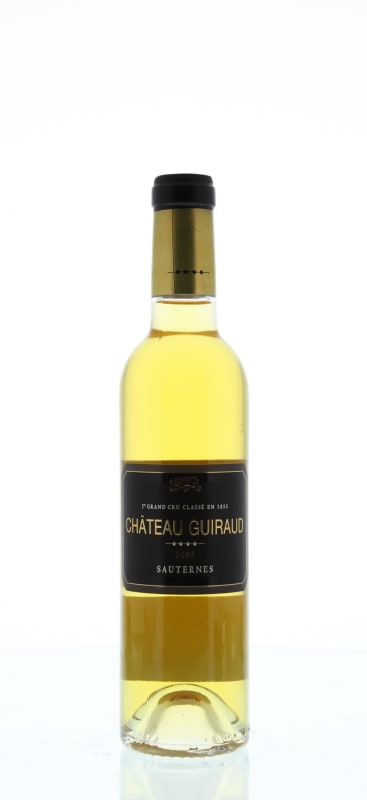


Winemaker Notes
The cool nights of August and shining sun of Septemberbrought a great complexity to this vintage.Château Guiraud 2005 is a great, complex andexuberant wine. We feel very fine aromas of crystallizedorange, exotic and mentholated notes as well as a littlebit of ginger. Thanks to a very beautiful noble rot thisyear, the botrytis has a splendid purity. The final taste isexplosive, honeyed, spicy and it lasts a very long time…
Professional Ratings
-
James Suckling
This appears to be the synthesis of the fabulous 2001 and 2003. It shows wonderful aromas of botrytis spice, honey and citrus rind. Lots of fruit with a tropical fruit undertone of mango and papaya on the palate. Intense finish. Too excellent not to drink.
-
Wine Spectator
#4 Wine Spectator Top 100 of 2008Delivers lots of botrytis spice, with lemon tart and cooked apple. Full-bodied, with loads of cream and vanilla and an intense tropical fruit and honey aftertaste. Long and viscous, with a layered and beautiful spicy finish. Hard not to drink it now. Best after 2014.
-
Wine Enthusiast
Typical of the huge power of Guiraud, this is one of the richest Sauternes in 2005. The wine is rich and intense, the dry edge of botrytis just dominating the sweetness. Flavors of honey, almonds and peaches give the wine extra complexity.
-
Wine & Spirits
Seething with power, there's baritone richness to this wine's complex fruit, a deeper tone to the surface of honey and citrus. It feels clean, fresh and bright, the structure holding the wine's complexity tight for now, waiting to release it with age.
-
Connoisseurs' Guide
No quibbles here. This is a concentrated, fairly complex offering whose pear syrup, pineapple, roasted nuts, coconutty aromas may be the slightest bit unusual but are every bit inviting. Juicy and rich in flavor with more than a touch of honey noted, the wine has plenty of underlying acidity that helps make its youthfully sugary flavors attractive even now but which also guarantees that this lush wine has a second decade and possibly more in its future.
-
Robert Parker's Wine Advocate
Tasted blind at the 10-Year On Tasting in Sauternes. The 2005 Château Guiraud has a rich nose of dried honey, orange blossom and buttercup that is nicely defined but does not quite have the intensity of the best Sauternes 05s. The palate is fresh and lithe on the entry, smooth and honeyed both in taste and texture with a long orange zest, vanilla and almond finish that is sensual and persistent. It meliorates in the glass, forages more zest and vitality, so don’t be afraid to aerate/decant this for an hour or two.


Apart from the classics, we find many regional gems of different styles.
Late harvest wines are probably the easiest to understand. Grapes are picked so late that the sugars build up and residual sugar remains after the fermentation process. Ice wine, a style founded in Germany and there referred to as eiswein, is an extreme late harvest wine, produced from grapes frozen on the vine, and pressed while still frozen, resulting in a higher concentration of sugar. It is becoming a specialty of Canada as well, where it takes on the English name of ice wine.
Vin Santo, literally “holy wine,” is a Tuscan sweet wine made from drying the local white grapes Trebbiano Toscano and Malvasia in the winery and not pressing until somewhere between November and March.
Rutherglen is an historic wine region in northeast Victoria, Australia, famous for its fortified Topaque and Muscat with complex tawny characteristics.

Sweet and unctuous but delightfully charming, the finest Sauternes typically express flavors of exotic dried tropical fruit, candied apricot, dried citrus peel, honey or ginger and a zesty beam of acidity.
Sémillon, Sauvignon Blanc, Sauvignon Gris and Muscadelle are the grapes of Sauternes. But Sémillon's susceptibility to the requisite noble rot makes it the main variety and contributor to what makes Sauternes so unique. As a result, most Sauternes estates are planted to about 80% Sémillon. Sauvignon is prized for its balancing acidity and Muscadelle adds aromatic complexity to the blend with Sémillon.
Botrytis cinerea or “noble rot” is a fungus that grows on grapes only in specific conditions and its onset is crucial to the development of the most stunning of sweet wines.
In the fall, evening mists develop along the Garonne River, and settle into the small Sauternes district, creeping into the vineyards and sitting low until late morning. The next day, the sun has a chance to burn the moisture away, drying the grapes and concentrating their sugars and phenolic qualities. What distinguishes a fine Sauternes from a normal one is the producer’s willingness to wait and tend to the delicate botrytis-infected grapes through the end of the season.