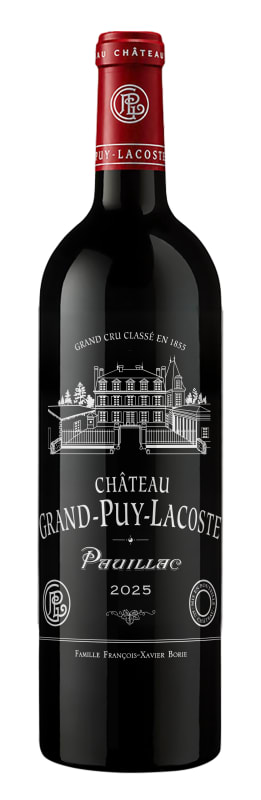


Winemaker Notes
Blend: 76% Cabernet Sauvignon, 24% Merlot
Professional Ratings
-
James Suckling
Excellent GPL, medium- to full-bodied with a great expression of dark fruit that is evenly distributed. It’s fresh and precise with grainy, integrated tannins that should only integrate more. A blend of 76% cabernet sauvignon and 24% merlot.
Barrel Sample: 96-97 -
Robert Parker's Wine Advocate
The 2025 Grand-Puy-Lacoste reveals a classic, refined bouquet of cassis, dark berries, cedar and lead pencil, with discreet floral nuances. Medium- to full-bodied, structured and precise, it’s built around a well-defined core of fruit framed by finely grained, youthful, filigreed tannins with a tensile profile. Less demonstrative than some of its peers in Pauillac, it privileges balance and typicity over sheer power, concluding with a long, elegant and mineral finish. Produced from a blend of 76% Cabernet Sauvignon and 24% Merlot, this is the first vintage vinified in the estate’s new gravity-fed cellar, enabling more precise parcel selection—an evolution that appears to reinforce the wine’s precision and coherence.
Barrel Sample: 95-97 -
Jeb Dunnuck
A Cabernet-dominant blend of 76% Cabernet Sauvignon and 24% Merlot from yields of 30 hectoliters per hectare, the 2025 Château Grand Puy Lacoste is gorgeous, with ultra-classic Pauillac aromatics of red and black fruits, lead pencil, graphite, and crushed stone. Medium-bodied on the palate, it has a concentrated, layered mouthfeel, ripe tannins, and a great finish. It's up there with the top vintages of this cuvée, and it doesn't get more Pauillac than this.
Barrel Sample: 94-96 -
Vinous
The 2025 Grand-Puy-Lacoste is the first to be made in the new gravity-fed winery. It was picked between September 4 and 18 at 30 hl/ha, much lower than normal, with a high percentage of Cabernet Sauvignon (76%). Matured in 65% new oak, it has a perfumed bouquet with blackberry and raspberry fruit, touches of graphite emerging with aeration, beautifully defined. The palate is medium-bodied with edgy tannins. Definitely one of the most refined GPLs that I have tasted at this stage, very harmonious, complex and engaging. Superb persistence on the finish, this is a complete Pauillac that is going to give immense pleasure. –Neal Martin
Barrel Sample: 94-96 -
Decanter
Deep violets and heady blackcurrants on the nose, fresh though, inviting and crystalline – aromatically expressive. Supple and sapid with a real hands-off feeling. Approachable with a clean, clear grip to the fine tannins, mint, cool blueberries, graphite and wet stones. The terroir really shines in the glass. Feels very modern with mouthwatering acidity setting the tone – bright, lively and upfront. Delicious, crunchy and leaves a lasting impression with grip, tension, energy and focus. Maybe a little less dense than usual but more refined. 13%. A yield of 30hl/ha.
Barrel Sample: 95


One of the world’s most classic and popular styles of red wine, Bordeaux-inspired blends have spread from their homeland in France to nearly every corner of the New World. Typically based on either Cabernet Sauvignon or Merlot and supported by Cabernet Franc, Malbec and Petit Verdot, the best of these are densely hued, fragrant, full of fruit and boast a structure that begs for cellar time. Somm Secret—Blends from Bordeaux are generally earthier compared to those from the New World, which tend to be fruit-dominant.

The leader on the Left Bank in number of first growth classified producers within its boundaries, Pauillac has more than any of the other appellations, at three of the five. Chateau Lafite Rothschild and Mouton Rothschild border St. Estephe on its northern end and Chateau Latour is at Pauillac’s southern end, bordering St. Julien.
While the first growths are certainly some of the better producers of the Left Bank, today they often compete with some of the “lower ranked” producers (second, third, fourth, fifth growth) in quality and value. The Left Bank of Bordeaux subscribes to an arguably outdated method of classification that goes back to 1855. The finest chateaux in that year were judged on the basis of reputation and trading price; changes in rank since then have been miniscule at best. Today producers such as Chateau Pontet-Canet, Chateau Grand Puy-Lacoste, Chateau Lynch-Bages, among others (all fifth growth) offer some of the most outstanding wines in all of Bordeaux.
Defining characteristics of fine wines from Pauillac (i.e. Cabernet-based Bordeaux Blends) include inky and juicy blackcurrant, cedar or cigar box and plush or chalky tannins.
Layers of gravel in the Pauillac region are key to its wines’ character and quality. The layers offer excellent drainage in the relatively flat topography of the region allowing water to run off into “jalles” or streams, which subsequently flow off into the Gironde.