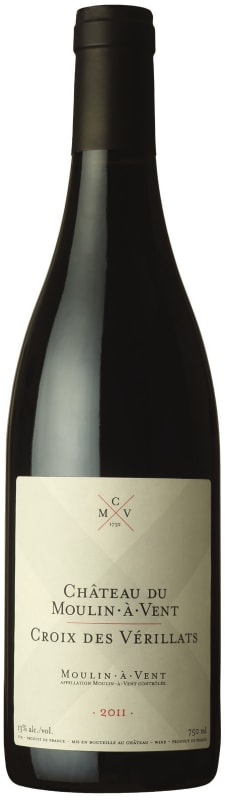


Winemaker Notes
Professional Ratings
-
Wine Enthusiast
From a fine vintage, this is a rich, generous and impressive wine. It has structure, spice and a creamy texture from the 14 months in wood. Great acidity gives just the right amount of freshness to the black currant and black-cherry fruits. It's well worth aging.
-
Robert Parker's Wine Advocate
The team here, expressing their satisfaction with last year’s rendition, says they did not change any significant elements of fermentation for the Chateau du Moulin-a-Vent 2011 Moulin-a-Vent Croix des Verillats, and in its elevage only the much more substantial reliance on 350-liter rather than 228-liter barrels. Tasted just ahead of its anticipated end-of-2012 bottling, this evinces cherry and black raspberry with distilled overtones; satisfyingly saline, roasted red meat and chalky undertones; brown spices and vanilla from barrel; and a fine spread of tannin that might well reflect the change made in cooperage. As it takes on air, alluring perfume of wisteria and violets rises from the glass, persisting inner-mouth. The 10,000 bottles of this long-finishing beauty should be well worth seeking out and savoring at least through 2018 (though, to be sure, it is the Chateau’s intention that these prove significantly longer-term vins de garde, and perhaps their expectations will be borne out, though I’m unprepared to predict that).
Range: 91-92


Delightfully playful, but also capable of impressive gravitas, Gamay is responsible for juicy, berry-packed wines. From Beaujolais, Gamay generally has three classes: Beaujolais Nouveau, a decidedly young, fruit-driven wine, Beaujolais Villages and Cru Beaujolais. The Villages and Crus are highly ranked grape growing communes whose wines are capable of improving with age whereas Nouveau, released two months after harvest, is intended for immediate consumption. Somm Secret—The ten different Crus have their own distinct personalities—Fleurie is delicate and floral, Côte de Brouilly is concentrated and elegant and Morgon is structured and age-worthy.

The bucolic region often identified as the southern part of Burgundy, Beaujolais actually doesn’t have a whole lot in common with the rest of the region in terms of climate, soil types and grape varieties. Beaujolais achieves its own identity with variations on style of one grape, Gamay.
Gamay was actually grown throughout all of Burgundy until 1395 when the Duke of Burgundy banished it south, making room for Pinot Noir to inhabit all of the “superior” hillsides of Burgundy proper. This was good news for Gamay as it produces a much better wine in the granitic soils of Beaujolais, compared with the limestone escarpments of the Côte d’Or.
Four styles of Beaujolais wines exist. The simplest, and one that has regrettably given the region a subpar reputation, is Beaujolais Nouveau. This is the Beaujolais wine that is made using carbonic maceration (a quick fermentation that results in sweet aromas) and is released on the third Thursday of November in the same year as harvest. It's meant to drink young and is flirty, fruity and fun. The rest of Beaujolais is where the serious wines are found. Aside from the wines simply labelled, Beaujolais, there are the Beaujolais-Villages wines, which must come from the hilly northern part of the region, and offer reasonable values with some gems among them. The superior sections are the cru vineyards coming from ten distinct communes: St-Amour, Juliénas, Chénas, Moulin-à-Vent, Fleurie, Chiroubles, Morgon, Regnié, Brouilly, and Côte de Brouilly. Any cru Beajolais will have its commune name prominent on the label.