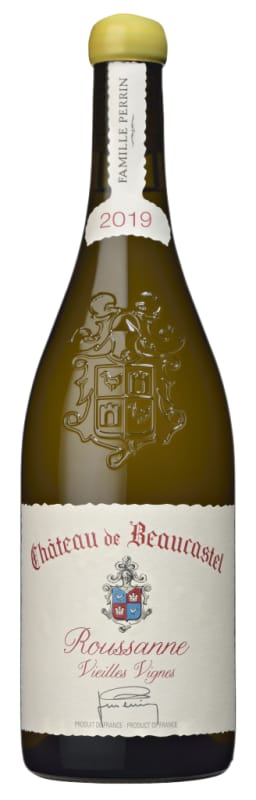


Winemaker Notes
Very beautiful golden color with shiny reflections. On the nose, this wine offers notes of quince, lime, and roasted pineapple. Very elegant on the palate, delicately oaky with an opulent texture, it reveals aromas of white flowers such as acacia and honeysuckle, honey, and citrus zest. The finish is exceptionally long and salty.
Professional Ratings
-
Jeb Dunnuck
One of my favorite whites in the world is the old vine Roussanne cuvée from Beaucastel, which comes from a single 3-hectare parcel just outside the domaine, in the northern, cooler part of Châteauneuf du Pape. The 2019 Châteauneuf Du Pape Roussanne Vieilles Vignes is another thrilling example of Roussanne and offers a vivid gold hue as well as gorgeous notes of white currants, honeysuckle, white flowers, crushed stone, and hints of gunpowder. With beautiful freshness, full-bodied richness, and ample power, it’s unquestionably the Montrachet of the Southern Rhône and a magical white. You can safely drink bottles anytime over the coming decade, then it’s best forgotten until around 20 years after the vintage.
-
Robert Parker's Wine Advocate
There are a mere 500 cases of the 2019 Chateauneuf du Pape Roussanne Vieilles Vignes, which derives from vines planted in 1909. Showing fabulous richness and opulence allied to an impeccable sense of balance and nearly infinite persistence, it's a tour de force of white Châteauneuf. Hints of roasted pineapple and grilled lime mark the nose, while the medium to full-bodied palate boasts layers of honeyed, creamy decadence yet remains dry, zesty and refreshing at the same time. Like most great wines, it's a study in seeming contradictions drawn together into seamless elegance. While there's a chance this wine may go through a quiescent phase, it's singing now, and if history is any indication, it will also drink well in a decade or so.


Full and silky in body but also charmingly crisp, Roussanne is native to the Rhône Valley of France. It is responsible for some of the finest Northern Rhône white wines. Roussanne adds richness and acidity to Marsanne’s soft, fruitiness, making age worthy and highly respected whites. Somm Secret—Roussanne takes its name from the French word, roux, meaning rouge or red because of the berry’s pink glow. In California, virtually all of the 339 acres of Roussanne come from true clones brought over by Tablas Creek and John Alban.

Famous for its full-bodied, seductive and spicy reds with flavor and aroma characteristics reminiscent of black cherry, baked raspberry, garrigue, olive tapenade, lavender and baking spice, Châteauneuf-du-Pape is the leading sub-appellation of the southern Rhône River Valley. Large pebbles resembling river rocks, called "galets" in French, dominate most of the terrain. The stones hold heat and reflect it back up to the low-lying gobelet-trained vines. Though the galets are typical, they are not prominent in every vineyard. Chateau Rayas is the most obvious deviation with very sandy soil.
According to law, eighteen grape varieties are allowed in Châteauneuf-du-Pape and most wines are blends of some mix of these. For reds, Grenache is the star player with Mourvedre and Syrah coming typically second. Others used include Cinsault, Counoise and occasionally Muscardin, Vaccarèse, Picquepoul Noir and Terret Noir.
Only about 6-7% of wine from Châteauneuf-du-Pape is white wine. Blends and single-varietal bottlings are typically based on the soft and floral Grenache Blanc but Clairette, Bourboulenc and Roussanne are grown with some significance.
The wine of Chateauneuf-du-Pape takes its name from the relocation of the papal court to Avignon. The lore says that after moving in 1309, Pope Clément V (after whom Chateau Pape-Clément in Pessac-Léognan is named) ordered that vines were planted. But it was actually his successor, John XXII, who established the vineyards. The name however, Chateauneuf-du-Pape, translated as "the pope's new castle," didn’t really stick until the 19th century.