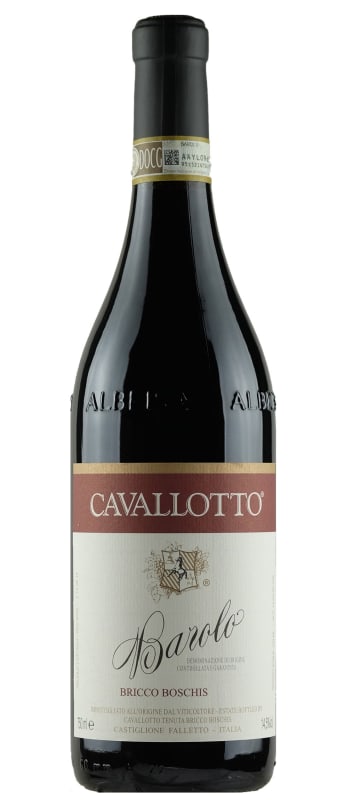


Winemaker Notes
All of the grapes for this wine come from the single 'cru' called Bricco Boschis. This is classic Castiglione Falletto Barolo, combining the clear fruit notes of La Morra and Barolo itself (strawberry, occasionally red-currant) with many other botanical notes supported by middling dark-chocolate tannins. It's firmer than La Morra, but not as beefy as Serralunga. While it can be drunk while young, this will age for as long as you can resist opening it.
Professional Ratings
-
Jeb Dunnuck
The 2018 Barolo Bricco Boschis pours a deep ruby and has spiced and enveloping aromatics of cigar box, leather, pure red cherry, and turned earth. This medium-bodied red is approachable and graceful, with moderate tannins and good concentration in its notes of Earl Grey tea, blood orange, and raspberry liqueur.
-
Wine Enthusiast
Capturing the freshness and finesse of the vintage, this has classic varietal aromas of rose petal, forest berry, camphor and underbrush. Reflecting the nose, the vibrant, focused palate delivers ripe red cherry, crushed raspberry, wild mint and star anise set against taut, refined tannins. Bright acidity keeps it balanced. While you won't have to wait years before enjoying this, it will also age at least another decade or more. Best 2024–2033.
-
Decanter
Muscular and powerful, don’t search for elegance here. Bricco Boschis is an old style Barolo typical of Alfio Cavallotto and his passion for authentic wines. The concentration and power are impressive for the 2018 vintage. Prunes and leather, leafy lightness, a touch of orange and an almost grapefruit note are sustained by firm acidity on a large, full, biting palate built for the long haul, filled out with youthful fruit concentration.
-
Robert Parker's Wine Advocate
The Cavallotto 2018 Barolo Bricco Boschis (a certified organic wine) is a lovely expression with fruit from one of the most beautiful sites in Castiglione Falletto, measuring 7.3 hectares. The wine is streamlined and tight with forest berry, blackcurrant and spice. It is taut and silky, showing fruit that has been shaped by cool nights and warm days. Bricco Boschis always delivers a special sense of sharpness and focus. Best After 2024
-
Wine Spectator
A firmly structured, dry Barolo, with a core of cherry and plum shaded by earth and tobacco elements. Turns austere, picking up an underlying mineral streak on the finish. Best from 2025.


Responsible for some of the most elegant and age-worthy wines in the world, Nebbiolo, named for the ubiquitous autumnal fog (called nebbia in Italian), is the star variety of northern Italy’s Piedmont region. Grown throughout the area, as well as in the neighboring Valle d’Aosta and Valtellina, it reaches its highest potential in the Piedmontese villages of Barolo, Barbaresco and Roero. Outside of Italy, growers are still very much in the experimentation stage but some success has been achieved in parts of California. Somm Secret—If you’re new to Nebbiolo, start with a charming, wallet-friendly, early-drinking Langhe Nebbiolo or Nebbiolo d'Alba.

The center of the production of the world’s most exclusive and age-worthy red wines made from Nebbiolo, the Barolo wine region includes five core townships: La Morra, Monforte d’Alba, Serralunga d’Alba, Castiglione Falletto and the Barolo village itself, as well as a few outlying villages. The landscape of Barolo, characterized by prominent and castle-topped hills, is full of history and romance centered on the Nebbiolo grape. Its wines, with the signature “tar and roses” aromas, have a deceptively light garnet color but full presence on the palate and plenty of tannins and acidity. In a well-made Barolo wine, one can expect to find complexity and good evolution with notes of, for example, strawberry, cherry, plum, leather, truffle, anise, fresh and dried herbs, tobacco and violets.
There are two predominant soil types here, which distinguish Barolo from the lesser surrounding areas. Compact and fertile Tortonian sandy marls define the vineyards farthest west and at higher elevations. Typically the Barolo wines coming from this side, from La Morra and Barolo, can be approachable relatively early on in their evolution and represent the “feminine” side of Barolo, often closer in style to Barbaresco with elegant perfume and fresh fruit.
On the eastern side of the Barolo wine region, Helvetian soils of compressed sandstone and chalks are less fertile, producing wines with intense body, power and structured tannins. This more “masculine” style comes from Monforte d’Alba and Serralunga d’Alba. The township of Castiglione Falletto covers a spine with both soil types.
The best Barolo wines need 10-15 years before they are ready to drink, and can further age for several decades.