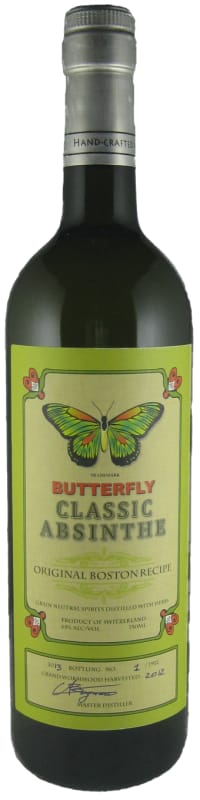


Distiller Notes
The best absinthes should rarely, if ever, be consumed straight and have always been distilled at high strengths in order to be mixed with water. For the perfect serve, slowly add four to five parts iced water from a carafe, absinthe fountain or balancier. With Butterfly, some absinthe lovers will prefer not to pour the water over a sugar cube and, of course, there is absolutely no need to burn it.
For the perfect serve, slowly add 4 to 5 parts iced water and watch the metamorphosis as the liquid turns milky white with a hint of pastel green. Created more than 100 years ago for consumers looking for a slightly more accessible taste profile, Butterfly adds citrus and mint notes to the flavors of anise and fennel and the slight bitterness of wormwood.
Proof: 130
Professional Ratings
-
Wine Enthusiast
The backstory is a little complicated: first made in Boston circa 1902, it's now been resurrected in Switzerland, thanks to a Boston-based historian. The absinthe itself is more straightforward. It louches to cloudy pale yellow, releasing a mild, citrusy aroma. On the palate, the star anise flavor is assertive and bright, even when diluted with water, and backed by lemongrass and ginger.


Enjoyed for hundreds of years in Europe as a restorative and cure for many types of maladies, Absinthe reached its peak popularity in late 19th and early 20th century Parisian bars and cafés where it was a favorite of Hemingway, Joyce, Van Gogh and Picasso. Similar to Gin, Absinthe is a neutral, high proof spirit (110 to 144) infused with a variety of herbs and botanicals. These typically include green anise, sweet fennel and grand wormwood. Absinthe is most often light green in color but can also be clear.