


Winemaker Notes
Pair with all fish, especially sushi and sashimi, shellfish such as shrimp, prawns, crayfish and grilled lobster, poultry and white meat, cashews, parmesan or prosciutto.
Professional Ratings
-
Decanter
60% Pinot Noir, 25% Chardonnay, 15% Meunier sourced from more than 300 crus, including 85% grands and premiers crus; 15% fermented in old oak barrels. The complexity and richness of Special Cuvée is unparalleled among the entry non-vintage blends of every Champagne house, short of ascending to the mesosphere of Krug. Its grand recipe explains why, built on incredible depth of 50%-60% reserves. Triumphant complexity is a given at Bollinger, but it’s the dynamic freshness and vitality that really set it apart as one of the most affordable Champagne benchmarks.
-
Australian Wine Companion
Spectacularly complex ‘Poor Man's Krug’, a Catherine Wheel of spice and apple aromas and flavours; superb structure and imposing length. Surely the greatest value champagne of all. More than 300 parcels from more than 85% grand crus and premier crus, 15% of the base wine fermented in old barrels; 60/25/15% pinot noir, chardonnay and pinot meunier.
-
Wilfred Wong of Wine.com
COMMENTARY: In my nearly five decades of working in the wine trade—I started young—Bollinger has been my number one Champagne of choice. This wine has been consistently excellent. The current Special Cuvée Brut seems a bit fresher and brighter than past efforts. TASTING NOTES: This wine is beautiful. Its aromas and flavors of ripe apples and light yeasty notes—enhanced with a touch of chalkiness—should make it an excellent choice with clams and linguine in a reduction sauce of white wine, slivered garlic, and freshly-cracked black pepper. (Tasted: September 24, 2018, San Francisco, CA)
-
Jeb Dunnuck
A rich though youthful golden hue, the NV Champagne Special Cuvee Brut is classic and ripe with lush, rounded, and complex aromas of golden apricot, hazelnut, wet stone, and black cherry. Made with 45% of the wine coming from the 2019 vintage, with 55% reserve wine, it’s full-bodied yet elegant and light on its feet, with a ripe and luxurious feel and just a hint of warmth on the finish. The mousse is refined and rounded. Long on the palate, it's inviting now but will have plenty of life ahead of it if stored property. This exceptional cuvee with its distinctive personality continues to be one of the best entry wines to the range from this house and is a benchmark wine for them.
-
James Suckling
A polished palate of fine bubbles with pears, light bread dough and caramel undertones. Medium-bodied with pretty toasted-oak and vanilla flavors. Refined finish. Touch of quince and grapefruit with dried apples. Base wine 2021 plus nine different vintages. A blend of 61% pinot noir, 25% chardonnay and 14% pinot meunier.
-
Wine Spectator
This harmonious Champagne is wonderfully vibrant as it dances across the palate, with the satinlike mousse carrying flavors of white cherry, Marcona almond and ground coffee that show accents of candied kumquat, ginger, aromatic verbena and graphite. A streak of racy salinity emerges on mouthwatering finish. Pinot Noir, Chardonnay and Pinot Meunier. Drink now
-
Robert Parker's Wine Advocate
Disgorged in May 2021, the latest rendition of Bollinger's NV Brut Special Cuvée is showing beautifully, offering up aromas of ripe orchard fruit, citrus oil and peach, mingled with hints of walnuts and freshly baked bread. Medium to full-bodied, fleshy and enveloping, with a generous core of fruit, lively acids and a pillowy mousse, it's seamless and complete, concluding with an expansive finish.
-
Wine Enthusiast
As always with this producer, this iconic nonvintage cuvée is dominated by Pinot Noir that gives impressive richness as well as ripe stone fruits. Wood fermentation adds further complexity as does the age of this bottling before release. Drink this Champagne now.
-
Wine & Spirits
A vinous Champagne, this has pinot-noir depths of flavor, the structure enhanced by barrel-fermented reserve wines. Youthfully blunt in its power, this will benefit from a year in the cellar, when it can settle into its dry mineral savor and hazelnut grace.
-
Connoisseurs' Guide
60% Pinot Noir; 25% Chardonnay; 15% Pinot Meunier. All Bolly in its toasty, chalky, slightly angular but powerful way, this wine reminds of the company's "Grande Annee" in its fairly bold approach. Frothy and insistent in its bubbles and tasty, rich, toasty, stony and vanillin all at the same time, this is Champagne with a purpose, and, in this case, it works without being over the top in any dimension.


In 1829, Champagne Bollinger introduced an instantly recognizable, dry, toasty style that connoisseurs around the globe have coveted ever since. Six generations of the Bollinger family have maintained that trademark style, and Bollinger is one of the rare Grande Marque houses to be owned, controlled and managed by the same family since it was founded.
With 399 acres of vineyards situated in the best Grands Crus and Premiers Crus villages, Bollinger relies on its own estate for nearly two-thirds of its grape requirements, including the Pinot Noir that gives its Champagne its distinctive roundness and elegance. Bollinger is one of a select few houses that can control the quality of its grape supply so carefully.
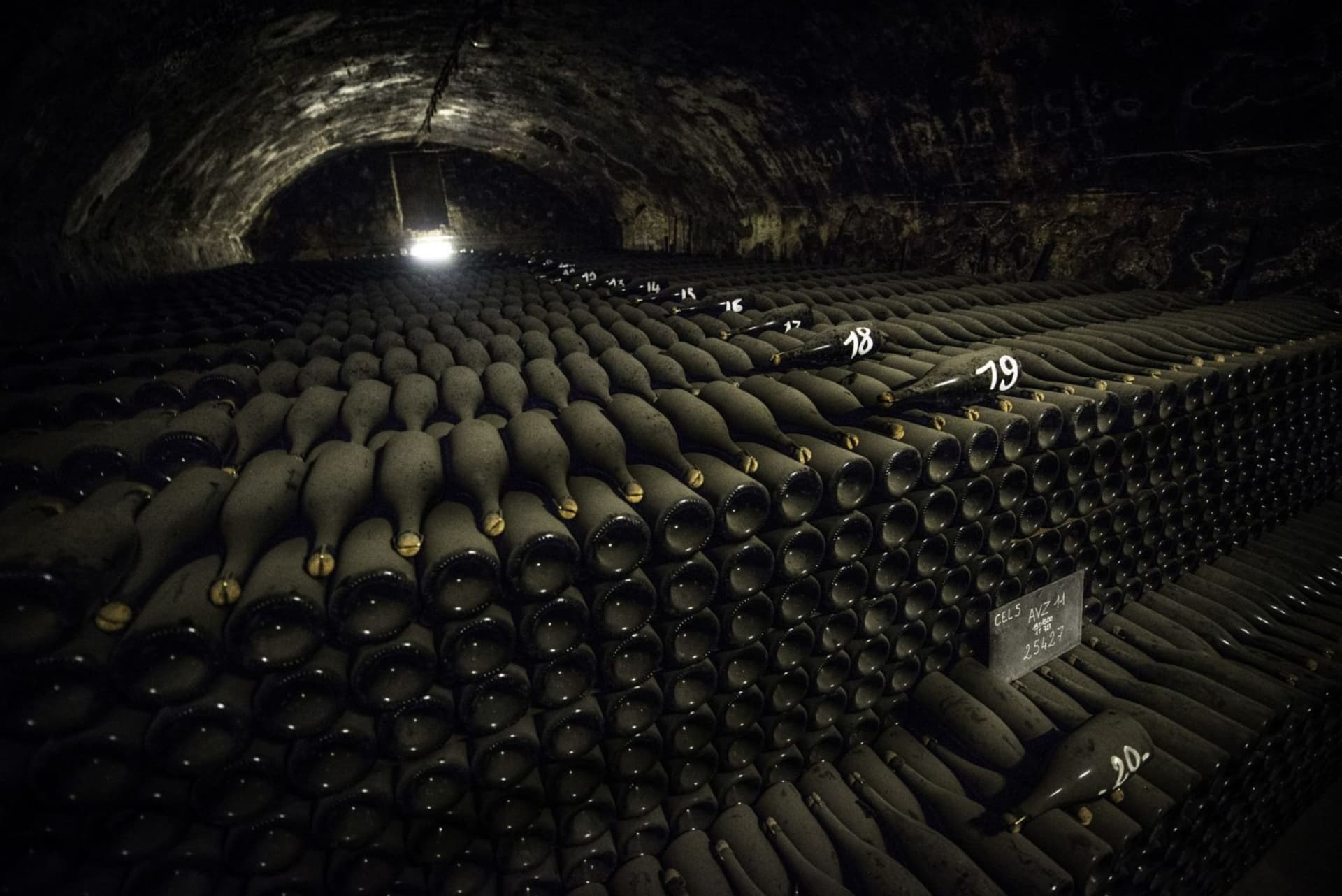
Bollinger is renowned for its stringent quality standards. It adheres to traditional methods, including individual vinification of each marc and cru, barrel fermentation (it is the last Champagne house to employ a full-time cooper) and extra-aging on the lees prior to disgorgement.
Members of the British Royal Court were among the first to embrace Bollinger’s unmistakable quality, and Queen Victoria made Bollinger the exclusive purveyor to the Court by Royal Warrant in 1884. Besides royalty, loyal devotees have included heads of state, celebrities and even famous fictional characters: Agent 007, James Bond, demands the exclusive Champagne Bollinger.

A term typically reserved for Champagne and Sparkling Wines, non-vintage or simply “NV” on a label indicates a blend of finished wines from different vintages (years of harvest). To make non-vintage Champagne, typically the current year’s harvest (in other words, the current vintage) forms the base of the blend. Finished wines from previous years, called “vins de reserve” are blended in at approximately 10-50% of the total volume in order to achieve the flavor, complexity, body and acidity for the desired house style. A tiny proportion of Champagnes are made from a single vintage.
There are also some very large production still wines that may not claim one particular vintage. This would be at the discretion of the winemaker’s goals for character of the final wine.

Associated with luxury, celebration, and romance, the region, Champagne, is home to the world’s most prized sparkling wine. In order to bear the label, ‘Champagne’, a sparkling wine must originate from this northeastern region of France—called Champagne—and adhere to strict quality standards. Made up of the three towns Reims, Épernay, and Aÿ, it was here that the traditional method of sparkling wine production was both invented and perfected, birthing a winemaking technique as well as a flavor profile that is now emulated worldwide.
Well-drained, limestone and chalky soil defines much of the region, which lend a mineral component to its wines. Champagne’s cold, continental climate promotes ample acidity in its grapes but weather differences from year to year can create significant variation between vintages. While vintage Champagnes are produced in exceptional years, non-vintage cuvées are produced annually from a blend of several years in order to produce Champagnes that maintain a consistent house style.
With nearly negligible exceptions, . These can be blended together or bottled as individual varietal Champagnes, depending on the final style of wine desired. Chardonnay, the only white variety, contributes freshness, elegance, lively acidity and notes of citrus, orchard fruit and white flowers. Pinot Noir and its relative Pinot Meunier, provide the backbone to many blends, adding structure, body and supple red fruit flavors. Wines with a large proportion of Pinot Meunier will be ready to drink earlier, while Pinot Noir contributes to longevity. Whether it is white or rosé, most Champagne is made from a blend of red and white grapes—and uniquely, rosé is often produce by blending together red and white wine. A Champagne made exclusively from Chardonnay will be labeled as ‘blanc de blancs,’ while ones comprised of only red grapes are called ‘blanc de noirs.’