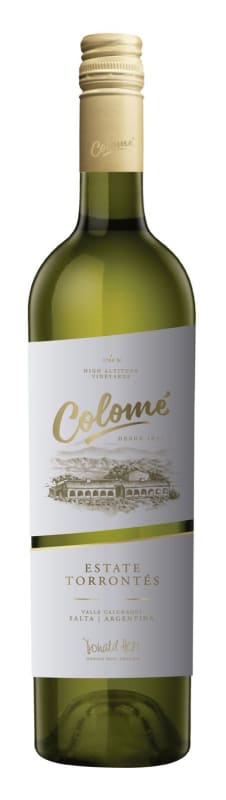


Winemaker Notes
Torrontés offers the floral notes of roses, the citrus aroma of grapefruit and a spicy hint. In the mouth it is fresh, round and well-bodied with a long, elegant finish.
Professional Ratings
-
James Suckling
Plenty of lemon-rind, white-peach and green-apple aromas follow through to a full-bodied, firm and fresh palate and a long, lingering finish. Shows tightness and crispness down the line.
-
Decanter
A wonderful example of Torrontés from high altitude vineyards (1,700m) in Salta. It exhibits a pale straw colour with a golden hue. Aromas are vibrant and youthful including rose petals, grapefruit, lychees and a hint of ginger spice. On the palate it is intense, forward and expressive, underpinned by balancing freshness. Alcohol at 13.5% is warm but well integrated. Drinking Window 2020 - 2025






Unapologetically fun and distinctively fragrant, Torrontés is regarded as the signature white grape of Argentina. In many ways it bears a striking resemblance to Muscat (and in fact is an offspring of Muscat of Alexandria). Sommelier Secret—If you’re in search of a new summer sipper, look no further than Torrontés. These wines are always inexpensive, delightfully refreshing and are best enjoyed in the sunny outdoors at a picnic, poolside or on the porch.

The Salta region in northern Argentina is home to world’s highest vineyards. Near the town of Payogasta, the Colomé Altura Máxima vineyard is planted at 10,206 feet in elevation.
Salta is part of the Calchaquí Valley, which benefits from more than 300 days of sun per year, subjecting its vines to considerable ultraviolet radiation. The valley experiences strong high altitude winds, even in the “lower” vineyards, which are planted at 5,413 feet. Because of these elevations and resulting extreme conditions, vines produce lower yields and thicker-skinned grapes, resulting in concentrated, aromatic and well-structured wines.
In a truly unique region, the highly aromatic variety, Torrontes, thrives; intense sun exposure allows full ripening, while cooling winds maintain the grapes’ acidity levels and phenolic balance.
Malbec, Cabernet Sauvignon, Bonarda, Syrah, and, particularly, Tannat have the most potential among reds.
Upscale hotels, beautiful colonial architecture, a majestic Andean backdrop and impressive food and wine make the area attractive among tourists as well.
Salta is the fourth most important Argentine wine-producing region after Mendoza, San Juan, and La Rioja. Its oldest vineyards were planted in 1862.