


Winemaker Notes
Pale yellow with greenish tints. Intense, rich, moderately fruity, complex scent. Medium-bodied, dry, mineral, with a pleasant high acidity, saline notes, marked aromatic persistence and after taste of anise and almond.
Professional Ratings
-
Jeb Dunnuck
Looking at the last ten seasons in Etna, 2020 falls into the category of a fresh vintage, as did 2016. The 2020 Etna Bianco Superiore Pietra Marina is bright, with notes of saline, fresh pineapple, lemon oil, and petrol. The palate is vertical and exhibits a lot of tension, with a medium-bodied frame, refreshing acidity, and a focused finish.
-
James Suckling
Very smoky style with seaweed, broom flowers and kerosene, enhanced by rich stone fruit and mineral depth. Electric on the palate, this has crisp acidity, tight texture and a lean finish, yet it’s silky and precise. Really savory and long with an almost peaty aftertaste.
-
Wine Spectator
A subtle skein of milled white pepper and fennel seed laces finely woven flavors of poached pear, Meyer lemon peel, lentil and beeswax, plus delicate mountain herb and floral notes. This classy white is backed by statuesque acidity, while a racy streak of petrol, stone and saline pushes through and echoes on the long, zesty finish.
-
Vinous
The 2020 Etna Bianco Superiore Pietra Marina is lifted and finessed with a remarkably pretty and airy character as white flowers, smoke and a dusting of sweet spice give way to nectarines. Elegant in feel yet seemingly weightless, it splashes across the palate with perfumed orchard fruit tones. Nuances of ginger mix with minerals and a subtle hint of citrus as the 2020 finishes with admirable length and a saline note. I'm not finding the typical tension and verticality of Pietra Marina here, but with that said, the 2020 is still lovely.



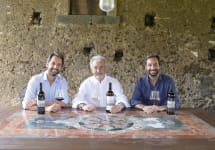
At the end of the 1800’s, Giuseppe Benanti, grandfather of Dr. Giuseppe Benanti, began the production of wines on one of his father’s old farms on the slopes of Mount Etna, at Viagrande (Catania). In 1988, Giuseppe Benanti revived the family’s old passion, with an extensive and selective study of the Etnean soils highly devoted to viticulture. He also investigated particular clones of indigenous vines and new oenological techniques to reproduce ancient fragrances using the most modern practices of vinification, in a perfect union of history and reality. From this five year study, wines of unique taste were produced recreating old flavors and keeping them intact over time.
Our wines have a strong personality and carry the culture and passion for wine of the Benanti family, always driven by respect for the places, terroir and old 'palmenti'. This passion, after revealing the marvels of the Etnean territory, has guided them to Pantelleria and then Pachino. Today the company, also run by Giuseppe Benanti’s sons, Antonio and Salvino, is placed in a market range of high quality level products and the request for its wines is strongly increasing. This is mainly due to the quality of its wines, known throughout Italy and abroad, and attested by many awards given annually by the most important national and international competitions.

There are hundreds of white grape varieties grown throughout the world. Some are indigenous specialties capable of producing excellent single varietal wines. Each has its own distinct viticultural characteristics, as well as aroma and flavor profiles.

A large, geographically and climatically diverse island, just off the toe of Italy, Sicily has long been recognized for its fortified Marsala wines. But it is also a wonderful source of diverse, high quality red and white wines. Steadily increasing in popularity over the past few decades, Italy’s fourth largest wine-producing region is finally receiving the accolades it deserves and shining in today's global market.
Though most think of the climate here as simply hot and dry, variations on this sun-drenched island range from cool Mediterranean along the coastlines to more extreme in its inland zones. Of particular note are the various microclimates of Europe's largest volcano, Mount Etna, where vineyards grow on drastically steep hillsides and varying aspects to the Ionian Sea. The more noteworthy red and white Sicilian wines that come from the volcanic soils of Mount Etna include Nerello Mascalese and Nerello Cappuccio (reds) and Carricante (whites). All share a racy streak of minerality and, at their best, bear resemblance to their respective red and white Burgundies.
Nero d’Avola is the most widely planted red variety, and is great either as single varietal bottling or in blends with other indigenous varieties or even with international ones. For example, Nero d'Avola is blended with the lighter and floral, Frappato grape, to create the elegant, Cerasuolo di Vittoria, one of the more traditional and respected Sicilian wines of the island.
Grillo and Inzolia, the grapes of Marsala, are also used to produce aromatic, crisp dry Sicilian white. Pantelleria, a subtropical island belonging to the province of Sicily, specializes in Moscato di Pantelleria, made from the variety locally known as Zibibbo.