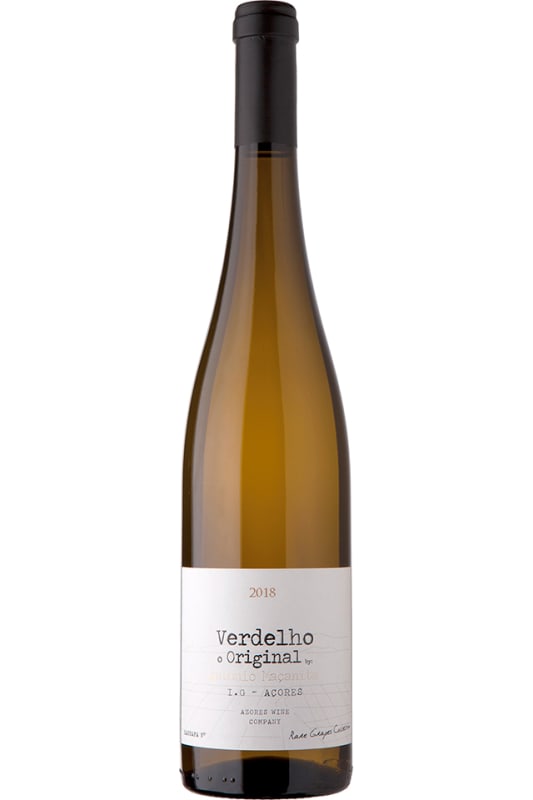


Winemaker Notes
Mineral and salty attack, it has the grape varietals and Azorean Terroir matrix, but with a much more exuberant, tropical aroma of the azorean pineapple and passion fruit, fresh fruit with acidity.
Professional Ratings
-
Robert Parker's Wine Advocate
The winery emphasizes that the Verdelho in the 2018 Verdelho Original is "not to be confused with Gouveio of the mainland or Verdejo of Spain. [It is a] unique grape to the islands of Portugal, Madeira and Azores. It has never been found in mainland Portugal." I repeat that every year, but it's worth doing again. If you're interested in geeky detail, see his study here: https://onlinelibrary.wiley.com/doi/10.1111/ajgw.12353. An unoaked blend from three islands in the Azores, it comes in with 12.5% alcohol. This has its acidity beautifully integrated. It shows some expressiveness even at this young age and a lovely finish. It's big, relative to the style, and bright. It evolved nicely in the glass as well. This is a fine example of the brand. Whether it is a little better or a little behind the last couple of vintages is immaterial—it is pretty close. We'll see as they acquire some age. There were 9,902 bottles produced.
-
Wine Enthusiast
Ripe and lightly honeyed, with creamy apple flavors, this is a delicious wine from the Azores islands. Its acidity has been tamed by the bright texture that brings out great fruitiness. Drink now.


While capable of making a delightful Portugeuse dry white wine, great as an aperitif and for pairing with raw fish and oysters, Verdelho is also a major grape in the production of Madeira. While many less expensive Madeira wines can be blends of different years or grapes, including Verdelho, single-varietal Madeira represent the highest quality versions that also have long aging capacities. Sercial, Boal, Malmsey and Verdelho are the best Madeira grapes. Of the four, Verdelho is the most concentrated and smoky. It is dry, intense, spicy and is flexible in food pairings. Somm Secret—Like many other fortified wines, Madeira made of Verdelho can tolerate extreme aging and some rare bottles can still be found from the late 19th/early 20th century.

Best known for intense, impressive and age-worthy fortified wines, Portugal relies almost exclusively on its many indigenous grape varieties. Bordering Spain to its north and east, and the Atlantic Ocean on its west and south coasts, this is a land where tradition reigns supreme, due to its relative geographical and, for much of the 20th century, political isolation. A long and narrow but small country, Portugal claims considerable diversity in climate and wine styles, with milder weather in the north and significantly more rainfall near the coast.
While Port (named after its city of Oporto on the Atlantic Coast at the end of the Douro Valley), made Portugal famous, Portugal is also an excellent source of dry red and white Portuguese wines of various styles.
The Douro Valley produces full-bodied and concentrated dry red Portuguese wines made from the same set of grape varieties used for Port, which include Touriga Nacional, Tinta Roriz (Spain’s Tempranillo), Touriga Franca, Tinta Barroca and Tinto Cão, among a long list of others in minor proportions.
Other dry Portuguese wines include the tart, slightly effervescent Vinho Verde white wine, made in the north, and the bright, elegant reds and whites of the Dão as well as the bold, and fruit-driven reds and whites of the southern, Alentejo.
The nation’s other important fortified wine, Madeira, is produced on the eponymous island off the North African coast.